


TL;DR
FedPLVM (Federated Prototype Learning with Variance Mitigation) tackles the challenge of training models across diverse data domains (e.g., different image styles or sensors) without sharing raw data. By replacing simple "average" class representations with a dual-level clustering strategy and a novel $\alpha$-sparsity loss, it captures the complex variance of "hard" domains, significantly boosting accuracy and fairness across heterogeneous clients.
What Problem Does This Paper Address?
Standard Federated Learning (FL) often assumes that while data is distributed, it comes from the same general "domain." In reality, clients often have data from vastly different sources—think of one hospital using high-res MRI scans while another uses older, noisier equipment. This is known as domain heterogeneity.
Existing "Prototype Learning" methods try to solve this by sharing "prototypes"—mean feature vectors for each class—instead of raw data. However, these methods typically use a single average vector per class. This works for "easy" domains where data clusters tightly, but fails for "hard" domains where data is scattered and complex. Treating a wide, messy distribution as a single average point (the "Vanilla" approach in Figure 1) leads to poor generalization and "unfair" performance gaps between easy and hard domains.
Methods
The authors introduce FedPLVM, which features two primary innovations:
- Dual-Level Prototype Clustering:
- Local Level: Instead of calculating one mean vector, each client uses a parameter-free clustering algorithm (FINCH) to identify multiple local prototypes that represent the actual shape and variance of their data.
- Global Level: To keep communication efficient and protect privacy, the server clusters these many local prototypes into a refined set of global clustered prototypes before sending them back to clients.
- $\alpha$-Sparsity Prototype Loss:
- Standard losses try to pull samples toward their own class prototype and push them away from others.
- FedPLVM introduces a sparsity factor ($\alpha \in (0, 1)$) applied as a power to the cosine similarity. This mathematical tweak makes the loss more aggressive at "repelling" prototypes of different classes, creating a clearer "sparsity" in the feature space.
- A correction term is added to ensure that while classes are pushed apart, samples within the same class still stay tightly grouped.
The overall workflow is visualized in Figure 2, showing how embeddings move from local clustering to global aggregation and back to local training.
Datasets
The researchers evaluated their method on three benchmark datasets representing different levels of domain shift:
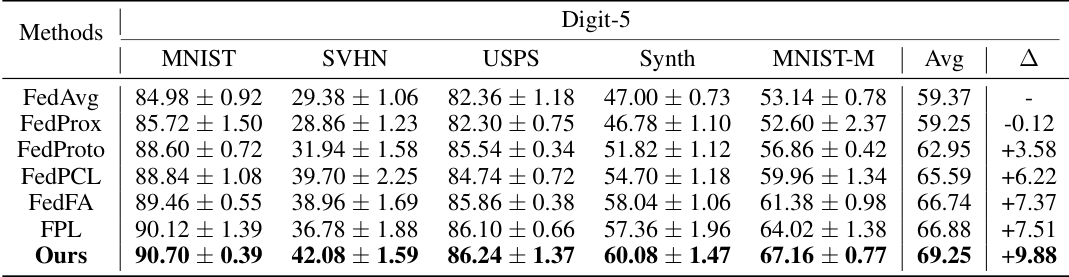
- Digit-5: A collection of five digit datasets (MNIST, SVHN, USPS, Synth, and MNIST-M). SVHN and Synth are considered "hard" domains due to their visual complexity.
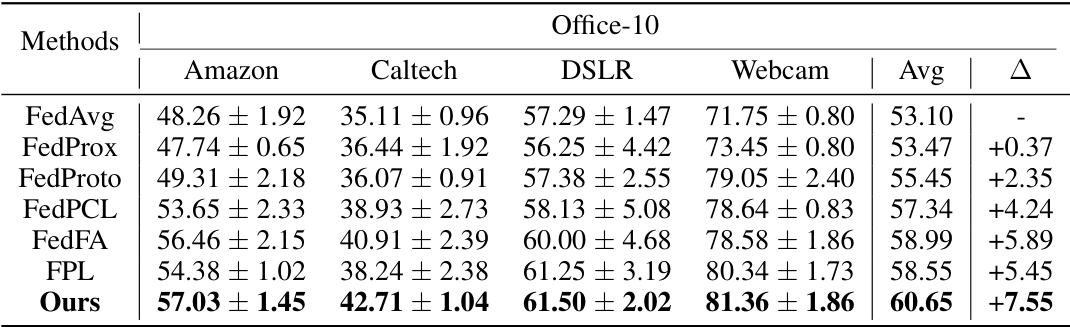
- Office-10: Images of office objects from four domains (Amazon, Caltech, DSLR, and Webcam).
- DomainNet: A large-scale dataset using a 10-class subset across six domains (Clipart, Infograph, Painting, Quickdraw, Real, and Sketch).
Key Insights and Ideas
- Averaging is Lossy: In heterogeneous FL, a single mean vector is a poor proxy for a complex data distribution. By allowing multiple prototypes per class, the model gains "anchors" that better represent the boundaries of difficult domains.
- Fairness through Variance: The method specifically helps "hard" domains more than "easy" ones. For example, in Digit-5, accuracy on the difficult SVHN domain jumped by 5.3%, while the already-easy MNIST domain only saw a 0.58% bump. This narrows the performance gap between clients.
- Communication Efficiency: By performing a second round of clustering at the server level, the system avoids the "prototype explosion" that would occur if every client sent dozens of local prototypes, keeping the bandwidth requirements manageable.
Key Results
FedPLVM consistently outperformed state-of-the-art baselines like FedAvg, FedProto, and FPL across all datasets.
- Digit-5: Achieved an average accuracy of 69.25%, a significant +9.88% improvement over standard FedAvg.
- Office-10: Reached 60.65% average accuracy, outperforming the next best method (FedFA) by nearly 2%.
- Variance Reduction: As shown in the ablation study (Figure 4), the dual-clustering approach significantly reduced the "variance" (the distance from samples to their class centers), leading to much tighter, more separable clusters in the feature space.
Limitations and Future Work
The authors identify noisy labels as a primary limitation. If a client has mislabeled data, those "outliers" can distort the local prototypes, leading to "Prototype Distortion" or "Ambiguity." This error can then propagate through the global model.
Future research directions include making the prototype generation process more robust to label noise and exploring the method's application in highly sensitive areas like healthcare data collaboration and IoT networks.
Summary updated