


TL;DR
This paper introduces a formal framework and seven multi-dimensional metrics to evaluate how realistically Large Language Models (LLMs) can simulate students in tutoring dialogues. The authors demonstrate that while simple prompting is the current industry standard for testing AI tutors, it often produces an "illusion" of realism; instead, supervised fine-tuning (SFT) and preference optimization (DPO) are required to capture the nuanced linguistic and cognitive behaviors of real learners.
What Problem Does This Paper Address?
The development of AI-powered tutors (like those from Khan Academy or OpenAI) is exploding, but evaluating them is a major bottleneck. Testing with real students is slow, expensive, and difficult to scale. To solve this, researchers often use "simulated students"—LLMs prompted to act like learners—to train and test their tutoring systems.
However, there has been little rigorous work to verify if these simulations are actually realistic. If a simulated student doesn't behave like a real human (e.g., they are too polite, too correct, or lack consistent knowledge gaps), the AI tutor trained against them might fail when it finally meets a real classroom. This paper tackles the "Substance or Illusion" question: are our simulated students realistic enough to be useful?
Methods
The authors propose a two-stage approach to move beyond simple text-matching:
- A Multi-Dimensional Evaluation Framework: They define seven metrics across four categories to measure realism:
- Behavioral: Dialogue acts (e.g., "Math Answer" vs. "Seek Information").
- Cognitive: Correctness of answers, the specific types of errors made, and "Knowledge Acquisition" (using Knowledge Tracing to see if the student's mastery changes realistically over time).
- Linguistic: Semantic similarity (Cosine Similarity) and word-level recall (ROUGE-L).
- Contextual: "Inducing Tutor Response," which measures how likely the simulated turn is to trigger the actual next response from a human tutor.
- Benchmarking Simulation Strategies: They compared several methods:
- Prompting: Zero-shot, OCEAN (personality-based) personas, and In-Context Learning (ICL).
- Fine-Tuning: Training Llama-3 models (3B and 8B) using SFT on real student data.
- Optimization: Using Direct Preference Optimization (DPO) to further align models with the proposed realism metrics.
Datasets
The study utilized the Question-Anchored Tutoring Dialogues 2k, the largest publicly available dataset of real student-tutor interactions. It consists of roughly 2,000 dialogues from the Eedi platform, where middle school students solve math problems (Algebra, Geometry, etc.) with human tutors via online chat.
Key Insights and Ideas
- The "Politeness" Trap: Prompted LLMs tend to be overly verbose and formal. Real students are brief (averaging ~4 words per turn) and often use informal grammar or typos. Fine-tuned models captured this "linguistic fingerprint" much better than prompted ones.
- The Correctness Bias: Prompted models are "too good." They frequently generate correct answers even when the real student struggled. Interestingly, even giving a model a "cheat sheet" (the Oracle method) improved its correctness but didn't help it act more like a student in other behavioral dimensions.
- Knowledge Tracing as a Metric: The authors creatively used Knowledge Tracing (KT) to ensure simulated students "learn" at a human-like pace. If a simulated student suddenly masters a complex concept after one hint when a human wouldn't, the simulation is deemed unrealistic.
- The Limits of RL: While DPO improved performance, the gains over standard SFT were marginal. This suggests that student behavior is inherently noisy and difficult to optimize using current reinforcement learning techniques.
Key Results
The main benchmark results (Table 1) show a clear divide: fine-tuned models (SFT/DPO) dominated almost every metric except for raw correctness.
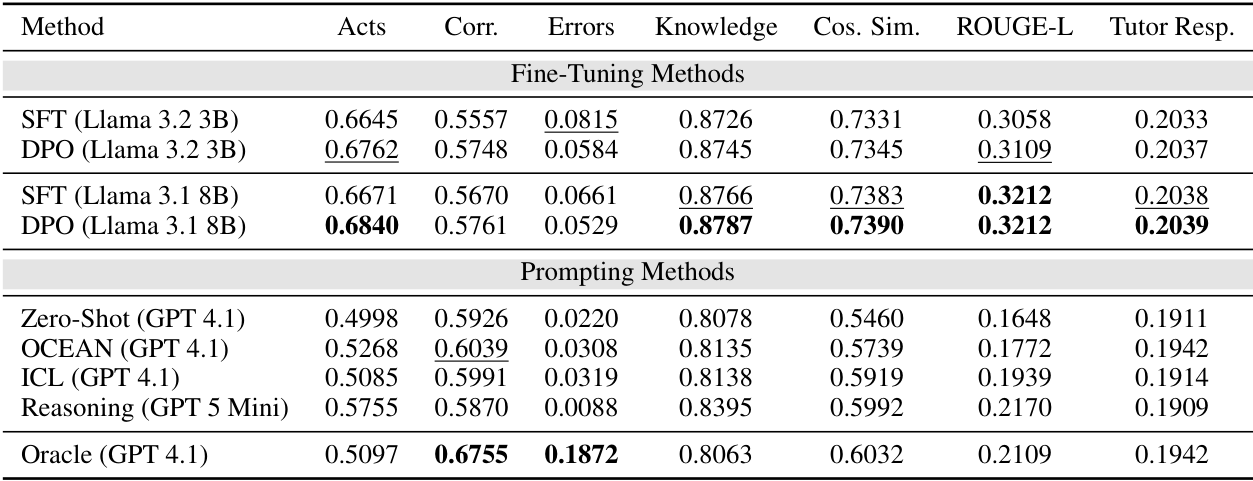

Human experts validated these findings. In blind tests, educators rated the DPO-optimized models as significantly more realistic in terms of dialogue acts and linguistic style compared to zero-shot prompting.
Limitations and Future Work
- Domain Specificity: The study was limited to middle school math. Student behavior in language learning or computer science might follow different patterns.
- Turn-Level vs. Dialogue-Level: The evaluation focused on individual turns. Future work needs to assess "long-term realism"—whether a simulated student remains consistent across a 20-turn conversation.
- The "Black Box" of Proprietary Models: Some metrics rely on GPT-4/5 for annotation, which introduces costs and potential biases from those models' own internal logic.
- Diversity: Current models tend to produce "average" student behavior. The authors suggest that future simulations should better account for individual differences, such as varying levels of student persistence or frustration.
Summary updated