


TL;DR
Guessing the exact 3D arrangement of a room from a single 2D photo in one shot usually leaves you with floating lamps and chairs fused into tables. Instead of trying to get everything right on the first try, this paper splits the job between two Vision-Language Models (VLMs): a Perceiver that makes an educated initial guess, and a Planner that acts like a virtual interior designer—nudging, rotating, and resizing objects step-by-step until the physics actually make sense.
What Problem Does This Paper Address?
Imagine looking at a flat photograph of a cluttered living room and trying to map out the exact 3D position, size, and angle of every piece of furniture. Because a single 2D image flattens depth, it is inherently ambiguous.
Historically, neural networks treat monocular 3D layout estimation as a one-shot regression problem: feed the image in, spit all the 3D bounding boxes out in a single forward pass. While these models are great at spotting local visual cues, they lack a sense of global physical reality. In an indoor room, objects depend on one another—lamps sit on nightstands, chairs tuck under desks without passing through solid wood. In one-shot prediction, tiny depth or angle errors compound, resulting in physically impossible scenes full of colliding or levitating furniture.
Methods
The authors reframe 3D layout estimation from a static prediction task into a sequential decision-making process called Perceive-then-Plan, powered by their core formulation: Layout-as-Policy (LaP).
- The Perceiver (Grounding as Initialization): Standard VLMs struggle to output raw 3D coordinates directly. To bridge this gap, the authors inject 3D geometric priors (from a pretrained geometry encoder) directly into the VLM's visual features using a lightweight modulation gate. Instead of guessing arbitrary 3D box corners, the Perceiver predicts a clean local-axis representation. Finally, using SVD on the bottom faces of objects to find the floor, the scene is rotated into a gravity-aligned frame and snapped onto a discrete integer grid (e.g., 0.1m cells).
- The LaP Planner (Refinement as Policy): Once the scene is represented as structured text on a grid, a second LoRA-tuned VLM takes over. Treating the layout as a "state," it outputs code-like discrete actions—
SELECT(i),MOVE(dx, dy, dz),RESIZE(ds),ROTATE_Y(dθ), andSTOP—in an iterative loop until the room stabilizes. - Training via SFT + DPO: Designing an explicit mathematical reward function for "what makes a room look right" is notoriously brittle. Instead, the authors take ground-truth 3D rooms, scramble them with random actions, and invert those actions to create synthetic "expert" repair trajectories for Supervised Fine-Tuning (SFT). Next, they apply Direct Preference Optimization (DPO), showing the model pairs of good trajectories versus degraded or noisy ones so it learns which corrective actions work best without explicit reward engineering.
Datasets
- Training: Combined training and validation splits of Hypersim and SUN RGB-D (filtered to scenes with 5 to 30 objects, totaling 42,160 samples). No new benchmark datasets are introduced, though the authors generate synthetic perturbed trajectory pairs from these splits to train the Planner.
- Evaluation: 1,000 randomly sampled test pairs from SUN RGB-D, plus zero-shot cross-dataset testing on 3D-FRONT and ARKitScenes.
Key Insights and Ideas
- Judging is easier than defining: Why use DPO instead of reinforcement learning with a physics engine? Because comparing two action sequences to see which yields a cleaner room is dead simple, whereas hand-crafting a reward function that balances image alignment against 3D physics is a nightmare.
- Discretization unlocks VLM planning: Snapping continuous 3D coordinates onto a gravity-aligned integer grid shrinks a massive, continuous search space into a tractable vocabulary. Without this grid canonicalization, the Planner struggles to output coherent multi-step actions.
- Free downstream editing: Because the Planner natively speaks in movement and rotation commands (
MOVE,ROTATE_Y), you can easily hijack it after layout estimation for language-guided scene editing—like telling it, "Put the stove on counter_1."
Key Results
Both stages pull their weight quantitatively and qualitatively:
- Better 3D Grounding: On SUN RGB-D, the 8B Perceiver hits 0.58 Reprojection IoU and 0.08 Average Depth Error, comfortably beating massive closed- and open-source VLMs like GPT-4o (0.27 IoU), Qwen3-VL 32B (0.33 IoU), and specialized 3D VLMs like N3D-VLM (0.33 IoU).
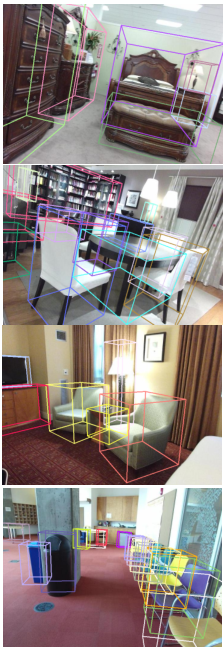
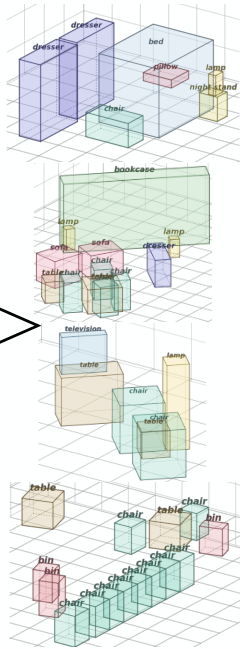
- Iterative Physics Repair: Running the 8B LaP Planner until convergence boosts the 2B Perceiver's initial Reprojection IoU from 0.54 to 0.67, slashes the Support Violation Rate (floating/penetrating objects) nearly threefold from 11.63% to 4.12%, cuts pairwise 3D collisions from 3.62 to 1.44, and halves rotation error from 17.74° to 8.62°.
- One-shot vs. Rule-based: A one-shot VLM trained on the exact same refinement data barely moves the needle (3.54 collisions) and actually worsens depth error. Conversely, a pure physics/rule-based solver eliminates all collisions (0.0), but ruins visual alignment with the photo (dropping Reprojection IoU from 0.54 to 0.26).
- Zero-Shot Generalization: On unseen datasets like 3D-FRONT, the full pipeline boosts Reprojection IoU to 0.70 while cutting support violations down to 2.83%, outperforming specialized monocular 3D detectors like DetAny3D and OVMono3D.
Limitations and Future Work
- Upstream Bottlenecks: The pipeline relies on 2D object detections as input; if the 2D detector misses an object or draws a terrible box, that error propagates downstream.
- Clutter & Camera Angles: Training excludes dense scenes with over 30 objects. Additionally, because gravity direction is estimated via SVD on object bottom faces, the canonical grid can tilt out of alignment in tight close-ups where the floor is barely visible.
- Future Work: Extending the perceive-then-plan paradigm to handle multi-view images and embodied robotic planning.
Summary updated