


TL;DR
This paper provides a rigorous information-theoretic analysis of Multi-Source-Free Domain Adaptation (MSFDA), identifying a fundamental trade-off between bias and variance. By balancing these factors through optimal domain aggregation, selective pseudo-labeling, and joint feature alignment, the authors propose a new algorithm that achieves state-of-the-art performance on major benchmarks like Office-Home and DomainNet.
What Problem Does This Paper Address?
Machine learning models often fail when deployed in a "target" environment that differs from their "source" training data—a problem known as domain shift. While Unsupervised Domain Adaptation (UDA) helps bridge this gap using unlabeled target data, real-world constraints like data privacy (e.g., medical records) and massive storage requirements often make the original source data inaccessible.
This leads to the Source-Free setting, where you only have pre-trained models, not the data. Furthermore, in many cases, knowledge is spread across multiple sources (e.g., different cities' street views or different hospital systems). Combining these challenges results in MSFDA.
Previous MSFDA methods were largely heuristic, focusing on clever training tricks without a solid theoretical foundation. This paper fills that gap by asking: What are the fundamental limits of adapting multiple source models without their data, and how can we design algorithms that respect these limits?
Methods
The authors' approach is grounded in a new generalization error bound (Theorem 4.1) that decomposes the error into three controllable parts:
- Label Mismatch Bias: The error from noisy or incorrect pseudo-labels.
- Feature Misalignment Bias: The error from the shift in data distributions in the feature space.
- Variance: The error stemming from having a limited number of labeled samples.
To minimize these, they propose a three-pronged strategy, visualized in the schematic below:
- Domain Aggregation: Instead of treating all source models equally, they learn optimal weights ($w$) to create a mixture of experts. They use Information Maximization (IM) to ensure the aggregated predictions are both confident for individual samples and diverse across the whole dataset.
- Selective Pseudo-labeling: To balance bias and variance, the algorithm doesn't label everything. It uses a surrogate selection rule (combining prototype-based denoising and confidence scores) to pick a high-quality subset of target data for training. They also use Mixup data augmentation on this subset to further reduce variance.
- Joint Adversarial Feature Alignment: Unlike methods that align sources one by one, this paper argues for alignment in the joint representation space of all source models. They use an adversarial discriminator to make the features of the unlabeled target data indistinguishable from the pseudo-labeled subset.
Datasets
The authors evaluated their method on four standard domain adaptation benchmarks:
- Digits-Five: A collection of five digit datasets (MNIST, SVHN, USPS, MNIST-M, and Synthetic Digits).
- Office-31: 31 categories from three environments (Amazon, DSLR, and Webcam).
- Office-Home: A more challenging set with 65 categories across four domains (Art, Clipart, Product, and Real-world).
- DomainNet: The largest and most difficult benchmark, featuring 0.6 million images across 345 categories and six distinct domains (e.g., Sketch, Quickdraw, Infograph).
Key Insights and Ideas
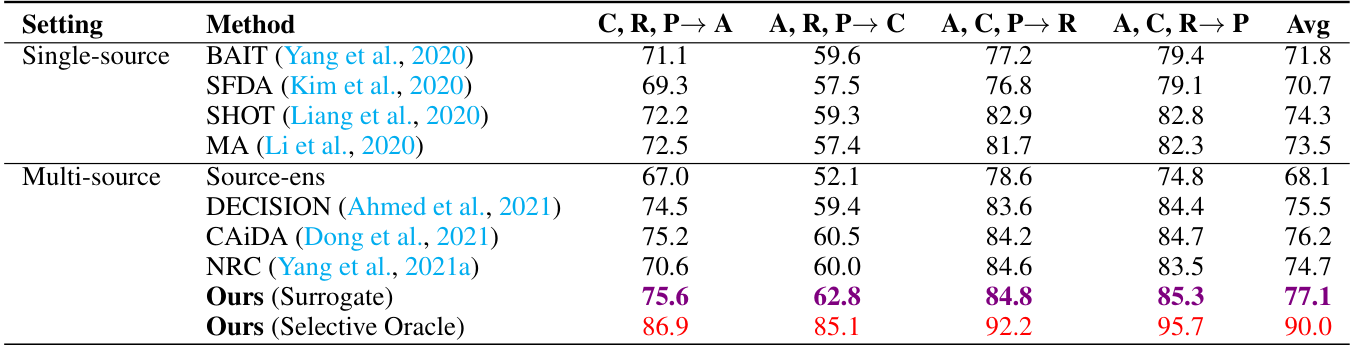
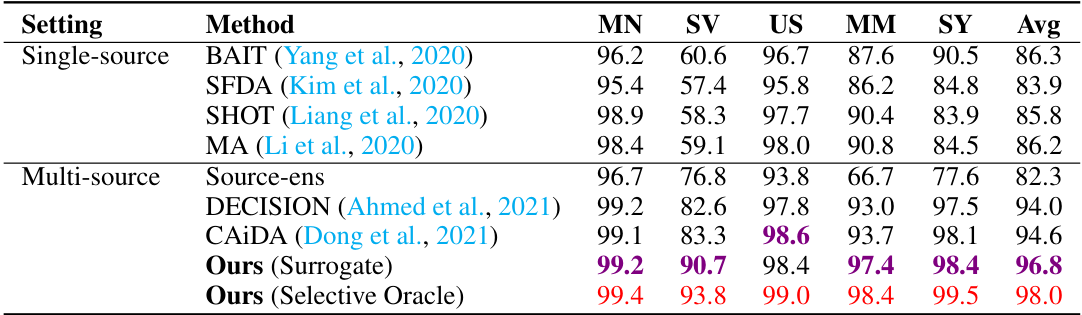
- The Bias-Variance Trade-off is Central: Labeling more target data reduces variance but risks introducing high bias if the pseudo-labels are wrong. The "Selective Oracle" experiments (using ground-truth labels for selection) show that perfect selection could boost accuracy by over 10% on hard datasets, highlighting that selection is the primary bottleneck in MSFDA.
- Joint Alignment is Better than Separate: The authors prove (Remark 1) that aligning the joint feature space of all source models provides a tighter bound on error than aligning each source individually.
- I-Projection for Aggregation: The paper connects model aggregation to the concept of I-projection in information geometry, providing a mathematical justification for why a weighted mixture of source models is superior to any single model.
Key Results
The proposed algorithm, "Ours (Surrogate)," consistently outperformed existing state-of-the-art (SOTA) methods like DECISION and CAiDA across all benchmarks.
- Digits-Five: Achieved an average accuracy of 96.8%, notably beating SOTA by 3.7% on the difficult M-MNIST task.
- Office-31: Reached 92.0% average accuracy, showing particular strength in the D,W $\rightarrow$ A task.
- Office-Home: Outperformed SOTA by 2.3% on the most difficult task (A,R,P $\rightarrow$ C), reaching an average of 77.1%.
- DomainNet: Maintained a lead on the most challenging benchmark with 48.4% average accuracy.
Detailed results for Office-Home and Digits-Five can be seen in the tables below:
Limitations and Future Work
The authors acknowledge that while their surrogate selection rule is effective, it is still a heuristic. The massive performance gap between their practical algorithm and the "Selective Oracle" (which reaches 90.0% on Office-Home vs. the surrogate's 77.1%) suggests that there is significant room for improvement. Future research should focus on developing more sophisticated selection rules that can better approximate the "Oracle" behavior in a completely unsupervised, source-free manner.
Summary updated