


TL;DR
Omni-SMoLA introduces a parameter-efficient architecture that combines Soft Mixture of Experts (Soft MoE) with Low-Rank Adaptation (LoRA) to boost generalist multimodal models. By utilizing specialized low-rank experts for different modalities—text, vision, and multimodal—it achieves new state-of-the-art (SOTA) performance across a wide range of tasks while adding negligible inference overhead (only ~1.4%).
What Problem Does This Paper Address?
Large Multimodal Models (LMMs) face a "generalist's dilemma." While they are impressive across many tasks, a single generalist model often performs worse than a collection of task-specific "specialist" models. Fine-tuning a massive model on a huge variety of tasks simultaneously typically leads to performance degradation.
Standard Mixture of Experts (MoE) architectures are a promising solution because they allow different parts of the model to specialize. However, for massive models (50B–100B+ parameters), standard MoE is prohibitively expensive because it involves replicating large transformer blocks, leading to massive memory and storage requirements. Furthermore, multimodal tasks are diverse: some require deep visual understanding, others require reading text (OCR), and some need a complex blend of both. A one-size-fits-all expert approach often fails to capture these nuances efficiently.
Methods
The authors propose Omni-SMoLA (Soft Mixture of Low-rank Experts), which integrates three key ideas:
- Soft MoE: Unlike traditional "sparse" MoEs that pick one or two experts (often leading to training instability and "token dropping"), Soft MoE uses a fully differentiable "dispatcher" and "combiner" to softly mix expert outputs. This ensures every expert receives a weighted contribution of tokens.
- Low-Rank Experts (SMoLA): Instead of replicating entire transformer layers, each expert is a pair of low-rank matrices (inspired by LoRA). This keeps the parameter count extremely low—adding experts only increases the total parameters by a fraction of a percent.
- Omni-Modality Design: The "Omni" part refers to the architecture's structure. As shown in Figure 1, the model uses three parallel SMoLA blocks that act as residual additions to a frozen foundational backbone (like PaLI-X). These blocks are specialized: one for visual tokens, one for text tokens, and one for multimodal tokens.
Datasets
The models were trained and evaluated on a massive "Full Mixture" of vision-language tasks:
- Image Captioning: COCO Captions, Textcaps, and VizWiz-Cap.
- Visual Question Answering (VQA): VQAv2, OK-VQA, VizWiz-VQA, ST-VQA, TextVQA, OCRVQA, InfoVQA, DocVQA, ChartQA, and AI2D.
- Zero-Shot Generalization: The authors also tested on "out-domain" datasets not seen during training, including NoCaps, A-OKVQA, ScienceQA, and TallyQA.
Key Insights and Ideas
- Scaling Experts > Scaling Rank: A major finding is that simply increasing the rank of a single LoRA module hits diminishing returns. However, increasing the number of low-rank experts continues to drive performance gains. As shown in Figure 2, performance scales consistently as the number of experts per modality increases from 4 to 144.
- Modality Specialization is Crucial: Having separate experts for vision and text is more effective than having a larger pool of general multimodal experts for the same computational cost.
- Residual Specialization: The core intuition is that the large frozen backbone provides the "foundational knowledge," while the lightweight experts residually learn the "specialized skills" (like OCR or fine-grained visual recognition) needed for specific tasks.
Key Results
Omni-SMoLA achieves remarkable results across both large (55B) and small (5B) model scales:
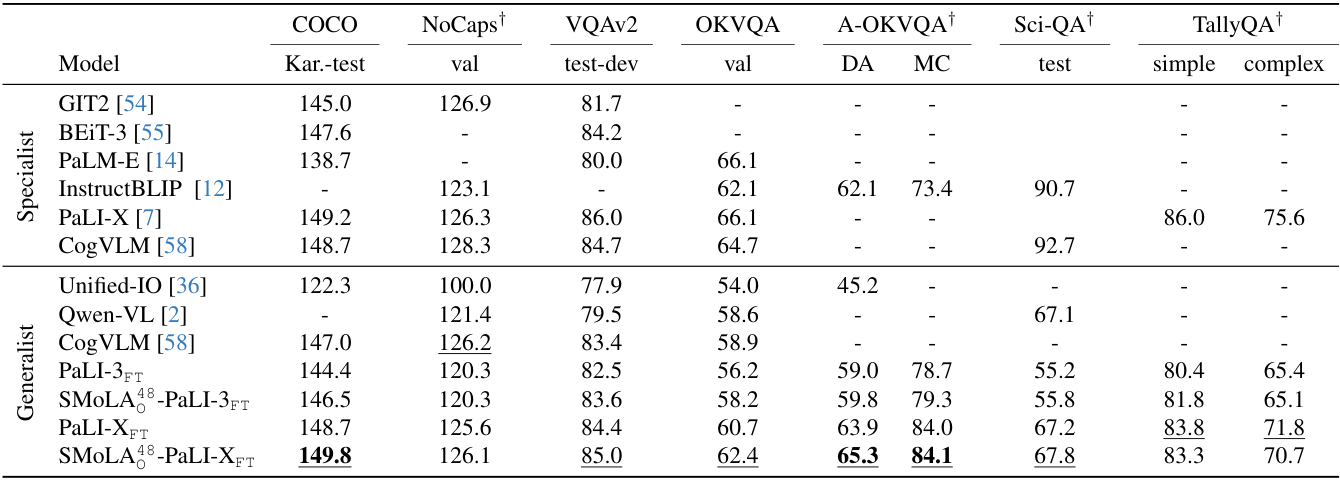
- New SOTA: It achieved a new SOTA CIDEr score of 149.8 on COCO captioning, outperforming even task-specific specialists.
- Generalist Dominance: In the "with OCR" setting, a single Omni-SMoLA model outperformed specialist SOTA models on 6 out of 10 text-heavy benchmarks, including TextVQA and DocVQA.
- Efficiency: Despite using 48 experts per block, the inference slowdown was a negligible 1.4% compared to the base model.
- Quantitative Gains: The model showed significant improvements over standard fine-tuning (MT-FT) on complex tasks like DocVQA (+2.4 points), InfoVQA (+3.2 points), and ChartQA (+3.6 points).
Detailed performance comparisons for natural image tasks and text-heavy tasks can be found in the paper's main results tables:

Limitations and Future Work
- Specialist Gap: While Omni-SMoLA narrows the gap significantly, it still slightly underperforms specialists on certain knowledge-heavy tasks like OK-VQA.
- Prompt Sensitivity: The authors noted a slight performance drop on the TextCaps task, likely due to prompt ambiguity when using the same generalist prompt for different types of captioning.
- Future Directions: The authors suggest that the architecture is highly extensible; future work could involve adding experts for even more modalities (like audio or video) or exploring how to dynamically grow the expert pool as new tasks are encountered.
Summary updated