


TL;DR
While Group Distributionally Robust Optimization (Group DRO) protects machine learning models against changes in subpopulation proportions, it leaves them highly vulnerable to shifts within those subpopulations—a critical issue for data-scarce minority groups. This paper introduces a hierarchical DRO framework that simultaneously models both inter-group and intra-group uncertainties using Wasserstein-based latent perturbations. The resulting method significantly improves worst-group accuracy on both standard benchmarks and newly proposed, realistic minority-group shift scenarios.
What Problem Does This Paper Address?
Deep learning models frequently latch onto spurious correlations—like associating the concept of a "waterbird" with a water background rather than the bird itself. When tested on minority groups that break these patterns (e.g., a waterbird on land), standard empirical risk minimization (ERM) models perform poorly.
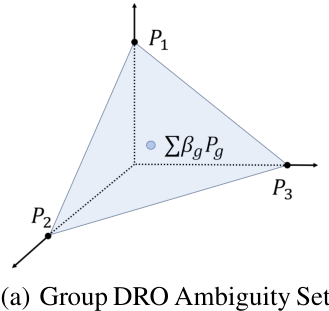
To fix this, methods like Group DRO minimize the loss of the worst-performing group. However, Group DRO operates under a rigid assumption: it assumes that the training samples for each group perfectly represent that group's true distribution. In reality, minority groups are often extremely small (sometimes constituting less than 1% of the dataset). Because their sample size is limited, their training distributions are statistically unreliable. If a test set introduces a subtle shift within that minority group (e.g., a different species of bird or a change in accessories), existing robust methods collapse because they treat within-group distributions as fixed.
Methods
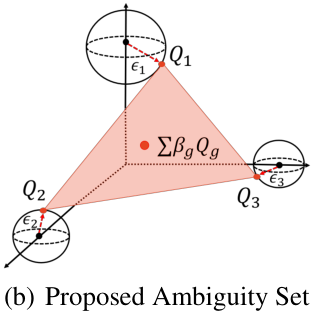
The authors propose a Hierarchical Ambiguity Set that expands the uncertainty model to two distinct levels:
- Inter-group level: Controlled by mixing proportions ($\beta$), allowing the test-time group frequencies to vary arbitrarily (similar to standard Group DRO).
- Intra-group level: Controlled by an infinite-order Wasserstein distance ($W_\infty$) radius ($\epsilon_g$) around each group's training distribution to capture within-group variability.
Crucially, the intra-group perturbation radius is adaptive: it is scaled inversely with the group size ($\epsilon_g = \epsilon / \sqrt{n_g}$). This means smaller, less statistically reliable groups receive larger uncertainty buffers.
To make this complex optimization problem computationally tractable, the authors derive a surrogate upper bound. This mathematical reformulation transforms the problem into an adversarial perturbation task executed in a latent semantic space (the feature representation layer just before the final classification layer). They solve this via an efficient coordinate-wise iterative training procedure (Algorithm 1) that sequentially updates the latent perturbations, the worst-case group weights, and the model parameters.
The difference in how these two methods conceptualize uncertainty can be seen in their ambiguity sets:
Datasets
The method was evaluated on three standard benchmarks, alongside newly engineered variants designed to simulate realistic intra-group distribution shifts:
- CMNIST (Colored MNIST): Classifying digits where color is a spurious attribute.
- Shifted Variant: Minority group images are rotated by 90° at test time.
- Waterbirds: Classifying birds against land/water backgrounds.
- Shifted Variant: The training minority group contains only waterfowls, while the test minority group contains only seabirds.
- CelebA: Classifying blond hair where gender is a spurious attribute.
- Shifted Variant: The minority group (blond males) consists only of individuals without glasses during training, but only individuals with glasses during testing.
Key Insights and Ideas
- The Minority Group Double-Whammy: Minority subpopulations suffer twice over: they are underrepresented in the overall mixing proportions (inter-group shift) and their small sample sizes make them highly susceptible to internal distribution variances (intra-group shift).
- Statistical Confidence via Radius Scaling: Setting the Wasserstein perturbation radius inversely proportional to $\sqrt{n_g}$ elegantly builds statistical confidence directly into the optimization objective.
- Latent Space Robustness: Perturbing data in a latent semantic space rather than raw pixel space allows the model to defend against meaningful variations (like adding glasses or changing bird species) without destroying class-defining features.
- Data-Driven Hyperparameter Tuning: To select the perturbation radius $\epsilon$ without looking at the test data, the authors use 1D t-SNE to partition the training data into extreme quantiles, creating synthetic validation splits that mimic real-world intra-group shifts.
Key Results
The hierarchical approach demonstrates clear superiority when evaluating Worst-Group Accuracy under shifted distributions:
- Shifted CelebA: The proposed method achieves 72.1% worst-group accuracy, outperforming Group DRO (59.8%) by over 12% absolute, while state-of-the-art baselines like PDE collapse to 56.3%.
- Shifted CMNIST & Waterbirds: The method achieves 71.8% and 93.7% respectively, consistently outperforming all baselines.
- Original (Unshifted) Benchmarks: The framework does not sacrifice standard performance; it secures top-tier or slightly improved worst-group accuracy (e.g., 73.6% on CMNIST, 90.8% on Waterbirds), proving that modeling intra-group uncertainty acts as an effective regularizer even when distributions remain stable.
Limitations and Future Work
- Dependence on Group Labels: The current framework relies on explicit group annotations during training. Extending this hierarchical framework to settings where group annotations are latent or must be inferred automatically is a vital next step.
- Domain Constraints: The empirical evaluation focuses entirely on image datasets. Exploring how this framework translates to text or tabular domains—where semantic latent spaces behave differently—remains an open question.
- Theoretical Simplification: The convergence guarantees assume a fixed feature map during optimization, which represents an idealized regime rather than the full non-convex joint optimization of all deep network parameters.
Summary updated