


TL;DR
This paper introduces LRCoin, a Bitcoin-based cryptocurrency framework designed to secure data trading in Internet of Things (IoT) networks. By utilizing a novel, bilinear pairing-based continual-leakage-resilient (CLR) ECDSA signature scheme, LRCoin ensures transaction security even when side-channel attacks consistently leak portions of a device's private key over time.
What Problem Does This Paper Address?
The rise of the "Device-as-a-Service" (DaaS) model allows IoT devices—such as personal weather stations or smart city sensors—to automatically sell their collected data in exchange for cryptocurrency. However, IoT devices are notoriously vulnerable to malware and physical side-channel attacks.
In a standard blockchain setup like Bitcoin, a device uses a static private key to sign transactions via the Elliptic Curve Digital Signature Algorithm (ECDSA). If an adversary uses side-channel attacks to gradually leak bits of this private key over multiple transactions, they can eventually reconstruct the full key, forge signatures, and steal the device's funds. This paper addresses the critical challenge of securing blockchain transactions in environments where partial key leakage is practically inevitable.
Methods
The authors propose an efficient, bilinear pairing-based signature scheme that is inherently resilient to continuous information leakage. The key techniques include:
- Stateful Key Management: Instead of relying on a static private key, the secret key is split into two distinct shares stored in separate parts of the device's memory.
- Continual Key Refreshing: The signature process is broken into two sequential steps (
Sign1andSign2). After every single transaction round, the two shares of the secret key are mathematically refreshed. This ensures that leaked bits from previous rounds become useless to an attacker in subsequent rounds. - Asymmetric Bilinear Pairings: The scheme utilizes asymmetric bilinear maps ($e: G_1 \times G_2 \rightarrow G_T$) to structure the signature and verification process, allowing the system to maintain compatibility with the core logic of ECDSA while embedding leakage resilience.
- Generic Bilinear Group Model: The authors provide a rigorous mathematical proof demonstrating that the scheme is existentially unforgeable against adaptively chosen message attacks, even under a continual leakage setting.
Datasets
Not discussed in the paper. As a theoretical and applied cryptography paper, it does not utilize machine learning or empirical datasets. Instead, the scheme was evaluated via performance benchmarks using a custom implementation built with the MIRACL cryptographic library.
Key Insights and Ideas
- Bypassing Impossibility Results: It is traditionally considered mathematically impossible to achieve continual leakage resilience if a secret key is uniquely and statically determined by its public key. LRCoin bypasses this barrier by making the internal secret key stateful (constantly changing) while keeping the public key fixed.
- Memory Isolation (Active vs. Passive): By splitting the signature generation into two steps, only one memory share of the key is "active" (and thus vulnerable to side-channel leakage) at any given moment. This effectively halves the potential attack surface during computation.
Key Results
The authors prototyped their signature scheme on both a laptop (Intel Core i5, 4GB RAM, Windows 7) and a smartphone (4GB RAM, Android 7.1.1) using an AES-80 bit security level on a Cocks-Pinch curve.
- Computational Overhead:
- Setup: 23.27 ms (laptop) / 40.66 ms (phone)
- Key Generation (KeyGen): 1.16 ms (laptop) / 12.38 ms (phone)
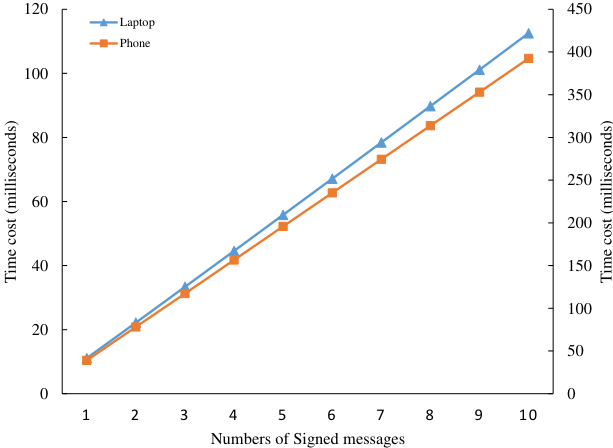
- Signing (1 message): 11.08 ms (laptop) / 39.08 ms (phone)
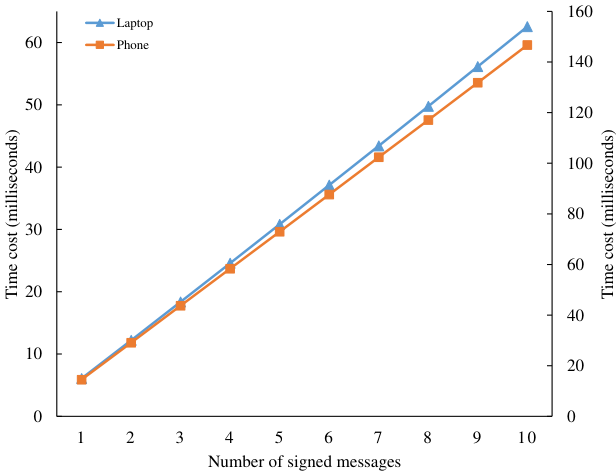
- Verification (1 message): 6.08 ms (laptop) / 14.53 ms (phone)
- Linear Scalability: As shown in the benchmarking experiments, both signing and verification times scale linearly with the number of messages. This demonstrates that the computational cost remains practical for consumer-grade and mobile IoT infrastructure.
Limitations and Future Work
- Idealized Security Model: The security proof is conducted under the generic bilinear group model, which is an idealized cryptographic abstraction. A stronger proof under standard, non-generic hardness assumptions remains an open challenge.
- State Synchronization Risks: Because the private key must be continuously updated, the system relies heavily on stable stateful storage. If an IoT device loses power or experiences a memory fault mid-refresh, the key shares could become desynchronized, permanently locking the wallet.
- Security Level Scaling: The implementation was benchmarked at an AES-80 bit security level. Modern industrial applications typically require AES-128 or higher, which will inherently increase the pairing computation overhead on resource-constrained IoT microcontrollers.
Summary updated