


TL;DR
Training neural networks has always been trapped in a strict sequential "for-loop": you cannot compute step $t+1$ until step $t$ is finished. EIPO (Efficient Inter-step Parallel Optimization) shatters this temporal bottleneck by recasting the entire sequence of optimizer steps as a single system of nonlinear equations, allowing multiple future weight updates to be solved simultaneously across GPUs. It cuts training iterations by up to $21\times$ and wall-clock time by up to $4.6\times$—without needing extra GPU memory, extra tokens, or sacrificing model quality.
What Problem Does This Paper Address?
Why does training a modern LLM take millions of GPU hours? Even with massive clusters, we are bottlenecked by time.
Current parallelization strategies—data, model, and pipeline parallelism—are all intra-step methods. They slice up data or layers to make a single gradient descent (GD) step faster, but they still obey the iron law of sequential training: $w_1$ depends on $w_0$, $w_2$ depends on $w_1$, and so on. If your training recipe calls for 500,000 sequential steps, you have to wait for 500,000 sequential ticks of the clock.
The authors ask a provocative question from numerical analysis: what if we parallelize across steps (inter-step parallelism), updating tomorrow's weights alongside today's?
Methods
Instead of viewing an optimizer (like SGD, Adam, or AdamW) as a sequential recipe, the authors view the entire trajectory of weights $\{w_0, w_1, \dots, w_T\}$ as independent unknown variables in a giant system of Preconditioned Nonlinear Equations (PNEs). The unique mathematical root of this system is exact—it recovers the precise weight trajectory the standard sequential optimizer would produce.
Solving for millions of steps at once would melt any GPU, so EIPO introduces three clever mechanisms:
- Sliding-Window Block Restart: Instead of solving the whole trajectory, EIPO opens a small "sliding window" of $p$ steps (e.g., $p=7$ across GPUs). It guesses the weights in this window, refines them in parallel, slides the window forward as early steps stabilize, and repeats.
- Quasi-Newton Root-Finding: Naive parallel fixed-point iteration (Picard iteration) converges slowly on long chains. Standard Anderson Acceleration (AA) fixes this using Quasi-Newton approximations of the inverse Jacobian, which speeds up convergence dramatically. However, classical AA requires storing a deep history buffer of past gradients—doubling or tripling memory, which is fatal for billion-parameter LLMs.
- Memory-Efficient Adaptive Anderson Acceleration (The Novel Secret Sauce): Rather than allocating a massive history buffer, EIPO extracts historical geometry directly from the momentum buffers (like Adam's moving averages) that the optimizer is already maintaining. Combined with a spectral safeguard (clipping/damping) to ensure global stability, this gives Quasi-Newton acceleration with zero auxiliary memory overhead.
Datasets
No new datasets are introduced; the authors evaluate EIPO across three distinct domains using standard benchmarks:
- Language Modeling: WikiText-2 (evaluating GPT-2, Llama-3.2-1B, Gemma-2B, Qwen-2.5-3B, Qwen-1.5-4B, and GPT-J-6B).
- Image Classification: CIFAR-10 (training CNNs, ResNet50, and ViT from scratch).
- Diffusion Generation: LSUN-Church at $128\times128$ resolution (training UNet/DDPM from scratch).
Key Insights and Ideas
- Standard GD is just "forward substitution": Viewing sequential training as just one slow numerical solver for a nonlinear equation liberates us to use much faster parallel root-finders—while mathematically guaranteeing we hit the exact same target trajectory.
- Momentum is free history: Realizing that Adam and SGD momentum states already encode an exponential moving average of historical residuals allows Quasi-Newton acceleration without the $\mathcal{O}(m \cdot d)$ memory penalty that previously made Anderson Acceleration impossible for LLMs.
- Orthogonality to existing parallelism: Because EIPO parallelizes across time (steps) rather than space (batches/layers), it achieves iteration reductions (like $21\times$) that Data Parallelism fundamentally cannot touch—and the two can be stacked together.
Key Results
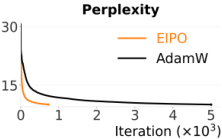
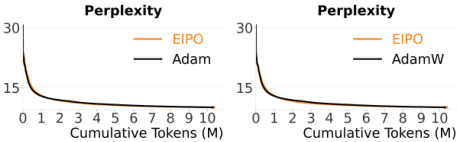
Across all tasks, EIPO matches baseline model quality, peak per-GPU memory, and total token consumption while slashing steps and time:
- LLMs (up to 6B parameters): Reduces optimizer iterations by $5.8\times$ to $21\times$ and delivers wall-clock speedups up to $4.6\times$ (e.g., $4.5\times$ on Gemma-2B, $4.0\times$ on Qwen-2.5-3B, and $2.8\times\text{--}3.0\times$ on Llama-3.2-1B).
- Vision (CIFAR-10 from scratch): Cuts iterations by $6.7\times\text{--}6.8\times$ and wall-clock time by $3.5\times\text{--}4.4\times$ on ResNet50 and ViT with identical peak memory and matched accuracy.
- Diffusion (LSUN-Church from scratch): Reaches a comparable FID score ($9.58$ vs. $9.18$) in 2.34 days (133k steps) compared to 7.39 days (600k steps) for standard Adam—a $3.2\times$ wall-clock speedup at an identical 78.6 GB memory footprint.
Limitations and Future Work
- Engineering Bottlenecks: While EIPO cuts algorithmic iterations by $6\times\text{--}21\times$, real-world wall-clock speedups top out around $3\times\text{--}4.6\times$. Why the gap? The authors' academic prototype passes inter-GPU messages through a Python multiprocessing queue via the CPU rather than direct GPU-to-GPU links.
- Hardware Constraints on Window Size: Because parallel steps run across GPUs, limited VRAM capped the GPT-J-6B experiment to a window size of $p=2$ (using SGD), restricting its speedup to $1.8\times$.
- Future Directions: Replacing Python queues with production-grade NCCL collectives, integrating ZeRO-style memory sharding, fusing deeper Anderson buffers with optimizer states, and combining EIPO directly with intra-step Data/Model Parallelism to close the gap toward theoretical speedups.
Summary updated