


TL;DR
This paper introduces an end-to-end deep learning framework that transforms unstructured clinical notes into interpretable, outcome-specific problem lists to predict patient risks like mortality and ICU readmission. By forcing the model to use clinically meaningful problems as intermediate features, the authors achieve state-of-the-art performance while providing clinicians with transparent, actionable reasoning.
What Problem Does This Paper Address?
Electronic Health Records (EHRs) are supposed to provide a clear summary of a patient’s medical state through "problem lists." In practice, however, these lists are often cluttered with resolved or irrelevant conditions, making them overwhelming for clinicians.
Furthermore, while deep learning models excel at predicting patient outcomes (like the likelihood of dying in the hospital), they are often "black boxes." Previous models might highlight specific words in a note as "important," but these highlights can be cryptic—for example, flagging the word "daughter" because it correlates with elderly patients being brought in by family. Clinicians need tools that don't just provide a risk score, but also explain that risk using recognized medical conditions (e.g., "Renal Failure" or "Sepsis").
Methods
The authors developed a novel framework that combines clinical natural language processing (NLP) with outcome prediction.
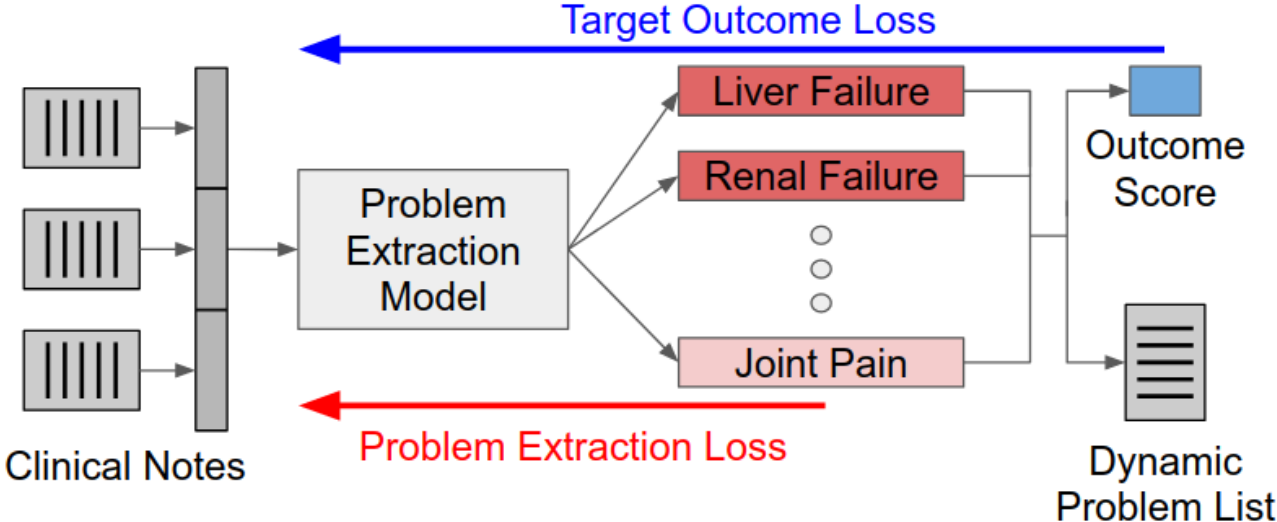
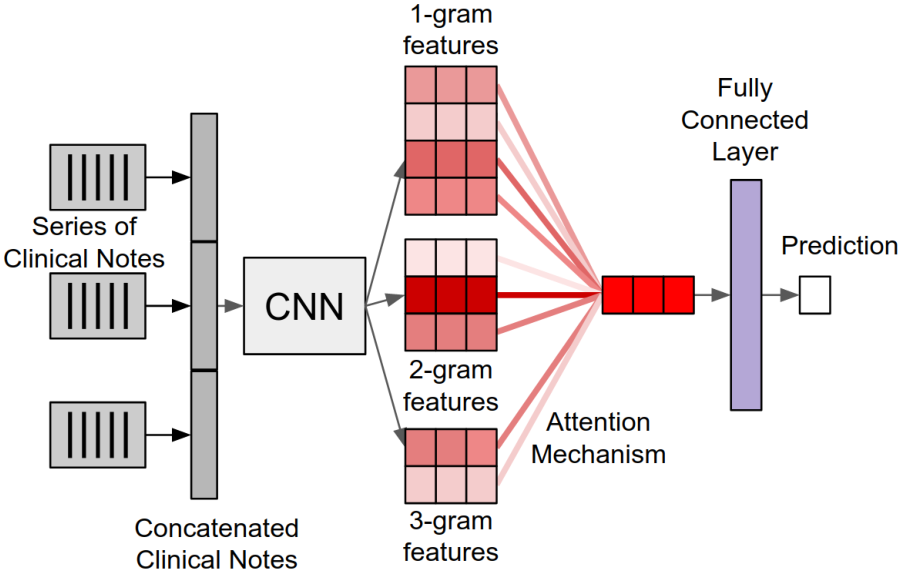
- Problem Extraction: The model uses a Convolutional Neural Network (CNN) with a guided multi-headed attention mechanism. Each "head" in the attention layer is dedicated to a specific medical problem (based on ICD-9 codes or "phecodes"). This allows the model to scan clinical notes and identify evidence for hundreds of different diagnoses and procedures simultaneously.
- Outcome Prediction: Instead of predicting mortality directly from the text, the model uses the predicted probabilities of these medical problems as features. The final outcome score is a linear combination of these problems, making the "weight" of each condition perfectly transparent.
- Gated Training Procedure: To ensure the intermediate problem list remains clinically accurate, the authors implemented a training threshold. If the model's ability to extract problems (its AU-ROC) falls below 0.90, the training focuses solely on the extraction task, preventing the outcome prediction task from "degrading" the clinical meaningfulness of the features.
Datasets
The study utilized the MIMIC-III database, a large, publicly available dataset containing de-identified clinical data from over 40,000 patients in critical care units. The authors specifically focused on a cohort of 33,311 unique patients who had a meaningful textual history (at least three notes) before ICU discharge.
Key Insights and Ideas
- Interpretability via Bottleneck: By creating a "bottleneck" where the model must represent the patient as a list of medical problems, the authors eliminate the "black box" nature of standard neural networks. You can see exactly which conditions (e.g., fluid disorders, pneumonia) are driving a high-risk score.
- Dynamic Tailoring: The paper demonstrates that "problem lists" should be dynamic. A clinician worried about ICU readmission needs to see different risk factors than one worried about immediate mortality. The framework allows for these outcome-specific views.
- Robustness to Noisy Labels: ICD-9 billing codes are notoriously incomplete. Interestingly, an expert evaluation found that 74% of the model's "false positives" (cases where the model predicted a code that wasn't in the official records) were actually correct clinical identifications that the human coders had missed.
- Clinical Outcomes as Orthogonal: The authors argue against treating death and readmission as a single "bad outcome," showing that they have distinct risk factors that should be modeled independently.
Key Results
- Predictive Performance: The framework achieved an AU-ROC of 0.710 for "bounceback" ICU readmission and 0.869 for in-hospital mortality. This outperformed strong baselines, including standard CNNs and LSTMs with attention.
- Expert Validation: In a qualitative study, four medical experts rated the "Dynamic Problem List" significantly higher (3.66/5) than a standard attention-based baseline (2.85/5). The experts found the dynamic lists to be more effective clinical decision support tools.
- Global Risk Factors: The model identified that "Disorders of fluid, electrolyte, and acid-base balance" and "Puncture of vessel" were top risk factors across almost all adverse outcomes studied.
Limitations and Future Work
- Taxonomy Reliance: The model is currently bound by existing medical taxonomies like ICD-9 and phecodes. While effective, these may not capture every clinical nuance present in the text.
- Architecture Evolution: The authors used a standard CNN for the extraction module. They suggest that incorporating more modern, pre-trained language models (like BERT or clinicalBERT) could further improve the accuracy of problem extraction.
- Generalization: While successful for mortality and readmission, the framework needs to be tested on other critical outcomes like the onset of sepsis or the need for intubation.
Summary updated