


TL;DR
CVLight is a decentralized reinforcement learning framework designed to optimize traffic signal control using data from Connected Vehicles (CVs). By employing a novel Asymmetric Advantage Actor-Critic (Asym-A2C) algorithm, the system learns to manage traffic effectively even when only a small fraction of vehicles (as low as 10%) are connected, significantly outperforming traditional and state-of-the-art RL baselines.
What Problem Does This Paper Address?
Adaptive Traffic Signal Control (TSC) is essential for reducing urban congestion, but its effectiveness depends heavily on the quality of traffic data. While Connected Vehicles (CVs) provide high-fidelity trajectory data, most existing TSC systems assume a 100% CV penetration rate—a scenario decades away from reality.
At low penetration rates (e.g., 10-30%), standard Reinforcement Learning (RL) agents struggle because they suffer from partial observability: they simply cannot "see" the majority of vehicles on the road. This leads to inefficient signal timing, such as keeping a light green for an empty lane because no "smart" cars are present to trigger a change. The authors aim to bridge this gap, creating a system that is robust enough to handle the "hidden" traffic of non-connected vehicles.
Methods
The core innovation is CVLight, which treats multi-intersection control as a decentralized RL problem.
Asymmetric Advantage Actor-Critic (Asym-A2C)
Standard Actor-Critic models provide the same information to both the "Actor" (the policy maker) and the "Critic" (the evaluator). CVLight introduces an asymmetric approach:
- Training Phase: The Critic is fed "global" information, including data from both CVs and non-CVs (simulated). This allows the Critic to accurately evaluate the true value of an action.
- Execution Phase: The Actor only receives partial observations from CVs. Because it was trained against a Critic with "perfect" sight, the Actor learns a policy that accounts for the likely presence of non-connected vehicles.
State and Reward Design
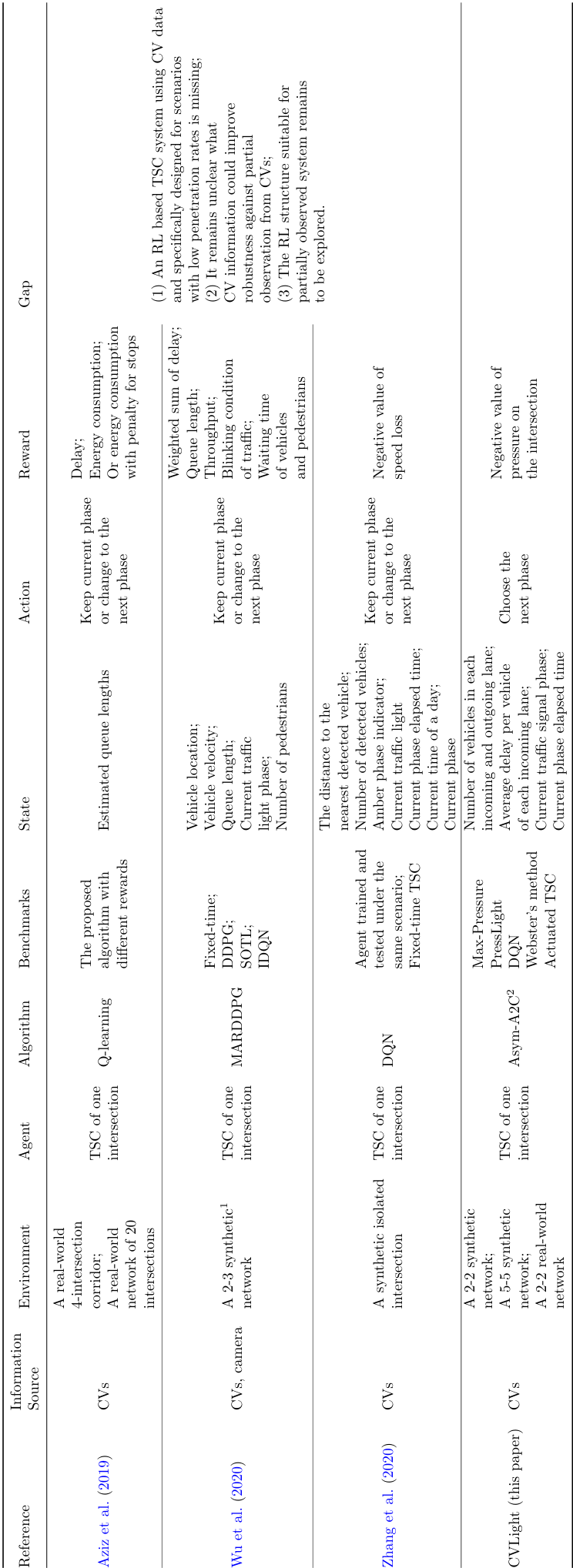
The authors move beyond simple vehicle counts. The state vector includes:
- Current Phase and Duration: To ensure fairness and prevent "starving" lanes.
- Scaled Average Delay: A cumulative metric that captures the history of the intersection, providing a more stable signal than instantaneous vehicle counts at low penetration.
- Pressure-based Reward: The reward is based on "Max-pressure" theory, aiming to balance the queue lengths between incoming and outgoing lanes to maximize throughput.
Datasets
The researchers evaluated CVLight using the SUMO (Simulation of Urban Mobility) package across three main scenarios:
- Synthetic 2-by-2 Grid: Used for initial training, sensitivity analysis, and policy visualization.
- Synthetic 5-by-5 Grid: Used to test scalability and the effectiveness of a pre-training technique (transferring weights from the 2x2 model).
- Real-world Case Study: A 2-by-2 road network in State College, Pennsylvania, USA (Beaver Ave and College Ave), utilizing real-world intersection geometries and unidirectional traffic flows.
Key Insights and Ideas
- The Critic as a Teacher: The asymmetric structure allows the agent to "learn the hidden patterns." Even if the Actor only sees one CV, the training process has taught it that one CV often implies a larger hidden queue of non-CVs.
- Delay > Counts: At low penetration, vehicle counts are extremely noisy. Cumulative delay acts as a low-pass filter, providing the agent with a much more reliable indicator of congestion.
- Scalability via Transfer Learning: Training a large 5x5 network from scratch is computationally expensive. The authors found that pre-training on a 2x2 network and then fine-tuning on the 5x5 network improved convergence speed by 50%.
Key Results
- Superiority at Low Penetration: In the 2x2 synthetic test, CVLight (Asym) achieved significantly lower average delays than PressLight, DQN, and Max-pressure, particularly at the 10% penetration rate.
- Generalizability: Agents trained at a 10% penetration rate maintained high performance even when tested at 100% penetration, whereas baseline models like PressLight failed to generalize to higher rates.
- Real-world Performance: In the State College case study, CVLight outperformed all benchmarks across all penetration levels, demonstrating its readiness for complex, non-grid geometries.
- Policy Visualization: Visualization showed that the Asymmetric agent was much better at "balancing" traffic, switching phases appropriately even when it didn't directly observe CVs in a congested lane, whereas the Symmetric agent would often get "stuck" in a single phase.
Limitations and Future Work
While CVLight is a major step forward, the authors note several areas for improvement:
- Interpretability: Like most deep RL models, the specific decision-making logic remains a "black box." Future work will focus on neural network interpretability.
- Parameter Sharing: To further improve scalability for massive networks (e.g., thousands of lights), the authors suggest exploring parameter-sharing techniques among agents.
- Extreme Scenarios: While 10% penetration is handled well, the authors acknowledge that even lower rates remain a challenge and may require integrating explicit state estimation methods (like queue estimation) into the RL framework.
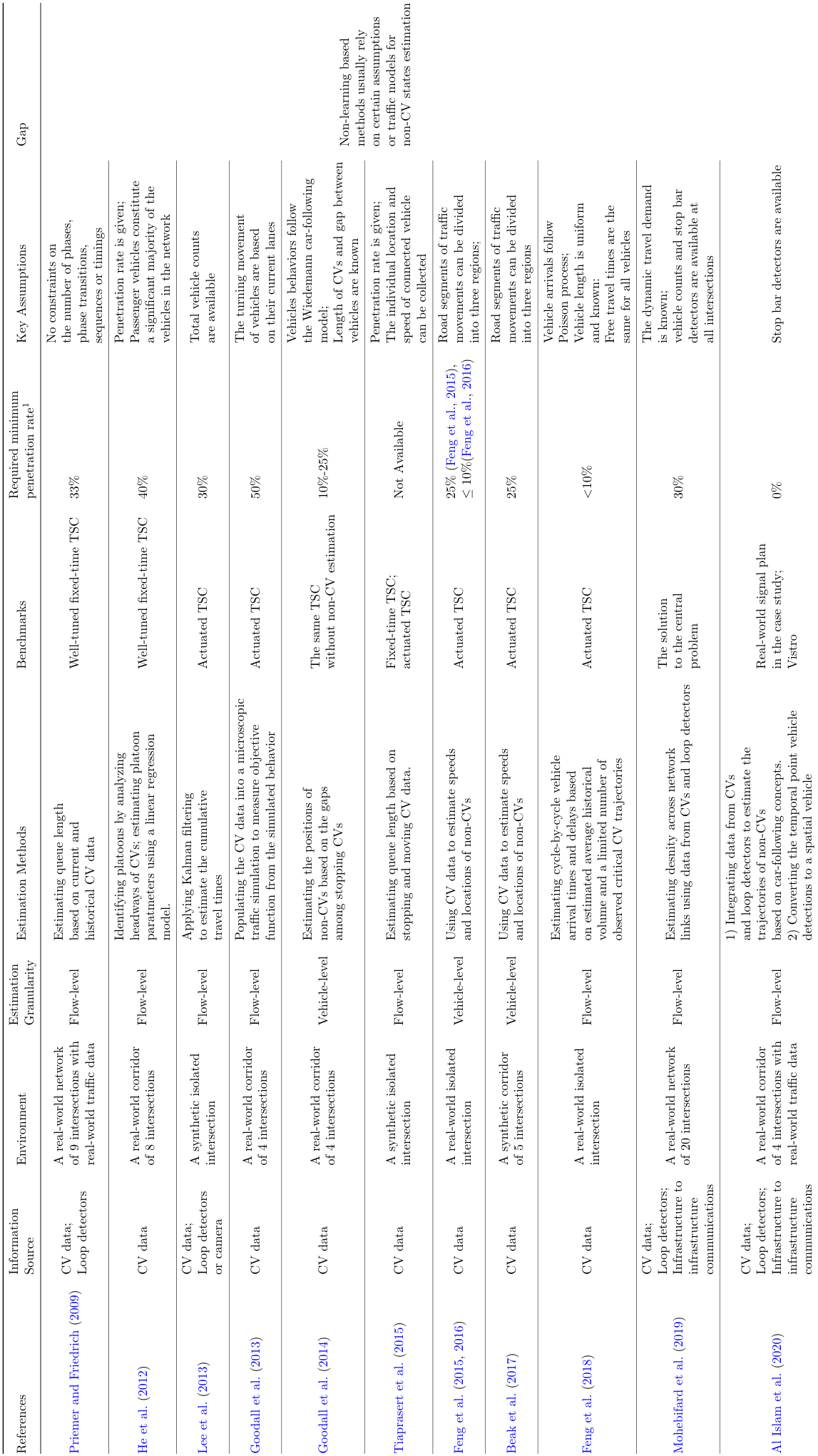
For a detailed comparison of how this work fits into the broader landscape of TSC research, the authors provide comprehensive summaries of both non-learning and learning-based approaches:
Summary updated