


TL;DR
HomNet is a novel deep learning framework that automates the detection of chromosomal structural abnormalities by mimicking the way human experts work: comparing "twin" (homologous) chromosomes to spot discrepancies. By leveraging this homologous similarity and aggregating data across multiple cells from a single patient, HomNet achieves state-of-the-art accuracy and completes a full patient diagnosis in under 5 milliseconds.
What Problem Does This Paper Address?
Chromosomal abnormalities are the root cause of many genetic diseases and miscarriages. While "numerical" abnormalities (like having an extra copy of Chromosome 21 in Down syndrome) are relatively easy to detect, structural abnormalities—such as deletions, inversions, or translocations of specific segments—are far more subtle.
Currently, identifying these requires highly trained cytogeneticists to manually inspect hundreds of chromosome diagrams (karyotypes) per patient. This process is slow, expensive, and prone to human fatigue. Previous AI attempts often treated each chromosome in isolation, ignoring a fundamental biological fact: chromosomes come in homologous pairs that should look identical. If one looks different from its partner, that difference is a massive red flag for a structural abnormality.
Methods
The authors introduce HomNet, which consists of three main components designed to capture these subtle structural differences:
-
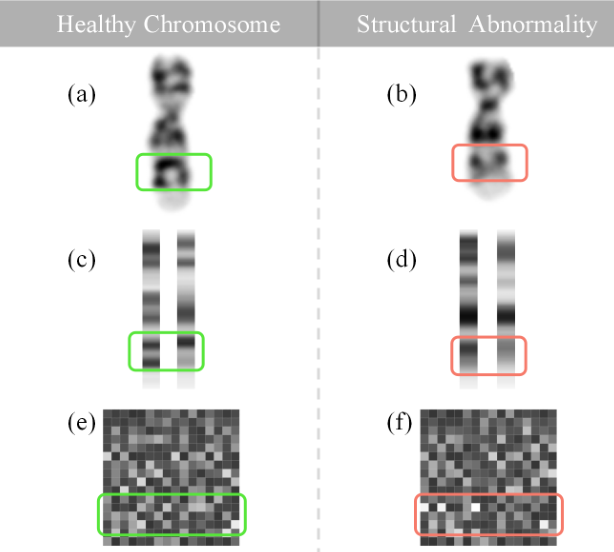
CMSBlock (Chromosome Modeling): Instead of processing raw 2D images, the model converts chromosomes into 1D "gray mean sequences" (see Figure 2 below). This reduces noise and focuses on the density of genetic material along the chromosome's length. The block also fuses prior knowledge, such as the chromosome type and "band level" (the resolution of the staining), to enrich the features.
Figure 2: The chromosomal sequences are the gray mean sequences of the left and right parts of the chromosome diagram. -
HomBlock (Homologous Alignment): This is the core innovation. Because chromosomes can bend or flip in a cell, they aren't perfectly aligned in images. HomBlock uses an inter-attention mechanism to adaptively align regions between the two chromosomes in a pair, allowing the model to directly calculate a "difference representation."
Figure 3: The framework of HomNet. The arrow heads refer to the dataflow of a pair of homologous chromosomes. -
BagBlock (Multi-pair Aggregation): Experts don't rely on just one cell; they look at several to confirm a finding. HomNet adopts a "Multiple Instance Learning" strategy, grouping chromosome pairs from different cells into a "bag." It then learns to weight these pairs, focusing on the most informative (clearest) diagrams to make a final patient-level prediction.
To handle the extreme label imbalance (less than 4% of real-world samples are abnormal), the authors developed a self-supervised pre-training strategy using artificial abnormalities. They synthetically generated five types of structural errors—deletions, additions, duplications, replacements, and Robertsonian translocations—to teach the model what "broken" chromosomes look like before fine-tuning on real clinical data.
Datasets
The study utilized a massive, anonymized real-world dataset and one public benchmark:
- Real-world Hospital Data: Collected from four Grade A tertiary hospitals in China (Hos#1-4). It includes 61,350 chromosome diagrams from 102 patients with confirmed structural abnormalities and 458,876 diagrams from 1,581 healthy individuals.
- Pki-3: A public chromosome dataset used to validate the model's performance on artificial abnormalities.
Key Insights and Ideas
- The Power of Comparison: The most significant finding is that comparing homologous pairs is far more effective than analyzing single chromosomes. In ablation studies, removing the "Pair strategy" caused the largest drop in performance.
-
Alignment Matters: Because chromosomes are flexible biological entities, simple subtraction of features doesn't work. The attention-based adaptive alignment in HomBlock is crucial for identifying differences in regions that might be shifted or rotated (see Figure 1).
 * Synthetic-to-Real Transfer: Pre-training on diverse artificial abnormalities allows the model to learn a general "grammar" of chromosomal structure, which then generalizes well to the messy, inconsistent data found in different hospital environments.
Key Results
HomNet significantly outperformed 11 baseline models, including standard computer vision architectures like ResNet and Vision Transformers (ViT), as well as specialized anomaly detection methods.
- Accuracy: On real-world data, HomNet achieved an AUC-ROC of up to 98.25% and an F1 score of 66.32% (notably high given the extreme class imbalance).
- Efficiency: The model is incredibly fast, processing a full patient case (115 pairs from 5 cells) in less than 5 milliseconds.
- Clinical Impact: The system is already integrated into AutoVision, an AI analysis system used in clinical trials across three major hospitals in China, where it demonstrated 98.4% diagnostic accuracy in automated analysis.
Limitations and Future Work
The authors note that data inconsistency between hospitals remains a challenge; equipment and environmental differences mean a model trained on one hospital's data needs fine-tuning to perform optimally at another. While the "Bag" strategy helps mitigate noise from bent or occluded chromosomes, extremely poor-quality images are still excluded from the pipeline. Future work may focus on improving the model's robustness to these physical distortions without manual filtering.
Summary updated