


TL;DR
This paper introduces BLANCA, a new benchmark designed to evaluate how well language models understand the natural language "artifacts" surrounding code, such as documentation and forum posts. The authors demonstrate that while general-purpose models perform decently, fine-tuning on these specific tasks significantly improves a model's ability to capture the deep semantics of programming concepts.
What Problem Does This Paper Address?
While AI for code has exploded recently, most research focuses on the code itself—parsing syntax trees or analyzing program flow. However, a wealth of critical information is hidden in "textual artifacts": the READMEs, API docs, and StackOverflow threads where developers explain why and how code works.
Until now, there hasn't been a systematic way to measure if a language model (like BERT) actually "understands" this technical text. If a model can't tell that a forum post about "linear models" relates to a specific SGDClassifier class in the documentation, it's missing a huge piece of the puzzle for tasks like automated code search or documentation generation.
Methods
The researchers developed five distinct downstream tasks to probe a model's understanding of code-related text:
- Forum Answer Ranking (R): Predicting which answer in a thread is the "best" or most popular.
- Forum Link Prediction (L): Determining if two different forum posts are semantically related.
- Forum to Class Prediction (F): Matching a forum discussion to the documentation of the class it's discussing.
- Class Hierarchy Distance Prediction (H): Predicting how far apart two classes are in a library's inheritance tree based only on their documentation.
- Class Usage Prediction (U): Predicting if two classes are used in similar ways in actual code based on their textual descriptions.
Datasets
The benchmark is built on Graph4Code, a massive knowledge graph linking 1.3 million Python programs to their corresponding documentation and StackOverflow posts. It includes 500,000 question-answer sets for ranking, ~29,000 post pairs for link prediction, and a massive set of class pairs for hierarchy and usage prediction.
Key Insights and Ideas
- General Models are a Good Start: Surprisingly, models trained on general natural language (like NLI tasks) perform reasonably well "out of the box." This suggests that "dev-speak" isn't a completely different language, but rather a specialized dialect.
- Fine-Tuning is Essential: Domain-specific fine-tuning on BLANCA tasks provides a massive performance boost. For example, BERTOverflow (trained on StackOverflow data) saw its ranking performance jump significantly after being tuned on the BLANCA Answer Ranking task.
- Multi-Tasking Wins: The best-performing models were those trained on multiple BLANCA tasks simultaneously. This indicates that the tasks are complementary; learning about class hierarchies helps the model understand forum posts, and vice versa.
- The "Duplicate" Challenge: Models found it harder to identify "duplicate" forum posts than "direct" links. This is likely because duplicates often describe the same problem using completely different terminology, requiring a deeper semantic understanding than simple keyword matching.
Key Results
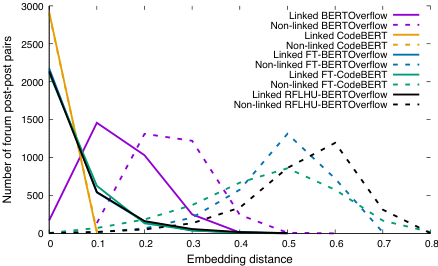
The authors demonstrated that fine-tuning consistently pulls related items closer in the embedding space while pushing unrelated ones further away.
 *[Can Machines Read Coding Manuals Yet?
- A Benchmark for Building Better Language Models for Code Understanding, page 5](/pdf/art_d2d35d56806c48b9b2dd7ce7c191f089#page=5)*
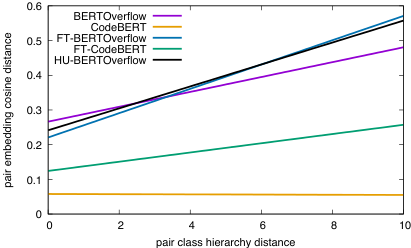
In the Forum Link Prediction task, fine-tuned BERTOverflow achieved a much higher "T" value (a measure of separation between linked and unlinked distributions) of 180.42, compared to just 59.52 for the base model. Similarly, for Class Hierarchy Prediction, the Pearson correlation between predicted and actual distance doubled from 0.17 to 0.34 after fine-tuning.
 *[Can Machines Read Coding Manuals Yet?
- A Benchmark for Building Better Language Models for Code Understanding, page 6](/pdf/art_d2d35d56806c48b9b2dd7ce7c191f089#page=6)*
Limitations and Future Work
- Language Scope: Currently, the benchmark is focused exclusively on Python. Results might differ for statically-typed languages like Java, where class hierarchies are more explicit.
- Labeling Heuristics: The "Forum to Class" task relied on automated heuristics for labeling, which may still contain some noise.
- Downstream Impact: The next step is showing that these improved embeddings actually lead to better performance on end-user tools like code recommenders or automated bug fixers.
Summary updated