


TL;DR
The paper introduces $\mu$-ChebNet, a lightweight spectral Graph Neural Network (GNN) that learns a node-wise density function to dynamically warp a graph's propagation geometry without altering its underlying topology. By replacing the standard fixed graph Laplacian with this task-adaptive operator, the model successfully mitigates oversmoothing and oversquashing in long-range reasoning tasks while avoiding the heavy computational overhead of graph transformers or rewiring schemes.
What Problem Does This Paper Address?
Standard Graph Neural Networks typically struggle with long-range tasks due to two fundamental phenomena:
- Oversmoothing: Repeated message-passing layers cause node representations to converge and become indistinguishable.
- Oversquashing: Information from exponentially growing neighborhoods is compressed into fixed-size node embeddings when passing through structural bottlenecks.
Existing solutions generally fall into two camps. They either use global attention mechanisms (like Graph Transformers), which scale quadratically ($O(N^2)$) and are computationally expensive, or they employ graph rewiring techniques, which alter the graph's topology and add significant preprocessing overhead.
The authors tackle this gap by seeking a middle ground: a method that locally steers and guides information propagation to avoid bottlenecks without changing the graph structure or incurring massive computational costs.
Methods
The authors propose $\mu$-ChebNet, which incorporates a learnable, task-adaptive graph Laplacian ($L_\mu$) into standard Chebyshev polynomial spectral filters (ChebNet).
- Learnable Node Density: First, a shallow Graph Convolutional Network (GCN) learns a single positive scalar weight $\mu_i$ for each node $i$: $$\mu = \text{GCN}(A, X, \Theta)$$
- Weighted Laplacian Construction: Instead of using the fixed combinatorial Laplacian $L = D - A$, they construct a weighted Laplacian $L_\mu = D_\mu - A_\mu$. The new edge weights are defined by averaging the learned node densities at their endpoints: $$(A_\mu)_{ij} = \frac{\mu_i + \mu_j}{2} A_{ij}$$
- Drift-Diffusion Mechanics: Mathematically, this formulation mimics diffusion in an inhomogeneous medium. The spatial variations in $\mu$ naturally induce a discrete, first-order "drift" or advection effect. This biases information flow toward task-relevant routes without requiring an explicit vector field.
- Polynomial Filtering: This $L_\mu$ is plugged directly into ChebNet or Stable-ChebNet filters, retaining the $O(Km)$ computational efficiency of polynomial spectral filtering (where $m$ is the number of edges and $K$ is the filter size).
Datasets
The model is evaluated across both synthetic and real-world benchmarks designed to test long-range communication:
- Barbell Graphs: A synthetic dataset specifically designed to probe oversquashing, where two dense cliques are connected by a single narrow bridge edge.
- Graph Property Prediction: A synthetic benchmark evaluating global structural properties like graph diameter, single-source shortest-path (SSSP) distances, and eccentricity.
- City-Networks Benchmark: A real-world, large-scale node classification dataset based on road networks from four major cities (London, Paris, Shanghai, Los Angeles), where labels depend on global accessibility/eccentricity.
- Open-Graph Benchmark (ogbn-proteins): A large-scale, real-world biological protein-protein interaction network for multi-label function prediction.
Key Insights and Ideas
- Node-Wise vs. Pair-Wise Learning: Instead of learning separate node-to-node communication weights (like attention mechanisms), $\mu$-ChebNet learns just one density value per node. This simple reweighting scales linearly on sparse graphs while achieving a similar "rewiring-like" effect.
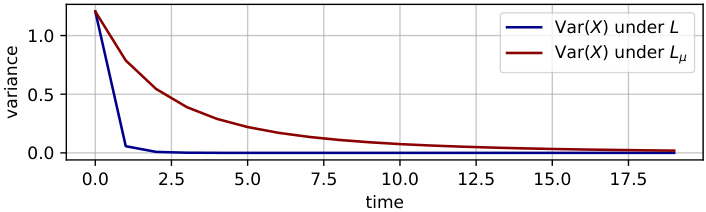
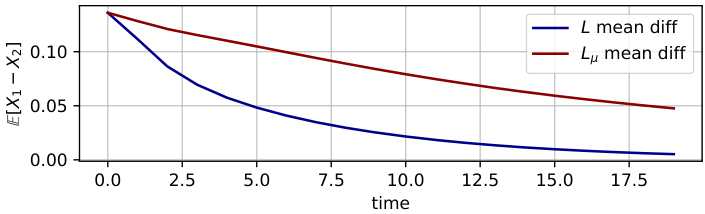
- Breaking Spectral Symmetries: On highly symmetric graphs with bottlenecks, standard Laplacians suffer from repeated eigenvalues (degeneracies), meaning distinct modes damp at the exact same rate. Learning $\mu$ breaks these symmetries, splitting the degenerate eigenvalues and allowing community-level information to persist longer during diffusion.
- Re-timing Spectral Decay: Rather than uniformly speeding up or slowing down diffusion, $L_\mu$ reshapes the spectrum of the graph, changing the relative timing with which different graph Fourier components are smoothed. This delays overmixing and preserves bottleneck-sensitive signals.
Key Results
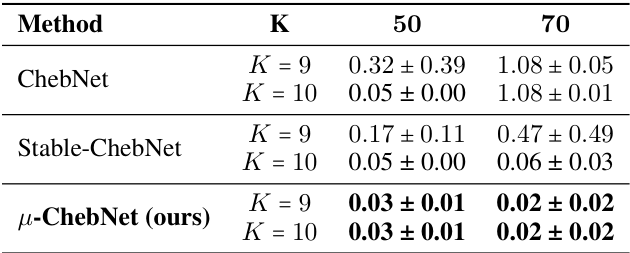
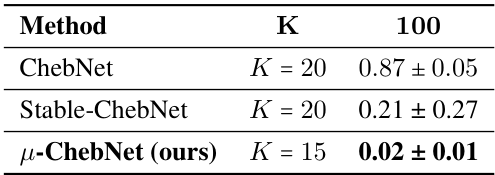
- Barbell Graphs: On graphs of size $N=50$ and $N=70$, $\mu$-ChebNet drastically outperforms standard ChebNet and Stable-ChebNet, reducing Mean Squared Error (MSE) from over 1.0 down to 0.02. For larger graphs ($N=100$), $\mu$-ChebNet lowers the MSE of Stable-ChebNet by an order of magnitude while requiring fewer layers ($K=15$ vs $K=20$).
- Graph Property Prediction: Combining the learned Laplacian with stability constraints ($\mu$-ChebNet + Stability) yielded systematic improvements across all tasks, achieving the lowest MSE for Diameter (-0.3179) and SSSP (-2.3217).
- ogbn-proteins: $\mu$-ChebNet achieved an ROC-AUC of 79.36%, outperforming traditional message-passing baselines and remaining highly competitive with heavy Graph Transformers like SPEXFORMER (80.65%), despite using only sparse graph operations.
Limitations and Future Work
- Mixed Gains with Stability Constraints: While adding stability constraints significantly boosted performance on synthetic benchmarks, it yielded mixed results on real-world datasets, sometimes leaving performance unchanged or slightly worse. The theoretical interplay between the learned density $\mu$ and spectral stability remains an open question.
- Parameterization of $\mu$: The authors only explored a simple GCN to parameterize the node weights; alternative architectures or attention-based parameterizations for $\mu$ were not ablated.
- Downstream Architectures: The learnable weighted Laplacian $L_\mu$ was exclusively paired with ChebNet-style filters. Future work could evaluate its utility in other spectral GNN frameworks or message-passing architectures.
Summary updated