


TL;DR
This paper introduces a geometric approach to personalized recommendation that replaces traditional vector embeddings with "box embeddings"—n-dimensional hyper-rectangles. By treating users and attributes as trainable Venn diagrams, the model naturally supports complex set-theoretic queries (like "action movies that are NOT romances") and outperforms standard neural vector methods by up to 30%.
What Problem Does This Paper Address?
Modern recommendation systems typically rely on collaborative filtering, representing users and items as vectors in a latent space. While excellent at capturing general similarities via dot products, these vector-based methods struggle with structured, set-theoretic queries.
For example, if a user Bob wants a "comedy that is not a romantic comedy," a standard system might struggle. Simply filtering a list of Bob's recommended movies against a "romance" attribute list is often inaccurate because attribute annotations are rarely complete. Learning a dense representation to fill in these gaps (matrix completion) usually assumes that features are linearly dependent. However, logical operations like intersection (AND) and negation (NOT) are fundamentally non-linear. This "mismatched inductive bias" leads to compounding errors as queries become more complex.
Methods
The authors propose modeling the problem as set-theoretic matrix completion. Instead of vectors, they represent users, items, and attributes as box embeddings—axis-parallel hyper-rectangles in $\mathbb{R}^n$.
Key aspects of the approach include:
- Trainable Venn Diagrams: A box represents a set of items. The volume of the box corresponds to the set's size, and the overlap between boxes represents their intersection.
- Geometric Scoring: The score for a movie $m$ given a user $u$ is the proportion of the movie's box contained within the user's box. This is calculated using volume ratios, which naturally mirrors the Jaccard index for similarity.
- Handling Logic: Because the intersection of two boxes is itself a box, conjunctions (AND) are easy to compute. Negations (NOT) are handled via inclusion-exclusion principles (subtracting the volume of the intersection from the volume of the base set).
- Smooth Optimization: To make these geometric operations differentiable for gradient descent, the authors use GumbelBox embeddings, which replace hard min/max operations with smooth approximations.
Datasets
The researchers evaluated their model across three diverse domains using four established datasets, augmented with attribute ground truth from sources like Wikidata and the Last.fm API:
- Movies: MovieLens 1M and MovieLens 20M.
- Songs: A subset of the Last-FM dataset.
- Restaurants: The NYC-R dataset (TripAdvisor data).
Detailed statistics for these datasets, including the splits used to test set-theoretic generalization, are provided in the paper's Table 1.
Key Insights and Ideas
- Inductive Bias Matters: The core "aha moment" is that logical queries are geometric, not linear. Vector spaces are great for "more like this," but box spaces are designed for "this AND that BUT NOT the other."
- Closing the Gap on Error Compounding: Traditional "filter-after-prediction" methods suffer from error compounding—small mistakes in predicting individual attributes multiply when you combine them. Box embeddings mitigate this by performing the logical operations directly on the learned representations.
- Generalization Spectrum: The authors show that box embeddings maintain higher accuracy even when moving from "weak" generalization (seeing parts of a query during training) to "strong" set-theoretic generalization (predicting entirely new combinations).
Key Results
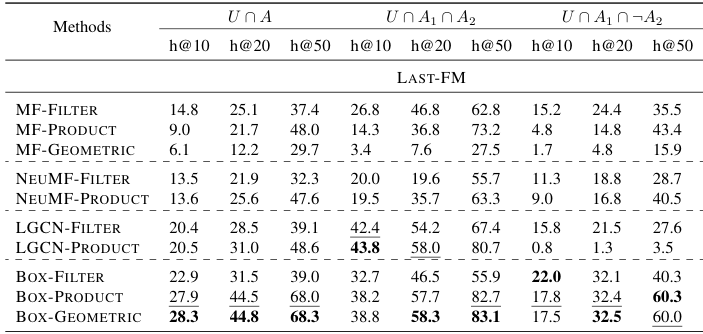
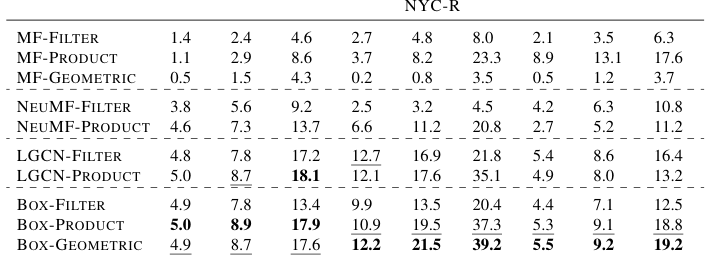
The box embedding models (specifically BOX-GEOMETRIC) significantly outperformed vector-based baselines like Matrix Factorization (MF), Neural Matrix Factorization (NeuMF), and LightGCN across all datasets.
- Overall Performance: Box embeddings showed an average 30% improvement in HR@50 (Hit Rate at 50) compared to the best-performing vector models.
- Complex Queries: On the most challenging queries ($U \cap A_1 \cap A_2$), the performance gap was most pronounced. In the Last-FM dataset,
BOX-GEOMETRICachieved an HR@50 of 83.1%, while the best vector-based approach (LGCN-PRODUCT) reached 80.7%, and standard MF methods lagged significantly behind. - Efficiency: While more complex than simple MF, box embeddings are significantly faster to train than graph-based methods like LightGCN, especially as batch sizes increase, making them a scalable choice for production systems.
Limitations and Future Work
While highly effective, the current work focuses on axis-parallel hyper-rectangles. The authors suggest that exploring other geometric shapes or more complex logical structures (beyond simple conjunctions and negations) could be fruitful. Additionally, while training is efficient, the use of GumbelBox approximations adds some computational overhead compared to standard dot products; future work could focus on further optimizing inference by transitioning from "soft" to "hard" geometric operators after training.
Summary updated