

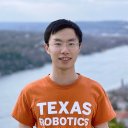
 Zhenyu Jiang
· 3 previous affiliations
- Amazon (United States)Since 2025
- Researcher · Since 2025
- The University of Texas at Austin2020–2025
- PhD student · 2020–2025
- Tsinghua University2016–2020
- Undergrad student · 2016–2020
Research Overview
Zhenyu Jiang focuses on the intersection of robotics and computer vision, developing methods for 3D object reconstruction, articulated object modeling, and dexterous robotic manipulation. His trajectory spans from building digital twins of physical environments to advancing imitation learning and whole-body control for humanoid robots. Currently, his work investigates sim-to-real co-training and foundation models to scale generalist robotic policies.
Research Trajectory
Beginning in 2022, his research addressed the digitization of physical objects and environments for embodied AI applications. He developed Ditto: Building Digital Twins of Articulated Objects from Interaction, a framework that reconstructs part-level geometry and articulation models from interactive perception. Around the same time, he tackled the challenge of reconstructing 3D models from sparse images without known camera poses in Few-View Object Reconstruction with Unknown Categories and Camera Poses. By jointly solving for camera pose and 3D shape, this work contributed to the broader area of View Invariant Representation Learning through Cross View Alignment.
Extending these 3D representations to robotic manipulation, he introduced ACID: Action-Conditional Implicit Visual Dynamics for Deformable Object Manipulation. This approach utilized the research direction of Tri-Plane Feature Representations for 3D Deep Learning to model the dynamics of high-DOF deformable objects. Continuing his work on sparse-view modeling in 2023, he presented LEAP: Liberate Sparse-view 3D Modeling from Camera Poses, which advanced the field of Pose Free 3D Reconstruction from Unconstrained Images by replacing explicit geometric projections with a data-driven neural volume. He also participated in developing Doduo: Learning Dense Visual Correspondence from Unsupervised Semantic-Aware Flow, a method for establishing dense visual correspondence in dynamic scenes without ground-truth supervision.
By 2024, the focus of his work shifted toward complex, multi-arm, and humanoid robot control. To address the data acquisition bottleneck in imitation learning, he developed DexMimicGen: Automated Data Generation for Bimanual Dexterous Manipulation via Imitation Learning (also detailed in an expanded preprint). This large-scale automated data generation system contributes to the broader area of Generative World Models for Zero-Shot Robot Learning by facilitating bimanual dexterous manipulation in simulation. He also explored human-robot interaction through natural language, introducing HARMON: Whole-Body Motion Generation of Humanoid Robots from Language Descriptions. This system leverages vision-language models to edit and refine human motion priors into expressive, text-aligned humanoid behaviors.
In 2025 and 2026, his research scaled toward generalist robotic policies and the mechanics of sim-to-real transfer. He was part of the collaborative effort behind GR00T N1: An Open Foundation Model for Generalist Humanoid Robots, combining vision-language models with diffusion transformers for high-frequency motor control across multiple robot embodiments. A major theme in this recent period is the integration of synthetic and real-world data. He investigated this in Sim-and-Real Co-Training: A Simple Recipe for Vision-Based Robotic Manipulation, demonstrating improvements in real-world task success by mixing small real datasets with large-scale simulation data. The empirical success of this approach was further examined in A Mechanistic Analysis of Sim-and-Real Co-Training in Generative Robot Policies, which unpacks why specific mixing ratios succeed. Additionally, he contributed to Residual Off-Policy RL for Finetuning Behavior Cloning Policies, proposing a method to learn per-step corrections on top of pre-trained policies for high-degree-of-freedom robots.
Current Directions
The most recent papers in the evidence address the scaling of generalist robotic policies and the optimization of sim-to-real transfer. Recent work investigates the mechanics of sim-and-real co-training, exploring how mixing large-scale synthetic simulation data with small amounts of high-quality real-world data can robustly improve vision-based manipulation without extensive manual tuning. Alongside empirical recipes for co-training, this research involves mechanistic analyses to understand optimal mixing ratios and the balance between domain invariance and class discriminability. Additionally, current efforts focus on refining pre-trained behavior cloning policies through residual reinforcement learning, enabling sample-efficient, real-world training for complex, high-degree-of-freedom humanoid robots.
Profile updated
Loading new papers…
Other researchers whose papers cluster into the same research directions — a proxy for overlapping technical interests and shared intellectual neighborhoods.
See something wrong? Report a mistake