

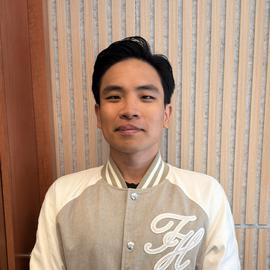
 Zhen Chen
· 2 previous affiliations
- Adobe Systems (United States)Since 2024
- Researcher · Since 2024
- Current
- The University of Texas at Austin2018–2024
- PhD student · 2018–2024
9 other authors named Zhen Chen: Zhen Chen (Hong Kong Polytechnic University · 162 papers), Zhen Chen (Tsinghua University · 47 papers), Zhen Chen (Nanchang Hangkong University · 5 papers), Zhen Chen (4 papers), Zhen Chen (Jingdong (China) · 京东 · 4 papers), and 4 more
Research Overview
Zhen Chen focuses on 3D computer graphics, geometric modeling, and artificial intelligence alignment. His trajectory spans the development of robust meshing algorithms for 3D asset creation and the reconstruction of simulation-ready digital garments. Most recently, his work addresses theoretical reinforcement learning, investigating how agents can optimize learning from pluralistic and inconsistent human feedback.
Research Trajectory
In 2023, Chen's research centered on advancing 3D content creation through improved meshing techniques. He contributed to the research direction of Scaling 3D Representations Beyond the Memory Wall through his involvement in Neural Volumetric Mesh Generator. This work introduced a pipeline combining diffusion models with a regularized projection method to generate high-quality, artifact-free volumetric meshes. In the same year, he developed Robust Low-Poly Meshing for General 3D Models, proposing an automated approach to generate visually preserving low-poly meshes from high-poly inputs found in the wild. This two-stage method extracts a feature-preserving, watertight offset surface before progressively simplifying it, allowing for seamless integration into standard 3D asset production pipelines.
By 2026, Chen's collaborative efforts expanded into specialized 3D reconstruction and theoretical machine learning. He participated in the broader area of Scaling 3D Generative Models with 2D Priors with the publication of ReWeaver: Towards Simulation-Ready and Topology-Accurate Garment Reconstruction. This framework reconstructs both 3D geometry and 2D sewing patterns from sparse multi-view images, producing simulation-ready assets applicable to virtual try-on and robotics. Concurrently, his research extended into AI alignment with PRISM: When Agents Provably Learn from Pluralistic Human Feedback. This theoretical framework demonstrates that standard reinforcement learning algorithms can still converge on optimal solutions even when human preferences are contradictory and context-dependent.
Current Directions
The most recent papers in the evidence indicate a dual focus on physics-aware 3D reconstruction and theoretical reinforcement learning. In the visual computing domain, current work investigates how to bridge digital representations and real-world physics by generating simulation-ready assets, such as garments with accurate topology, from sparse visual data. In the domain of artificial intelligence alignment, recent research addresses the challenge of pluralistic human feedback, exploring mathematical frameworks that allow agents to learn robustly from inconsistent and context-dependent preferences.
Profile updated
| Title | Venue | Year |
|---|---|---|
| ISArt: Single-Image, Structure-Guided Generation of Sim-Ready Articulated Assets | Openreview | 2027 |
| Unravel: Recovering an Interactive 3D Scene from a Single Image | Openreview | 2027 |
| GRASE: Geometry-native Real-to-sim Agentic Scene Modeling from Video | Openreview | 2027 |
| ArtiCritic: A Vision–Language Critic for Generated Articulated Objects | Openreview | 2027 |
| ReWeaver: Towards Simulation-Ready and Topology-Accurate Garment Reconstruction | CVPR | 2026 |
| PRISM: When Agents Provably Learn from Pluralistic Human Feedback | Pluralistic-Alignment @ ICML | 2026 |
| Robust Low-Poly Meshing for General 3D Models | ACM Trans. Graphics | 2023 |
| Neural Volumetric Mesh Generator | SBM @ NeurIPS | 2022 |
Loading new papers…
Other researchers whose papers cluster into the same research directions — a proxy for overlapping technical interests and shared intellectual neighborhoods.
See something wrong? Report a mistake