

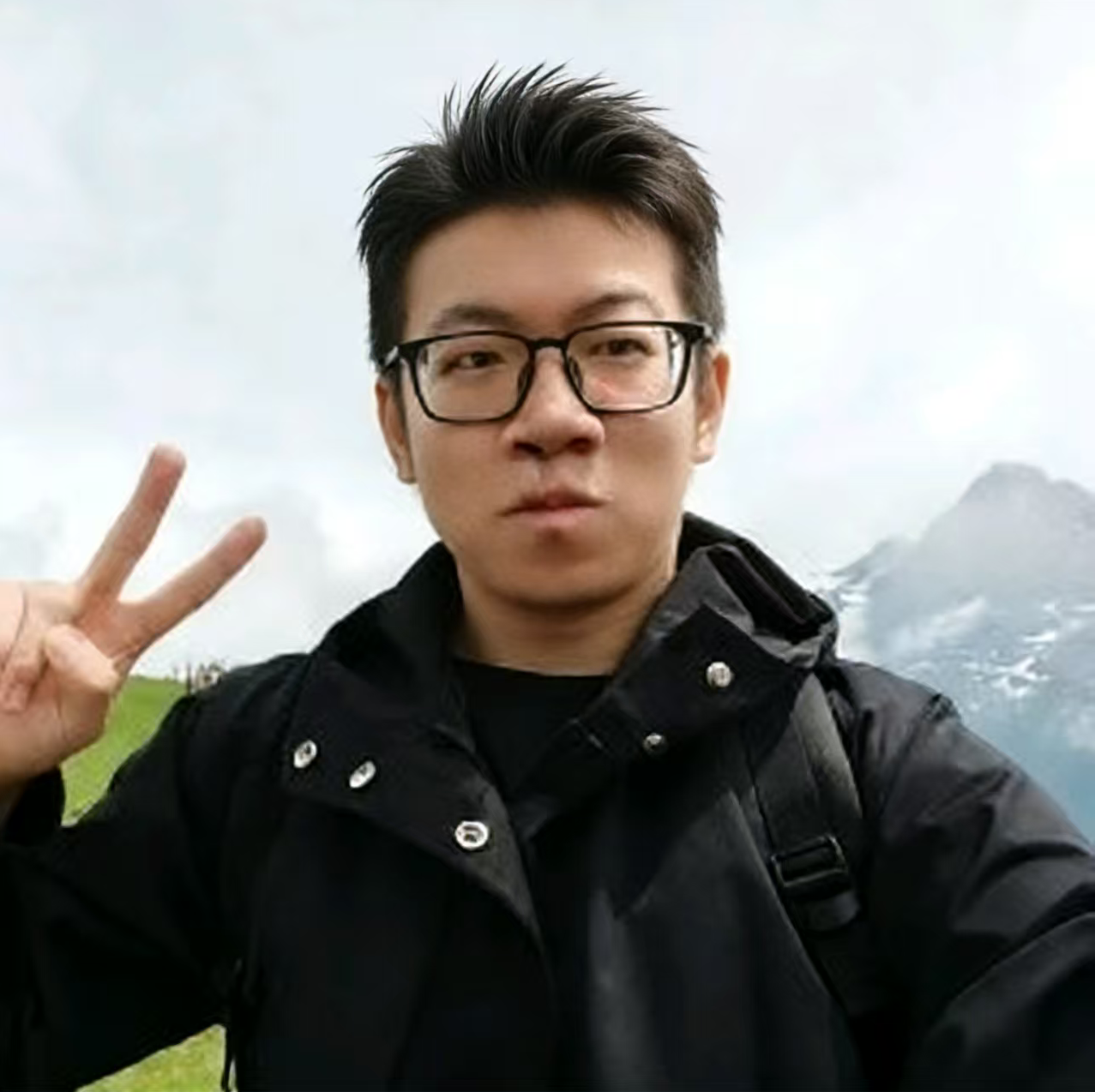
 Zeyi Sun
· 3 previous affiliations
- ByteDance (China)Since 2025
- Intern · Since 2025
- Shanghai Jiao Tong UniversitySince 2023
- PhD student · Since 2023
- Current
- Beihang University2019–2023
- Undergrad student · 2019–2023
Research Overview
Zeyi Sun focuses on multimodal foundation models, 3D content generation, and autonomous computer-use agents. His research explores how large vision-language models can be adapted for fine-grained visual reasoning, physically based rendering, and complex sequential decision-making. Recently, his work emphasizes reinforcement learning and self-evolving frameworks to improve the reasoning capabilities of autonomous agents.
Research Trajectory
Zeyi Sun’s research trajectory begins with the evaluation and benchmarking of foundational multimodal models. In 2023, he participated in a comparative study of leading vision-language models in Gemini vs GPT-4V: A Preliminary Comparison and Combination of Vision-Language Models Through Qualitative Cases. This work assessed the trade-offs between precision and context-rich reasoning, contributing to the area of Hierarchical Task Evaluation for Large Models and the research direction of Interleaved Multi-Image Reasoning in Large Multimodal Models.
In 2024, his focus expanded significantly into 3D content generation and the fine-grained adaptation of vision-language models. To address the data scarcity that limits 3D generative models compared to their 2D counterparts, he and his collaborators developed Bootstrap3D: Improving 3D Content Creation with Synthetic Data, which leverages synthetic data to improve 3D generation pipelines. Continuing in the 3D domain, he contributed to Make-it-Real: Unleashing Large Multimodal Model for Painting 3D Objects with Realistic Materials. This framework utilizes the world knowledge embedded in multimodal large language models to automatically assign physically realistic materials to 3D meshes, advancing the research direction of Generative PBR Texturing for Relightable 3D Assets.
Parallel to his 3D research, he worked on improving the spatial and semantic precision of vision-language models. He proposed X-Prompt: Towards Universal In-Context Image Generation in Auto-Regressive Vision Language Foundation Models, which compresses visual context into learnable tokens to enable few-shot image generation and complex editing tasks. This work aligns with the broader area of Modeling Semantic Deltas for Image Editing and Retrieval. To further enhance localized visual understanding, he introduced Alpha-CLIP: A CLIP Model Focusing on Wherever you Want, modifying the standard CLIP architecture with an auxiliary alpha channel that allows the model to focus on specific regions of interest for controlled editing. He also designed RAR: Retrieving And Ranking Augmented MLLMs for Visual Recognition, a framework that combines CLIP’s broad retrieval capabilities with the expert reasoning of multimodal models to improve fine-grained, zero-shot visual recognition.
Moving into 2025, his research began to bridge generative modeling with complex agentic reasoning and reinforcement learning. Expanding generative techniques to video, he developed RelightVid: Temporal-Consistent Diffusion Model for Video Relighting, a diffusion-based framework that enables high-quality, flicker-free video relighting using text prompts or environment maps. Further work in 3D understanding led to GPT4Point++: Advancing Unified Point-Language Understanding and Generation, which introduced point-language multimodal models designed for 3D object recognition, captioning, and controllable generation.
A major shift toward autonomous systems is evident in his recent work on computer-use agents. He contributed to CODA: Coordinating the Cerebrum and Cerebellum for a Dual-Brain Computer Use Agent with Decoupled Reinforcement Learning, an architecture that addresses the challenges of scientific computing by decoupling long-horizon planning from precise execution. To improve the data efficiency of these models, he introduced Visual-RFT: Visual Reinforcement Fine-Tuning. This work brings the paradigm of reasoning through reinforcement learning to large vision-language models by designing verifiable visual reward functions, contributing to the area of Group Relative Policy Optimization for Large Reasoning Models. Building on these agentic frameworks, his 2026 work includes SEAgent: Self-Evolving Computer Use Agent with Autonomous Learning from Experience, which allows computer-use agents to autonomously learn unfamiliar software through a self-improving curriculum without relying on human-labeled data. Extending this paradigm, Sun contributed to Visual-RFT++: Extending Visual Reinforcement Fine-Tuning to Multimodal Tool Use, a unified framework that scales reinforcement fine-tuning to multimodal agentic workflows, equipping vision-language models with verifiable reward mechanisms for web search and code-driven image manipulation.
Current Directions
The most recent papers in the evidence address the development of autonomous agents and the application of reinforcement learning to multimodal models. Recent work investigates how computer-use agents can navigate complex graphical user interfaces by decoupling high-level planning from low-level execution, and how these systems can autonomously learn to use unfamiliar software without human supervision. Additionally, ongoing research explores visual reinforcement fine-tuning, utilizing verifiable reward functions to extend large vision-language models into multimodal tool-use and agentic tasks such as code-based manipulation and web search.
Profile updated
Loading new papers…
Other researchers whose papers cluster into the same research directions — a proxy for overlapping technical interests and shared intellectual neighborhoods.
See something wrong? Report a mistake