

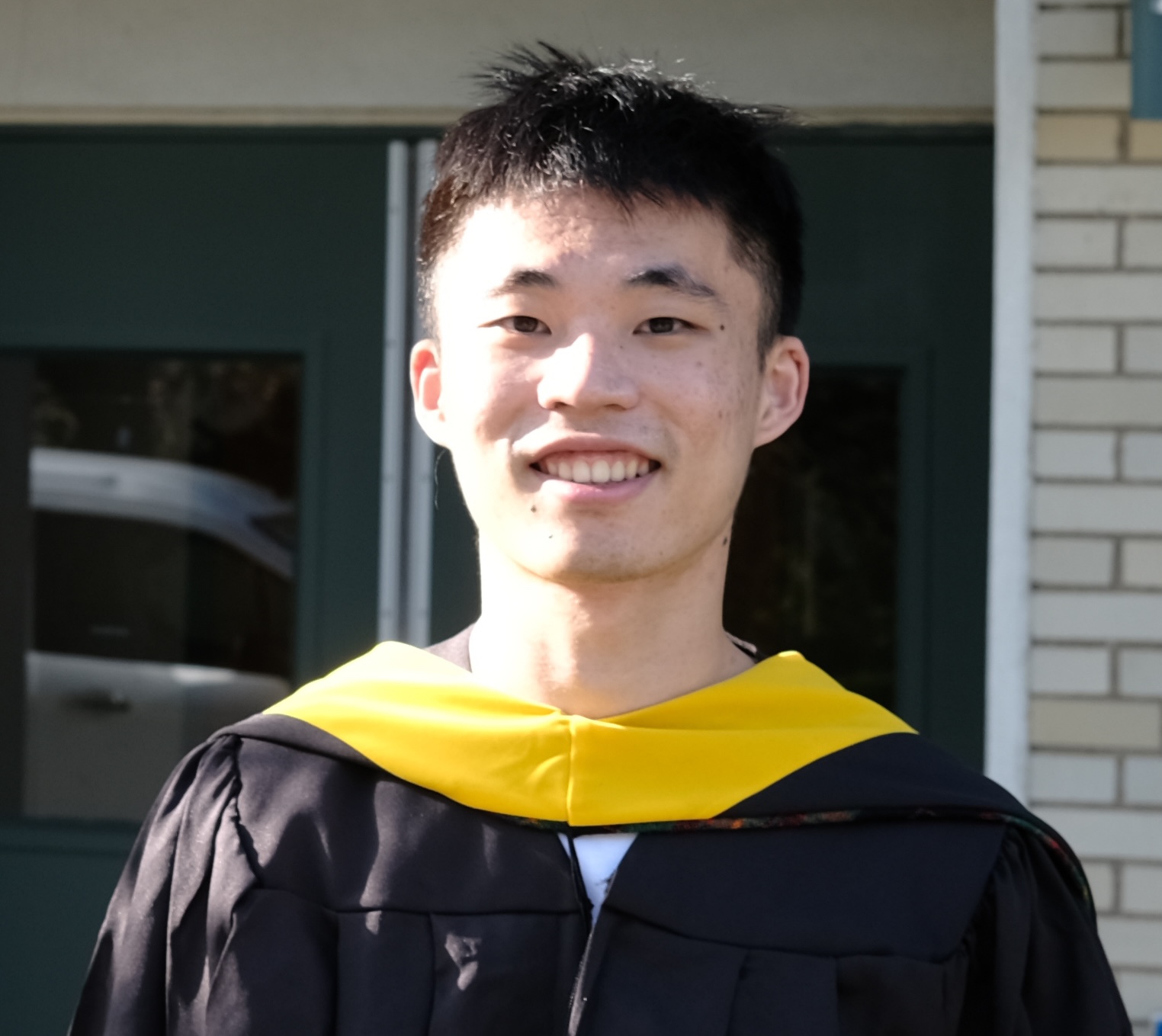
 Yuda Song
· 2 previous affiliations
- Carnegie Mellon UniversitySince 2020
- PhD student · Since 2022
- MS student · 2020–2021
- University of California San Diego2016–2020
- Undergrad student · 2016–2020
Research Overview
Yuda Song focuses on the theory and application of interactive decision-making, reinforcement learning, and representation learning. His trajectory spans foundational work in sample-efficient exploration and hybrid reinforcement learning to the co-design of robotic morphology and control. Most recently, his research addresses the alignment, reasoning capabilities, and iterative self-improvement of large language models.
Research Trajectory
Song's early work addresses the sample complexity of reinforcement learning (RL) through policy adaptation and representation learning. He introduced methods for adapting pre-trained policies to new environments in Provably Efficient Model-based Policy Adaptation. Expanding on representation learning, he contributed to the development of the BRIEE algorithm for model-free representation learning in Block MDPs, achieving near-optimal performance without restrictive reachability assumptions in Efficient Reinforcement Learning in Block MDPs: A Model-free Representation Learning approach. He further investigated offline pretraining to discover shared representations for target tasks in Provable Benefits of Representational Transfer in Reinforcement Learning. Concurrently, his research extended to physical agent design, contributing to a transform-and-control policy that incorporates skeletal structure modification into the decision-making process in Transform2Act: Learning a Transform-and-Control Policy for Efficient Agent Design. This work advanced the research direction of Co-Design of Robot Morphology and Control and the broader area of Morphology Conditioned Policies for Cross Embodiment Control.
A major theme in Song's trajectory is hybrid reinforcement learning, which bridges the gap between purely offline and online settings. He developed the Hy-Q algorithm to demonstrate the computational and statistical efficiency of combining offline datasets with real-world interaction in Hybrid RL: Using both offline and online data can make RL efficient. He later extended this paradigm to settings where offline data consists solely of state observations, such as videos without action labels, introducing the HYRLO framework in Hybrid Reinforcement Learning from Offline Observation Alone. Returning to representation learning in complex environments, he proposed the RichCLD framework and the CRIEE algorithm to handle high-dimensional observations governed by low-dimensional, Lipschitz continuous dynamics in Rich-Observation Reinforcement Learning with Continuous Latent Dynamics.
As large language models (LLMs) became central to artificial intelligence, Song's focus shifted toward their alignment and reasoning capabilities. He analyzed the theoretical and empirical trade-offs between online RL (such as PPO) and offline contrastive methods (such as DPO) for preference fine-tuning in The Importance of Online Data: Understanding Preference Fine-tuning via Coverage, contributing to the area of Reference Anchored Policy Optimization. Investigating the risks of training models on their own outputs, he examined model collapse and the scaling laws of self-improvement in Mind the Gap: Examining the Self-Improvement Capabilities of Large Language Models. This study provided critical insights into the research direction of Iterative Self Improvement for Large Language Models and the related area of Self-Correction and the Knowledge Bottleneck in Language Models. He continued to explore LLM reasoning by analyzing how outcome-based RL causes a systematic loss of generation diversity, which undermines test-time scaling, in Outcome-based Exploration for LLM Reasoning.
Alongside his LLM research, Song maintained an interest in foundational RL challenges. He analyzed the algorithmic trade-offs between privileged expert distillation and end-to-end RL in partially observable environments (POMDPs) in To Distill or Decide? Understanding the Algorithmic Trade-off in Partially Observable RL. Most recently, his work addresses the inefficiencies of sparse binary reward signals in LLM alignment. He proposed utilizing richer text-based signals in Expanding the Capabilities of Reinforcement Learning via Text Feedback. Additionally, he participated in the development of a compute-indexed objective that bridges standard RL and Maximum Likelihood approaches for binary tasks, improving test-time scaling efficiency, in Maximum Likelihood Reinforcement Learning.
Current Directions
The most recent papers in the evidence indicate a strong focus on the alignment, reasoning, and test-time scaling of large language models. Recent work investigates how to move beyond sparse, binary reward signals by incorporating granular text feedback into reinforcement learning pipelines. Additionally, ongoing research addresses the theoretical foundations of LLM self-improvement, exploring how outcome-based exploration and maximum likelihood objectives can enhance model diversity and reasoning capabilities without succumbing to model collapse.
Profile updated
Loading new papers…
Other researchers whose papers cluster into the same research directions — a proxy for overlapping technical interests and shared intellectual neighborhoods.
See something wrong? Report a mistake