

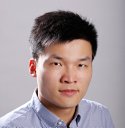
 Yuchen Liu
· 3 previous affiliations
- Adobe Systems (United States)Since 2020
- Researcher · Since 2020
- Current
- Princeton University2017–2022
- PhD student · 2017–2022
- Undergrad student · 2013–2017
13 other authors named Yuchen Liu: Yuchen Liu (35 papers), Yuchen Liu (Fudan University · 9 papers), Yuchen Liu (Zhejiang University · 5 papers), Yuchen Liu (4 papers), Yuchen Liu (Robert Bosch (Germany) · University of Stuttgart · 3 papers), and 8 more
Research Overview
Yuchen Liu focuses on visual generative modeling, neural network compression, and efficient deep learning architectures. His trajectory spans from early work on pruning and quantizing convolutional networks to the development of highly efficient generative adversarial networks and diffusion models. Currently, he investigates few-step generation approaches and training-free efficiency enhancements for large-scale video and image synthesis.
Research Trajectory
Liu’s early research established foundational techniques for reducing the computational footprint of deep learning models, particularly convolutional neural networks (CNNs). In 2019, he oversaw the development of Methodical Design and Trimming of Deep Learning Networks: Enhancing External BP Learning with Internal Omnipresent-supervision Training Paradigm, which introduced internal neuron learnability to facilitate deep compression and quantization. He expanded on this by addressing the deployment of massive models on edge devices in Rethinking Class-Discrimination Based CNN Channel Pruning. This work contributed to the broader research areas of Redundancy Aware Feature Selection and Non-uniform Sparsity Allocation for Efficient Neural Networks by removing entire feature maps to create smaller, dense models. Continuing this theme, he participated in Class-Discriminative CNN Compression, which integrated class discrimination into both pruning and distillation processes to align with the training objectives of CNNs.
As generative models grew in prominence and size, Liu shifted his focus toward optimizing their efficiency. He addressed the notoriously high computational costs of unconditional generative adversarial networks (GANs) with Content-Aware GAN Compression, introducing novel channel pruning and knowledge distillation schemes tailored for state-of-the-art GAN architectures. Recognizing that human-designed pruning functions could be sub-optimal, he subsequently explored automated metric discovery in Evolving transferable neural pruning functions, utilizing genetic programming to craft high-quality pruning metrics.
Around the conclusion of his doctoral studies, Liu’s work expanded into advanced image synthesis and manipulation. He developed 3D-FM GAN: Towards 3D-Controllable Face Manipulation, a conditional GAN framework designed to manipulate existing face images with precise 3D control without requiring post-training tuning. This research advanced the domains of Balancing Reconstruction Fidelity and Editability in Generative Inversion and Feed-Forward 3D Scene Reconstruction by encoding input images alongside physically-based renderings of 3D edits.
In recent years, as a researcher at Adobe Research, Liu has concentrated on the efficiency and scalability of diffusion models and multimodal systems. He guided the research in Attention-Driven Training-Free Efficiency Enhancement of Diffusion Models, introducing a framework that leverages attention maps to prune redundant tokens during inference without the need for computationally expensive retraining. He also led the development of DOLLAR: Few-Step Video Generation via Distillation and Latent Reward Optimization, a method combining variational score distillation and consistency distillation to drastically reduce inference time while maintaining high video quality. Concurrently, he collaborated on X-Fusion: Introducing New Modality to Frozen Large Language Models, contributing to a dual-tower architecture that enables frozen language models to process and generate images without catastrophic forgetting.
Current Directions
The most recent papers in the evidence indicate a strong focus on optimizing the inference speed and computational efficiency of large-scale generative models. Recent work investigates few-step generation approaches to address the iterative, time-consuming nature of diffusion models, particularly for video synthesis. This includes developing novel distillation techniques and latent reward optimization methods to achieve high-quality outputs with minimal denoising steps. Additionally, ongoing research explores training-free architectural enhancements, such as run-time token pruning driven by attention maps, to make state-of-the-art image and video generation models more scalable and accessible for practical deployment.
Profile updated
Loading new papers…
Other researchers whose papers cluster into the same research directions — a proxy for overlapping technical interests and shared intellectual neighborhoods.
See something wrong? Report a mistake