

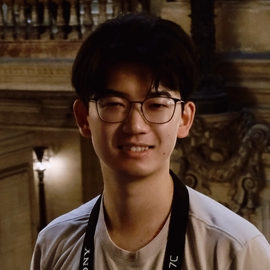
 Yuanhao Zhai
· 5 previous affiliations
- Meta (United States)Since 2025
- Research Scientist · Since 2025
- Doctor of Philosophy - PhD, Computer Science · 2021–2025
- Research Assistant · 2021–2024
- Applied Scientist Intern · 2024
- Research Intern · 2023
- Xi'an Jiaotong University2016–2020
- Bachelor of Engineering - BE, Computer Science · 2016–2020
Research Overview
Yuanhao Zhai focuses on image and video generative modeling, human action analysis, and weakly-supervised learning. His trajectory spans early work in temporal action localization to recent advancements in accelerating video diffusion and synthesizing human-centric content. Currently, his research investigates multi-modal generative frameworks for complex domains, including medical image synthesis and high-fidelity video generation.
Research Trajectory
Yuanhao Zhai’s early research concentrated heavily on video understanding, specifically addressing the high annotation costs associated with temporal action localization. By focusing on weakly-supervised temporal action localization (W-TAL), which requires only video-level labels rather than exhaustive frame-by-frame annotations, he developed methods to better identify and bound action instances. In 2019, he introduced the Action Coherence Network for Weakly Supervised Temporal Action Localization, proposing a novel coherence loss to supervise action boundary learning and facilitate proposal regression. He subsequently expanded on this problem with the Two-Stream Consensus Network for Weakly-Supervised Temporal Action Localization, which implemented an iterative refinement training method to generate precise temporal boundaries and filter out false positive proposals, contributing to the research direction of Bootstrapping Precise Temporal Boundaries from Weak Supervision. This foundational work culminated in a comprehensive journal extension, Action Coherence Network for Weakly-Supervised Temporal Action Localization, which further exploited classification predictions and video content to distinguish action instances from surrounding backgrounds. During this period, he also participated in specialized computer vision applications, contributing to Giant Panda Identification, which introduced the iPanda-50 benchmark dataset to address the subtle visual differences and cluttered environments inherent in wildlife conservation tracking.
Moving into 2023, Zhai’s research broadened to encompass open-set recognition, image forensics, and 3D reconstruction. To address the "scene bias" problem—where models identify actions based on static backgrounds rather than actual movement—he co-developed SOAR: Scene-debiasing Open-set Action Recognition. By utilizing adversarial reconstruction, this work forces models to ignore environmental clues, advancing the area of Evidential Deep Learning for Predictive Uncertainty Quantification. Concurrently, he explored image tampering detection with Towards Generic Image Manipulation Detection with Weakly-Supervised Self-Consistency Learning. This framework detects manipulations using only image-level labels by enforcing self-consistency across noise patterns, contributing to the broader research direction of Identifying Forgeries through Camera Sensor Fingerprints. In the domain of 3D vision, he presented High Fidelity 3D Hand Shape Reconstruction via Scalable Graph Frequency Decomposition, designing a frequency-split neural network that reconstructs personalized hand details from a single image by supervising the mesh in the graph frequency domain.
Around this time, Zhai increasingly focused on generative AI, particularly the synthesis of human motion and video. He addressed the complexity of human behaviors in Language-guided Human Motion Synthesis with Atomic Actions, proposing a curriculum learning strategy that decomposes complex motions into atomic actions for better adaptability. This interest in realistic human-centric content led to DisCo: Disentangled Control for Referring Human Dance Generation in Real World, which tackled the challenges of generating social media dance videos across a wide spectrum of poses, aligning with work in the area of Multi-Person Coordination in Generative Human Motion.
In 2024, his work on generative models matured to address fundamental challenges in video diffusion and multi-modal synthesis. He led the development of the Motion Consistency Model: Accelerating Video Diffusion with Disentangled Motion-Appearance Distillation, which successfully applies distillation techniques to video generation, overcoming the limitations of low-resolution or cluttered public datasets to produce high-quality frames rapidly. He also contributed to IDOL: Unified Dual-Modal Latent Diffusion for Human-Centric Joint Video-Depth Generation, a framework that simultaneously generates realistic videos of people and accurate 3D depth information, mitigating the jitter and misalignment common in standard depth estimators. Alongside his generative research, Zhai collaborated on optimizing neural architectures for secure applications, co-authoring Seesaw: Compensating for Nonlinear Reduction with Linear Computations for Private Inference. This framework accelerates private inference by replacing expensive nonlinear operations with linear ones, advancing the field of Communication Efficient Protocols for Private Machine Learning Inference.
Most recently, as a Research Scientist at Meta, Zhai has continued to expand the capabilities of multi-modal diffusion models into specialized domains. In 2025, he co-authored PathDiff: Histopathology Image Synthesis with Unpaired Text and Mask Conditions, a novel framework that generates high-fidelity medical images by leveraging high-level text and fine-grained spatial masks from unpaired datasets. This work represents a significant step forward in the research direction of Specialized Visual Grounding for Medical Foundation Models.
Current Directions
The most recent papers in the evidence indicate a strong focus on multi-modal generative modeling, particularly the acceleration and control of diffusion models for complex visual synthesis. Recent work investigates the distillation of video diffusion models to achieve rapid, high-quality generation without the artifacts typically introduced by noisy training data. Additionally, Zhai is exploring the intersection of generative AI and specialized domains, such as medical imaging, where models must synthesize high-fidelity content conditioned on unpaired text and spatial masks. This ongoing research emphasizes disentangled control, dual-modal generation (such as joint video and depth), and the creation of unified conditioning spaces that allow for precise structural and semantic manipulation in synthesized media.
Profile updated
Loading new papers…
Other researchers whose papers cluster into the same research directions — a proxy for overlapping technical interests and shared intellectual neighborhoods.
See something wrong? Report a mistake