

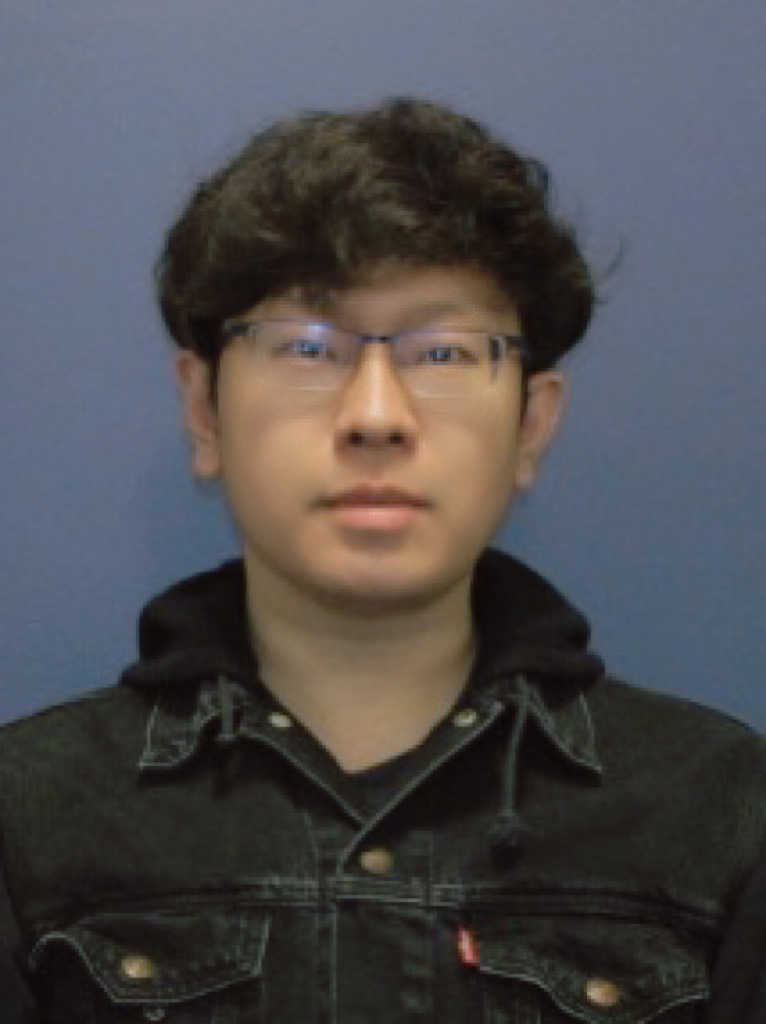
 Yu Wang
· 2 previous affiliations
- Current
- PhD student · 2016–2023
- Harvard University2024–2025
- Postdoc · 2024–2025
50 other authors named Yu Wang: Yu Wang (Tsinghua University · 679 papers), Yu Wang (Tianjin University · 79 papers), Yu Wang (University of Oregon · Vanderbilt University · 77 papers), Yu Wang (Shanghai Jiao Tong University · 62 papers), Yu Wang (53 papers), and 45 more
Research Overview
Yu Wang focuses on visual computing, applied mathematics, and geometric algorithms, leveraging partial differential equations and topology to solve complex shape analysis problems. His trajectory spans real-time shape deformation, spectral geometry, and the design of novel operators that extend beyond traditional Laplacian methods. Most recently, his work addresses differentiable sparse linear solvers to accelerate scientific machine learning and physical simulation.
Research Trajectory
Wang’s early research investigated real-time animation and deformation techniques for computer graphics. In 2014, he explored interactive environments with Sound localization and multi-modal steering for autonomous virtual agents, alongside methodological improvements for physical simulation in Fast Grid-Based Nonlinear Elasticity for 2D Deformations. He subsequently expanded on these themes by developing techniques for Linear subspace design for real-time shape deformation, establishing a foundation in efficient geometric computation.
Transitioning toward deeper intersections of applied mathematics and visual computing during his doctoral studies at MIT, Wang began addressing the limitations of traditional intrinsic shape analysis. He contributed to the research direction of Laplacian Spectral Geometry for Deformable Shape Analysis and the broader area of Scaling 3D Representations Beyond the Memory Wall by introducing the Dirichlet-to-Neumann (or Steklov) operator to the field. Detailed in Steklov Spectral Geometry for Extrinsic Shape Analysis, this approach captures volumetric geometry and subtle extrinsic features that standard intrinsic methods often miss. Building on the use of partial differential equations for geometric tasks, he later proposed Fast quasi-harmonic weights for geometric data interpolation. By formulating interpolation weights as the minima of an unconstrained problem governed by a parameterized family of second-order elliptic PDEs, this method achieved significant computational speedups over existing constrained optimization techniques.
This trajectory culminated in his 2023 dissertation, Geometric Computing beyond the Laplacian, which formalized a systematic program for designing algorithms that replace the ubiquitous Laplace-Beltrami operator with optimal, problem-specific alternatives. That same year, he applied these principles to the longstanding challenge of computing inversion-free maps for physical simulation and shape optimization. In Variational quasi-harmonic maps for computing diffeomorphisms, Wang and his collaborators demonstrated that a planar map is a diffeomorphism if and only if it is quasi-harmonic and satisfies a specific Cauchy boundary condition, reframing the mapping challenge as an optimal control problem.
Following his doctoral work, Wang held roles as a research fellow at Harvard Medical School and an AI researcher at Sony Geometry AI Group. Most recently, his research has expanded into high-performance numerical algorithms for machine learning. In 2025, he presented Schwarz–Schur Involution: Lightspeed Differentiable Sparse Linear Solvers, which reimagines sparse matrix factorization as a series of parallel, batched dense tensor operations. This work contributes to the research areas of Differentiable Simulation for System Identification and Design and Mitigating Fill-in in Sparse Matrix Operations, yielding a differentiable direct sparse linear solver fast enough to be integrated directly into deep learning architectures.
Current Directions
The most recent work in the evidence points toward a growing focus on the intersection of scientific machine learning and high-performance numerical algorithms. Specifically, Wang is investigating how to bridge the gap between traditional exact solvers and modern deep learning frameworks. By reformulating classical sparse matrix operations into differentiable, parallelized tensor operations, this direction aims to embed rigorous physical and geometric constraints directly into neural network architectures. This enables faster, high-precision differentiable simulations that can be leveraged for complex system identification, optimal control, and advanced geometric design.
Profile updated
Loading new papers…
Other researchers whose papers cluster into the same research directions — a proxy for overlapping technical interests and shared intellectual neighborhoods.
See something wrong? Report a mistake