

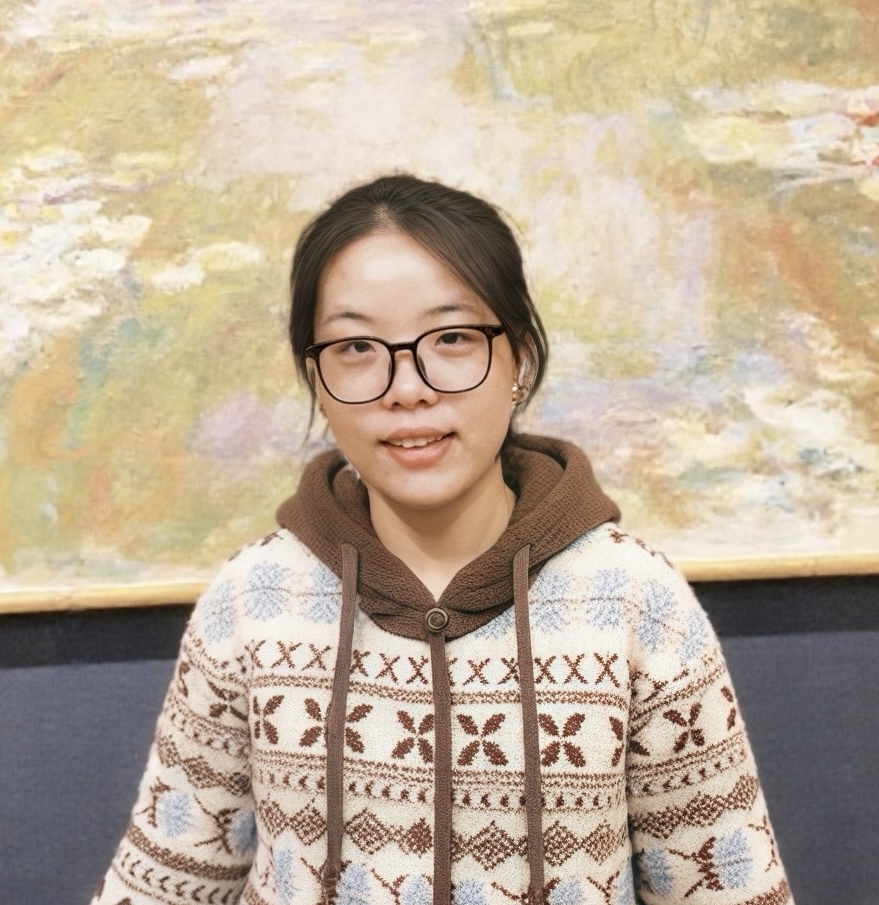
 Yu Wang
· 3 previous affiliations
- University of Wisconsin–MadisonSince 2025
- PhD student · Since 2025
- Current
- Peking University2022–2025
- MS student · 2022–2025
- Jilin University2018–2022
- Undergrad student · 2018–2022
50 other authors named Yu Wang: Yu Wang (Tsinghua University · 679 papers), Yu Wang (Tianjin University · 79 papers), Yu Wang (University of Oregon · Vanderbilt University · 77 papers), Yu Wang (Shanghai Jiao Tong University · 62 papers), Yu Wang (53 papers), and 45 more
Research Overview
Yu Wang focuses on robust semi-supervised learning, medical image analysis, and molecular representation learning. His trajectory spans from developing attention-based architectures for skin lesion segmentation to addressing out-of-distribution challenges in open-world learning environments. Most recently, his work investigates the application of diffusion models and large language models to scientific domains, specifically targeting structural dependencies and hallucination mitigation in molecular comprehension.
Research Trajectory
Yu Wang’s early research addressed challenges in medical image analysis, specifically focusing on the precise delineation of anatomical structures under interference. In 2022, he introduced Skin lesion segmentation with attention-based SC-Conv U-Net and feature map distortion, proposing a symmetrical encoder-decoder architecture that incorporates stepwise multi-scale inputs. By utilizing self-calibrated convolutions to capture broader contextual fields, this approach mitigated issues related to rough boundaries and the inaccurate segmentation of abnormally sized skin lesions.
Building on foundational work in feature extraction, his focus shifted toward the theoretical and practical challenges of learning from imperfect or unconstrained data. In 2023, he explored robust semi-supervised learning by addressing the often-overlooked problem of semantic-level corruption. He developed Out-of-Distributed Semantic Pruning for Robust Semi-Supervised Learning, a unified framework designed to prune out-of-distribution (OOD) semantics from in-distribution features. This method paired in-distribution samples with semantically overlapping OOD samples and applied a soft orthogonality regularization to improve model robustness.
Continuing this trajectory into unconstrained environments, he investigated the research direction of Open World Semi Supervised Learning, where unlabeled data contains entirely novel categories alongside known classes. This led to the publication of Discover and Align Taxonomic Context Priors for Open-world Semi-Supervised Learning. This work intersects with several broader methodological areas, including the area of Improving Unsupervised Learning Through Redundant Cluster Allocation and the research direction of Test Time Adaptation for Distribution Shift. By discovering and aligning taxonomic priors, the research also contributes to the broader area of Hierarchical Representations for Robust and Scalable Classification and work in the area of Hierarchical Knowledge Transfer for Zero Shot Generalization, providing structured approaches to managing novel categories in the wild.
More recently, Wang has applied advanced generative and foundational models to the domain of scientific discovery, particularly molecular representation learning. Recognizing that standard deep learning models often fail to capture the functional substructures of molecules, he collaborated on SubgDiff: A Subgraph Diffusion Model to Improve Molecular Representation Learning in 2024. This research advances the direction of Anisotropic Denoising for 3D Molecular Representation Learning by treating atoms not as independent points, but as organized, stable substructures within denoising diffusion probabilistic models.
Expanding on the intersection of artificial intelligence and chemistry, his 2025 collaborative work examines the reliability of large language models (LLMs) in scientific contexts. In How to Detect and Defeat Molecular Mirage: A Metric-Driven Benchmark for Hallucination in LLM-based Molecular Comprehension, he participated in analyzing the sources of hallucination—such as knowledge shortcuts—in LLMs tasked with molecular understanding. The study introduced Mol-Hallu, a free-form evaluation metric that quantifies hallucination based on scientific entailment, ensuring more reliable computational drug design and analysis.
Current Directions
Recent work investigates the application of advanced generative architectures and large language models to scientific discovery, with a primary focus on molecular comprehension. The most recent papers in the evidence address the structural realities of chemistry by modeling molecules as functional substructures rather than independent atoms, leveraging diffusion models to generate accurate 3D conformations. Concurrently, this research addresses the critical challenge of reliability in scientific AI. By analyzing knowledge shortcuts and developing metric-driven benchmarks, current efforts aim to quantify and mitigate hallucination in large language models, ensuring that computational tools for drug design and molecular analysis remain scientifically rigorous and dependable.
Profile updated
Loading new papers…
Other researchers whose papers cluster into the same research directions — a proxy for overlapping technical interests and shared intellectual neighborhoods.
See something wrong? Report a mistake