

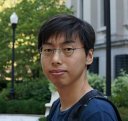
 Youngwoo Yoon
· 2 previous affiliations
- Principal Researcher · Since 2008
- PhD student · 2017–2022
Research Overview
Youngwoo Yoon focuses on human-computer interaction, autonomous social agents, and machine learning for robotics. His early work explored novel hardware interfaces before shifting toward the end-to-end generation of co-speech gestures for virtual avatars and humanoid robots. Most recently, he investigates standardized evaluation protocols for generative models and the integration of large language models into embodied task planning.
Research Trajectory
Yoon’s early research explored novel hardware interfaces for mobile devices. In Square: 3x3 keypad mapped to geometric elements of a square, he introduced a text entry device that mapped the nine keys of a standard keypad to the vertices, edges, and face of a single square button, leveraging distinct tactile properties to facilitate blind typing.
His focus subsequently shifted toward the development of autonomous social agents, particularly the synthesis of non-verbal behaviors for humanoid robots and virtual avatars. A central challenge in this domain is generating movements that align naturally with spoken language. Addressing the broader area of Modeling Idiosyncratic Motion in Talking Face Generation, he developed an end-to-end neural network model trained on hours of TED talks to synthesize iconic, metaphoric, deictic, and beat gestures directly from speech text in Robots Learn Social Skills: End-to-End Learning of Co-Speech Gesture Generation for Humanoid Robots. He expanded on this by incorporating multimodal inputs—text, audio, and speaker identity—to produce more reliable and individualized animations in Speech gesture generation from the trimodal context of text, audio, and speaker identity.
Recognizing that fully automated generation often lacks the precise control required by animators and interaction designers, Yoon sought to bridge automated synthesis with manual authoring. He introduced SGToolkit: An Interactive Gesture Authoring Toolkit for Embodied Conversational Agents, which combined neural generative models with an interactive interface, allowing designers to efficiently modify synthesized gestures. To support the data-intensive nature of these generative models, his group also developed methods to curate large-scale training data from in-the-wild sources, as detailed in A Tool for Extracting 3D Avatar-Ready Gesture Animations from Monocular Videos.
A significant portion of Yoon’s recent trajectory has been dedicated to establishing rigorous, standardized evaluation methodologies for generative models, contributing heavily to the research direction of Semantic Alignment in Co-speech Gesture Synthesis. He has been a key organizer and contributor to the GENEA (Generation and Evaluation of Non-verbal Behaviour for Embodied Agents) Challenges. This effort began with benchmarking data-driven co-speech gesture generation across multiple teams using standardized visualization pipelines and crowdsourced user studies, documented in The GENEA Challenge 2022: A large evaluation of data-driven co-speech gesture generation. The findings were further expanded in Evaluating Gesture Generation in a Large-scale Open Challenge: The GENEA Challenge 2022, which highlighted that while synthetic gestures can approach human-likeness, they frequently lack contextual appropriateness. Continuing this commitment to open evaluation, he oversaw the release of GENEA Challenge 2023 Human-Likeness subjective evaluation data. More recently, he addressed the broader crisis of evaluation in 3D gesture generation. In Gesture Generation (Still) Needs Improved Human Evaluation Practices: Insights from a Community-Driven State-of-the-Art Benchmark, he and his collaborators demonstrated that many published performance claims fail under disentangled human evaluation, advancing the research areas of Pairwise Evaluation Arenas for Generative Models and Standardized Evaluation Protocols for Machine Learning Research.
Parallel to his work on non-verbal behavior, Yoon has increasingly focused on the cognitive and physical capabilities of embodied agents, particularly in task planning and physical manipulation. To evaluate how well large language models function as high-level planners for robots, he co-developed LoTa-Bench: Benchmarking Language-oriented Task Planners for Embodied Agents, an open-source framework integrating LLMs with simulators to provide reproducible, quantitative metrics. He further addressed the limitations of monolithic LLM trajectories in complex environments by participating in the development of ReAcTree: Hierarchical LLM Agent Trees with Control Flow for Long-Horizon Task Planning, a method that decomposes goals into manageable subgoals handled by dynamic agent nodes. Extending his research into physical robotics and the area of Closing the Sim-to-Real Gap in Robotics, he explored multi-agent reinforcement learning in Learning Dexterous Bimanual Catch Skills Through Adversarial-Cooperative Heterogeneous-Agent Reinforcement Learning, where an adversarial "thrower" and a cooperative "catcher" interact to teach robots robust, two-handed catching skills.
Current Directions
The most recent papers in the evidence indicate a dual focus on rigorous evaluation methodologies for generative AI and the advancement of embodied agents through large language models and reinforcement learning. In the domain of social robotics, recent work investigates the critical need for standardized, community-driven benchmarks to accurately assess the human-likeness and semantic appropriateness of synthesized co-speech gestures. Concurrently, in the realm of physical and simulated robotics, current efforts address long-horizon task planning by structuring LLMs into hierarchical, dynamic trees, alongside adversarial-cooperative reinforcement learning frameworks designed to teach robots complex, dexterous physical skills such as bimanual catching.
Profile updated
Loading new papers…
Other researchers whose papers cluster into the same research directions — a proxy for overlapping technical interests and shared intellectual neighborhoods.
See something wrong? Report a mistake