

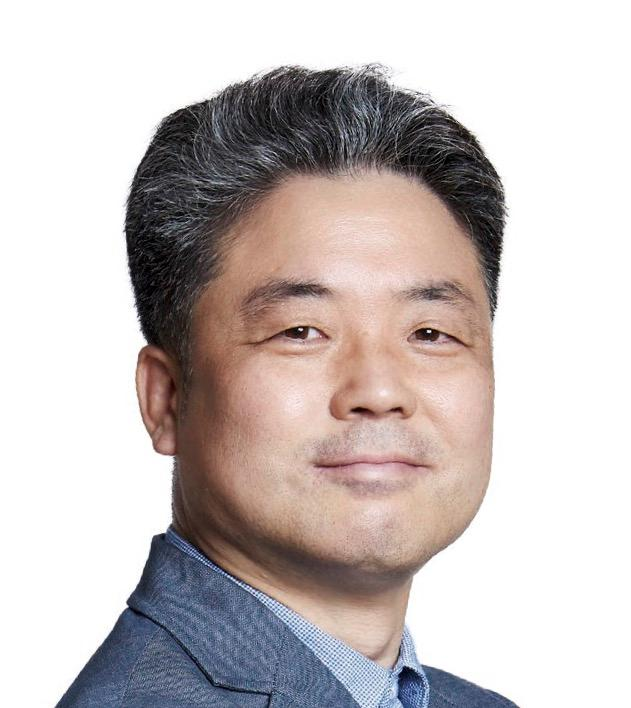
 Minsu Jang
· 4 previous affiliations
- Principal Researcher · Since 1999
- Current
- University of Science and TechnologySince 2022
- Professor · Since 2022
- Doctor of Philosophy (PhD), Artificial Intelligence · 2005–2015
- Sogang University1992–1994
- Master's degree, Artificial Intelligence · 1992–1994
Research Overview
Minsu Jang focuses on social human-robot interaction, the integration of foundation models into robotic systems, and intelligent task planning for embodied agents. His trajectory spans early work in ontology reasoning to extensive research in nonverbal behavior generation and human-care robotics. Recently, he investigates the application of large language models to hierarchical reasoning, uncertainty-aware planning, and adaptive assessment in autonomous systems.
Research Trajectory
His early research explored knowledge representation and semantic web technologies. He developed Bossam: An Extended Rule Engine for OWL Inferencing (2004), which introduced extended features to traditional rule engines to improve their representational simplicity and performance for OWL reasoning.
Transitioning toward human-robot interaction (HRI) and computer vision, he developed methods for Building an automated engagement recognizer based on video analysis (2014). This work established a data-driven pipeline for annotating social signals and classifying the engagement states of children interacting with robots. Expanding on social robotics, he participated in developing end-to-end neural network models for humanoid robots in Robots Learn Social Skills: End-to-End Learning of Co-Speech Gesture Generation for Humanoid Robots (2019). By training on extensive video datasets, the model successfully generated various human-like gestures directly from speech text, reducing the need for rule-based expert programming.
To support data-driven HRI, he contributed to large-scale datasets tailored for service robots. ETRI-Activity3D: A Large-Scale RGB-D Dataset for Robots to Recognize Daily Activities of the Elderly (2020) provided practical action categories captured from robot-view environments to assist in elderly care applications. Similarly, he collaborated on AIR-Act2Act: Human-human interaction dataset for teaching non-verbal social behaviors to robots (2021), which facilitated the teaching of responsive social behaviors. This focus on data-driven behavior culminated when he designed Nonverbal Social Behavior Generation for Social Robots Using End-to-End Learning (2022). By combining a Seq2Seq model with a Generative Adversarial Network, the system generated fluid, realistic robot motions from human interaction data, intersecting with the broader research direction of Bridging the Embodiment Gap in Robot Learning.
In 2023, his work addressed the formal evaluation of human-care robots. He oversaw research proposing the Social Robot Intelligence Quotient to Measure Human-Robot Interaction Performance for Human-Care Service Robots, a metric based on element intelligence quotients such as user modeling and self-expression. Concurrently, he guided an analysis of user satisfaction in An Analysis of Quality Attributes and Service Satisfaction for Artificial Intelligence-based Guide Robot, which evaluated quality attributes for AI guide robots and touched upon the broader area of modeling non-linear human preferences.
As large language models (LLMs) emerged as powerful reasoning engines, he began integrating them into robotic task planning. He integrated Belief-Desire-Intention (BDI) models into prompt design in A Structured Prompting based on Belief-Desire-Intention Model for Proactive and Explainable Task Planning (2023), enabling agents to generate goal-directed service plans while providing transparent rationales for their decisions. In 2024, he guided the creation of LoTa-Bench: Benchmarking Language-oriented Task Planners for Embodied Agents, an open-source framework for evaluating LLMs as high-level task planners in simulated environments. He also explored efficient adaptation of foundation models in Model Comparison for Fast Domain Adaptation in Table Service Scenario (2024), demonstrating that freezing a model's backbone and utilizing active learning outperforms using redundant datasets for specialized tasks. Furthering the reliability of LLM planners, he directed work on A Simple Baseline for Uncertainty-Aware Language-Oriented Task Planner for Embodied Agents (2024), which introduced mechanisms to quantify uncertainty and explore alternative execution paths.
Moving into 2025, his work addresses the complexities of long-horizon tasks and real-time responsiveness in embodied AI. He contributed to ReAcTree: Hierarchical LLM Agent Trees with Control Flow for Long-Horizon Task Planning, which decomposes complex goals into dynamic agent trees to improve multi-step reasoning and task recovery. To enhance real-time interaction, he co-authored Episode-Level Multimodal KV Caching for Embodied Question Answering, introducing caching methods that significantly reduce query latency. Concurrently, he continues to advance human-care applications, overseeing the development of Adaptive Robot-Mediated Assessment using LLM for Enhanced Survey Quality in Older Adults Care Programs, which integrates large language models to conduct context-aware, real-time satisfaction surveys.
Current Directions
The most recent papers in the evidence address the advanced integration of large language models into embodied agents, focusing on long-horizon planning, real-time multimodal processing, and adaptive human-robot interaction. Recent work investigates hierarchical architectures that decompose complex goals into manageable subgoals, allowing agents to reason, act, and backtrack during extended tasks. Additionally, current research explores computational efficiencies for embodied question answering—such as episode-level multimodal caching—to reduce latency for real-time robotic control. In the domain of human-care robotics, these foundation models are being applied to create adaptive, robot-mediated assessment systems that dynamically respond to user interactions in older adult care programs.
Profile updated
Loading new papers…
Other researchers whose papers cluster into the same research directions — a proxy for overlapping technical interests and shared intellectual neighborhoods.
See something wrong? Report a mistake