

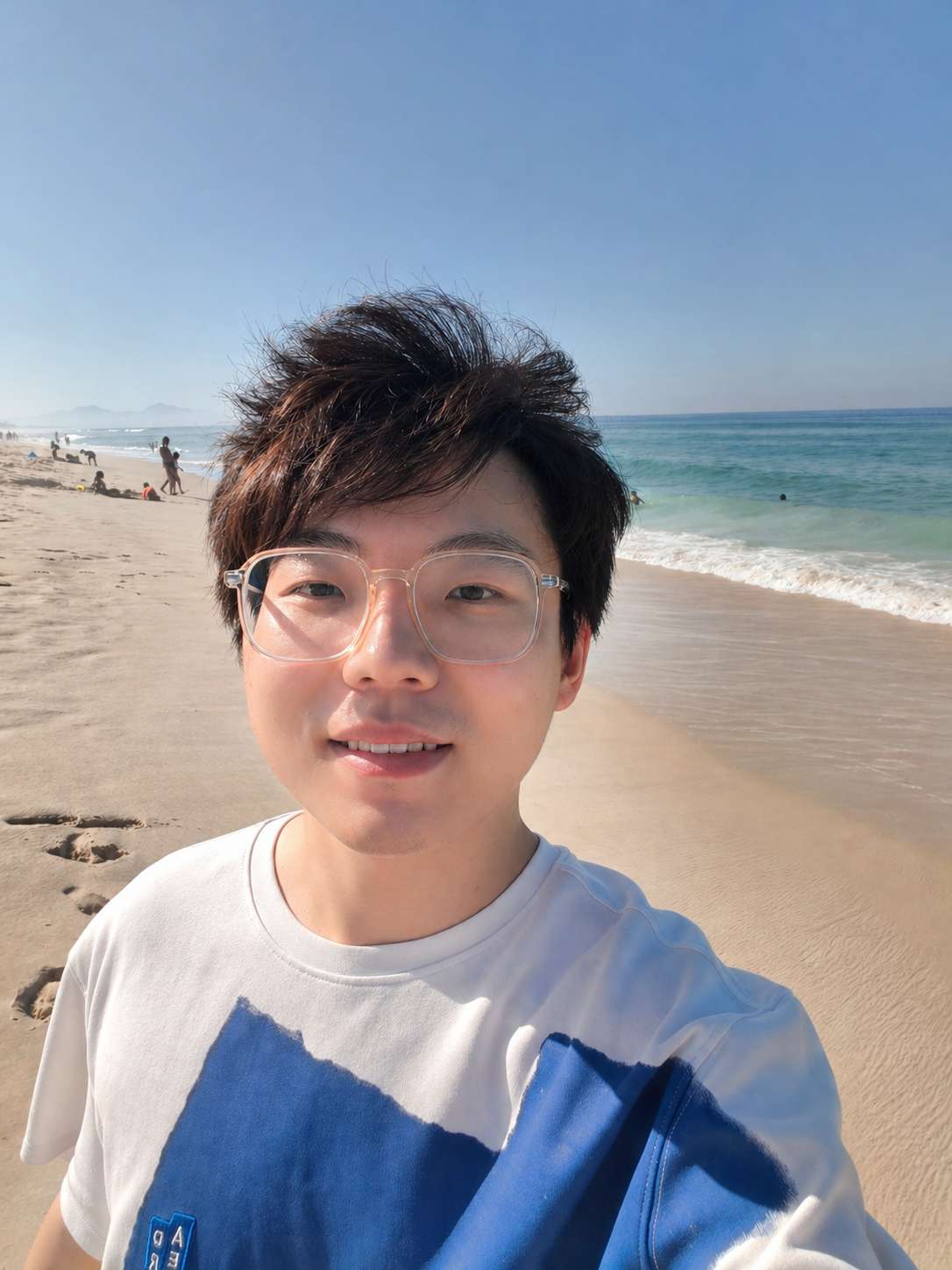
 Yifan Wang
· 1 previous affiliation
- Saarland UniversitySince 2023
- PhD student · 2023–2027
- Current
24 other authors named Yifan Wang: Yifan Wang (University of International Business and Economics · 111 papers), Yifan Wang (Tsinghua University · 60 papers), Yifan Wang (Dalian University of Technology · 44 papers), Yifan Wang (Robert Bosch (Germany) · 14 papers), Yifan Wang (Purdue University West Lafayette · 10 papers), and 19 more
Research Overview
Yifan Wang focuses on natural language processing, model explainability, and controllable text generation. His trajectory spans early work in machine translation and discourse structure to recent advancements in the interpretability and fairness of large language models. Currently, he investigates inherently interpretable neural architectures and the alignment of internal model representations with generated outputs.
Research Trajectory
Yifan Wang’s early research involved addressing data scarcity in natural language processing, specifically participating in the research direction of Neural Machine Translation for Low-Resource Languages. In Unsupervised Mandarin-Cantonese Machine Translation (2023), he contributed to the development of an unsupervised system that translated between Mandarin and Cantonese without relying on parallel training data. By constructing a one-million-sentence Cantonese monolingual corpus and utilizing character-level tokenization within a Transformer architecture, the research team achieved competitive translation metrics, intersecting with the broader area of Shared Semantic Spaces for Language Agnostic Retrieval.
That same year, his work explored the integration of explicit linguistic structures into neural networks for long-form text processing. He collaborated on Incorporating Distributions of Discourse Structure for Long Document Abstractive Summarization, which introduced RSTformer. This abstractive summarization model extended the Longformer architecture by incorporating both the types and the uncertainty of discourse relations derived from Rhetorical Structure Theory. The specialized attention mechanism allowed the model to better capture nuanced discourse, improving performance on long document summarization tasks.
Moving into 2024, Wang’s research expanded to address the area of Balancing Readability and Factual Integrity in Text Simplification. With collaborators, he presented SciNews: From Scholarly Complexities to Public Narratives - a Dataset for Scientific News Report Generation. This work provided a parallel corpus of academic publications and their corresponding news reports across nine scientific disciplines. The dataset was designed to facilitate the automated generation of accessible scientific narratives, and the accompanying analysis highlighted key divergences in readability and brevity between dense academic manuscripts and public-facing reports.
Concurrently, he developed methods for guiding language model outputs without requiring extensive retraining. He introduced RSA-Control: A Pragmatics-Grounded Lightweight Controllable Text Generation Framework, a training-free approach that directs text generation by recursively reasoning between imaginary speakers and listeners. This pragmatics-grounded framework includes a self-adjustable rationality parameter to dynamically modulate control strength based on context, ensuring that target attributes are correctly interpreted by listeners even amidst textual distractors.
In 2025, Wang’s focus shifted deeply into model interpretability, specifically contributing to the research direction of Neural Feature Alignment during Gradient Descent. Recognizing that post-hoc explanation methods for black-box models often struggle with faithfulness, he introduced B-cos LM: Efficiently Transforming Pre-trained Language Models for Improved Explainability. This work adapted B-cos networks—an architecture previously limited to computer vision that removes bias terms and promotes input-weight alignment—for natural language processing tasks. The approach effectively transforms pre-trained language models into inherently interpretable architectures that offer more reliable explanations.
He also participated in collaborative investigations probing the mathematical capabilities and internal logic of large language models. In Can LLMs subtract numbers?, the research team identified a specific failure mode in subtraction where pretrained models struggle to produce negative signs. The study revealed a disconnect between the models' internal representations—which correctly indicated a negative result—and their final outputs, a gap that instruction tuning largely corrected. This work contributed to the broader area of Aligning Internal Model Knowledge with External Token Generation.
Most recently, in 2026, Wang investigated the intersection of interpretability and algorithmic equity. He presented Bridging Fairness and Explainability: Can Input-Based Explanations Promote Fairness in Hate Speech Detection?, a systematic quantitative study evaluating whether input-based rationales can genuinely improve fairness. The findings demonstrated that while explanations are highly effective for identifying biased individual predictions and serving as training signals to reduce bias, they are surprisingly unreliable for selecting the fairest model from a pool of candidates.
Current Directions
The most recent papers in the evidence address the intersection of model explainability, algorithmic fairness, and the alignment of internal representations. Recent work investigates how inherently interpretable architectures can be adapted for natural language processing to provide faithful, input-based explanations without relying on unreliable post-hoc methods. Additionally, Wang explores the practical utility of these explanations in mitigating bias and promoting fairness in sensitive applications such as hate speech detection. Another active theme involves probing the internal logic of large language models to understand and correct disconnects between a model's internal knowledge and its generated tokens, particularly in structured reasoning and mathematical tasks.
Profile updated
Loading new papers…
Other researchers whose papers cluster into the same research directions — a proxy for overlapping technical interests and shared intellectual neighborhoods.
See something wrong? Report a mistake