

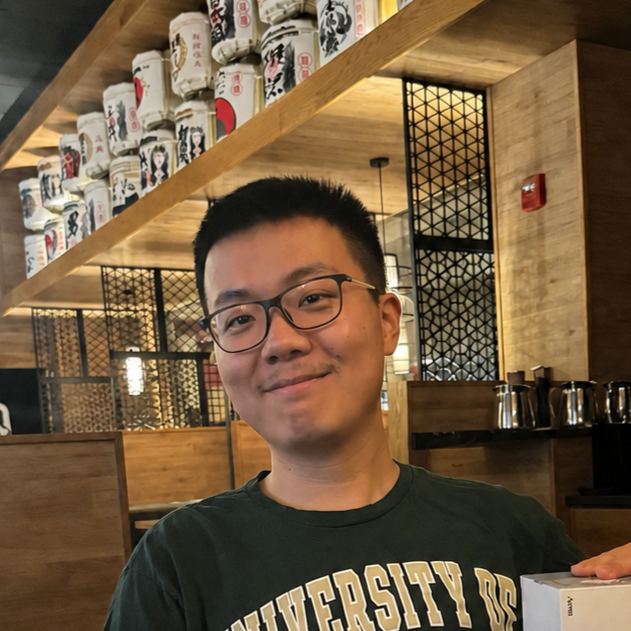
 Xiyang Wu
· 6 previous affiliations
- University of Maryland, College ParkSince 2021
- PhD student · 2021–2026
- Graduate Research Assistant · Since 2023
- Graduate Teaching Assistant · 2021–2025
- NEC (United States)Since 2026
- PhD Research Intern · Since 2026
- PhD Research Intern · 2025
- Emory University2021
- Graduate Research Assistant · 2021
- Georgia Institute of Technology2019–2021
- MS student · 2019–2021
- Graduate Research Assistant · 2020
- Tianjin University2015–2019
- Undergrad student · 2015–2019
Research Overview
Xiyang Wu focuses on multi-modal foundation models, embodied artificial intelligence, and agentic decision-making. His early work explored multi-agent reinforcement learning and intent-aware planning for autonomous systems in complex environments. More recently, his research addresses hallucination detection and mitigation in vision-language models, emphasizing robust physical reasoning and the safe integration of large language models into robotic control.
Research Trajectory
The early phase of his research centered on multi-agent systems, simulation, and autonomous planning. In 2020, he introduced FireCommander: An Interactive, Probabilistic Multi-agent Environment for Joint Perception-Action Tasks, a framework designed to evaluate heterogeneous robot teams. This work contributed directly to the research direction of Reinforcement Learning for Heterogeneous Agent Teams, as well as the areas of Modeling Information Decay in Dynamic Environments and Simulating Autonomy Through Wizard of Oz Prototyping.
Building on his expertise in autonomous systems, his focus expanded to include complex traffic navigation and industrial perception. He developed iPLAN, a distributed multi-agent reinforcement learning algorithm detailed in Intent-Aware Planning in Heterogeneous Traffic via Distributed Multi-Agent Reinforcement Learning. This approach enables autonomous vehicles to infer the hidden intents and behavioral incentives of nearby drivers relying solely on local observations. During this period, he also participated in research on high-speed industrial inspection, contributing to A novel image registration-based dynamic photometric stereo method for online defect detection in aluminum alloy castings, which adapted traditional static photometric stereo techniques for dynamic, online environments.
Bridging perception and natural language, he began exploring how foundational models can inform physical agents. With collaborators, he developed LANCAR: Leveraging Language for Context-Aware Robot Locomotion in Unstructured Environments, a framework that translates human language descriptions of terrain into actionable embeddings, significantly improving robotic navigation in complex, off-road scenarios. This interest in the intersection of language models and physical embodiment naturally extended to safety and reliability, contributing to the broader area of Linguistic Brittleness in Vision Language Models. This is evident in his work on On the Vulnerability of LLM/VLM-Controlled Robotics, which examines the robustness and potential failure modes of integrating large language and vision-language models into robotic control pipelines.
By 2025, his research heavily emphasized the evaluation, reasoning capabilities, and alignment of Large Vision Language Models (VLMs). He provided a comprehensive overview of the field's rapid advancements and ongoing challenges in A Survey of State of the Art Large Vision Language Models: Benchmark Evaluations and Challenges. A major theme of this recent work is grounding VLMs in physical reality and mitigating their tendency to rely on linguistic shortcuts rather than genuine visual evidence. To this end, he introduced MASS: Motion-Aware Spatial-Temporal Grounding for Physics Reasoning and Comprehension in Vision-Language Models. This work translates physical-world context cues into interpretable representations to improve physics-driven reasoning, accompanied by the MASS-Bench dataset for evaluating physics-related comprehension in both real and AI-generated videos. To further address model reliability, he co-developed VideoHallu: Evaluating and Mitigating Multi-modal Hallucinations on Synthetic Video Understanding, a benchmark of synthetic videos designed to expose hallucinations where models defy physics or common sense, utilizing reinforcement learning on negative-control data to improve visual reasoning.
His collaborative efforts in 2025 also span text generation, video customization, and fine-grained visual reasoning. He contributed to the area of Verbosity Bias in Preference Learning through Semantically-Aware Rewards for Open-Ended R1 Training in Free-Form Generation, which introduces PrefBERT, a lightweight reward model that provides semantically-aware feedback for reinforcement learning, allowing smaller models to avoid the verbosity bias common in larger reward systems. In the domain of video generation, he participated in First Frame Is the Place to Go for Video Content Customization, demonstrating that models implicitly use the first frame as a conceptual memory buffer, enabling robust customization with minimal training examples. Finally, advancing the research direction of High-Level Semantic Integration for Visual Saliency, he contributed to CaughtCheating: Is Your MLLM a Good Cheating Detective? Exploring the Boundary of Visual Perception and Reasoning, a benchmark testing the limits of multi-modal models in subtle visual perception tasks, such as identifying minute visual contradictions in an image.
Continuing into 2026, Wu expanded into evidence grounding in video reasoning and persistent recovery mechanisms for interactive agents. In ASSEMBLE: Atomic Skills for Evidence-Grounded Video Reasoning, Wu introduced a framework that structures long-video reasoning into timestamped evidence catalogs and atomic skills, using Group Relative Policy Optimization to jointly optimize answer accuracy and citation alignment. Addressing multi-step decision-making, Wu also developed Failure Recovery via Belief Updates and World Modeling for Long-Horizon Agents, proposing BELIEFWEAVER to maintain relational belief states across execution attempts alongside an implicit world model that guides exploration and distills prospective reasoning into compact student models.
Current Directions
The most recent papers in the evidence indicate a strong focus on the reasoning capabilities and reliability of Multi-Modal Large Language Models (MLLMs). Current work investigates how to ground these models in physical reality, moving beyond surface-level linguistic pattern matching to achieve robust spatial-temporal and physics-based reasoning. This involves developing specialized benchmarks—such as those utilizing synthetic, physics-defying videos or requiring fine-grained visual detective work—to expose and mitigate multi-modal hallucinations. Additionally, recent efforts explore explicit evidence grounding in complex video reasoning through reinforcement learning, as well as belief-updating world models that allow long-horizon agents to diagnose and recover from multi-step execution failures.
Profile updated
Loading new papers…
Other researchers whose papers cluster into the same research directions — a proxy for overlapping technical interests and shared intellectual neighborhoods.
See something wrong? Report a mistake