

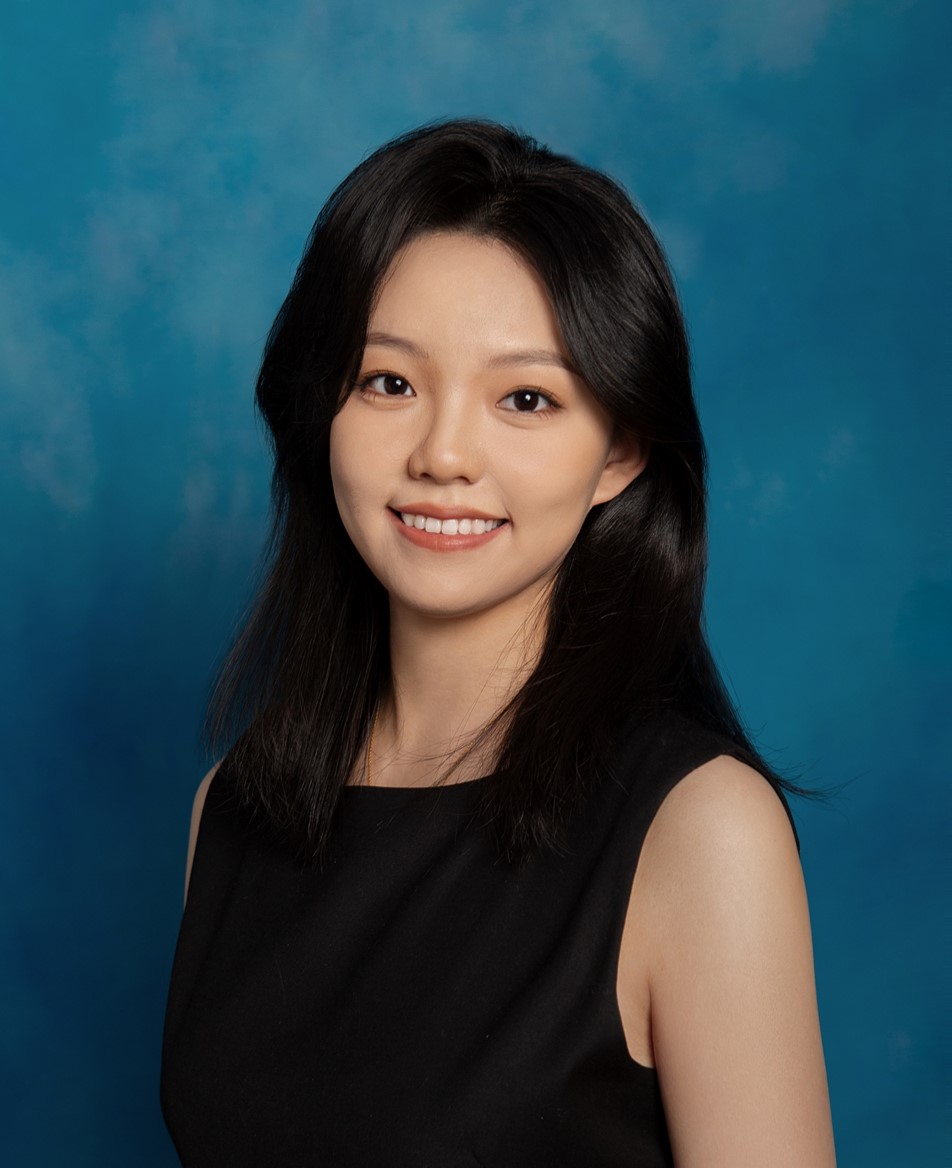
 Xinyu Liu
· 2 previous affiliations
- PhD student · 2024–2028
- Current
- Xidian University2016–2023
- MS student · 2020–2023
- Undergrad student · 2016–2020
10 other authors named Xinyu Liu: Xinyu Liu (Imperial College London · 175 papers), Xinyu Liu (University of Virginia · 8 papers), Xinyu Liu (4 papers), Xinyu Liu (Nanjing University · 1 paper), Xinyu Liu (Carnegie Mellon University · 1 paper), and 5 more
Research Overview
Xinyu Liu focuses on generative modeling, unified multimodal systems, and efficient visual reasoning. His research addresses the generation-understanding gap in multimodal large language models and explores high-resolution image and video synthesis. Recently, his work emphasizes reason-informed video editing and self-improvement frameworks for unified multimodal architectures.
Research Trajectory
His early work in 2023 addressed core challenges in computer vision and autonomous systems. He introduced spectral methods to bridge the gap between image-level language descriptions and dense shape delineation in Delving into Shape-aware Zero-shot Semantic Segmentation. In parallel, he collaborated on ADAPT: Action-aware Driving Caption Transformer, developing an end-to-end architecture that provides natural language narrations to improve the interpretability of autonomous driving decisions.
In 2024, his research expanded into 3D perception and generative modeling. He participated in adapting indoor 3D dense captioning techniques to outdoor LiDAR point clouds in TOD3Cap: Towards 3D Dense Captioning in Outdoor Scenes. Exploring the reliability of complex agent architectures, he contributed to the area of Post-Generation Safety Auditing for Large Language Models and the study of Cascading Failures in Multi-Agent Language Model Networks through the development of AgentMonitor: A Plug-and-Play Framework for Predictive and Secure Multi-Agent Systems. Concurrently, he addressed challenges in high-fidelity image synthesis, introducing HiPrompt: Tuning-free Higher-Resolution Generation with Hierarchical MLLM Prompts. This work advanced the research direction of Resolution Agnostic Generative Models for Arbitrary Scale Synthesis by leveraging multimodal large language models to generate hierarchical prompts, enabling pretrained diffusion models to produce 4K images without object repetition artifacts.
By 2025, a major theme of his work became the unification of understanding and generation capabilities within multimodal large language models (MLLMs). He identified and addressed the "do as I say, not as I do" phenomenon in Self-Contradiction as Self-Improvement: Mitigating the Generation-Understanding Gap in MLLMs. This framework utilized a model's superior understanding capabilities to grade its own weaker generations, contributing to the broader area of Iterative Self-Preference Optimization for Language Models. He further explored these cognitive bottlenecks by co-authoring From Perception to Cognition: A Survey of Vision-Language Interactive Reasoning in Multimodal Large Language Models, which mapped out multi-step logical reasoning and touched upon directions such as Heterogeneous Vision Encoders for Multimodal Large Language Models and Iterative Visual Reasoning via Active Perception. In 2026, he continued this trajectory by participating in Turning Internal Gap into Self-Improvement: Promoting the Generation-Understanding Unification in MLLMs, which formalized a virtuous cycle for simultaneous task improvement without external supervision.
Alongside his work on MLLM architectures, he maintained an active focus on dynamic scene understanding and video generation. As principal investigator, he guided the development of OOTSM: A Decoupled Linguistic Framework for Effective Scene Graph Anticipation, predicting the evolution of relationships in visual scenes. He also advanced generative video capabilities, introducing VFX Creator: Animated Visual Effect Generation with Controllable Diffusion Transformer to provide precise spatial and temporal control over complex visual effects. Extending this control to semantic editing, he developed ReViSE: Towards Reason-Informed Video Editing in Unified Models with Self-Reflective Learning, bridging the disconnect between a model's reasoning capacity and its visual transformation skills. Additionally, his collaborative efforts in 3D perception continued with LiON: Learning Point-Wise Abstaining Penalty for LiDAR Outlier DetectioN Using Diverse Synthetic Data.
Current Directions
The most recent papers in the evidence address the fundamental disconnect between perception, reasoning, and generation in unified multimodal models. Current work investigates self-improvement frameworks that leverage a model's internal understanding capabilities to supervise and refine its generative outputs, effectively turning architectural gaps into self-correction mechanisms. Additionally, ongoing research focuses on reason-informed video editing and controllable diffusion transformers, seeking to ground complex visual transformations in robust, multi-step logical reasoning.
Profile updated
Loading new papers…
Other researchers whose papers cluster into the same research directions — a proxy for overlapping technical interests and shared intellectual neighborhoods.
See something wrong? Report a mistake