

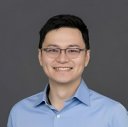
 Wen-Sheng Chu
· 3 previous affiliations
- Google (United States)Since 2018
- Research Scientist · Since 2018
- Apple (United States)2017–2018
- Research Scientist · 2017–2018
- Carnegie Mellon University2011–2017
- PhD student · 2011–2017
Research Overview
Wen-Sheng Chu focuses on computer vision, generative modeling, and on-device perception systems. His early research established foundational methods for automated facial analysis and video understanding, addressing challenges in expression recognition and temporal modeling. His current work investigates advanced generative diffusion models, multimodal reasoning, and dynamic vision-language architectures.
Research Trajectory
In the early 2010s, Chu’s research centered on robust facial analysis and video understanding, particularly in unconstrained environments. He addressed the limitations of rigid preprocessing pipelines with Identifying Gender from Unaligned Facial Images by Set Classification (2010), proposing a subspace-based approach that extracted random image patches to accurately classify gender without requiring precise face alignment. Expanding into temporal media, he developed Unsupervised Temporal Commonality Discovery (2012), which introduced an efficient branch-and-bound algorithm to find semantic temporal patterns across multiple videos without exhaustive quadratic search. He later applied related co-occurrence principles to video condensation in Video co-summarization: Video summarization by visual co-occurrence (2015), utilizing a maximal biclique finding algorithm to identify and extract sparsely co-occurring visual concepts across topic-related videos.
A major thematic arc in Chu’s trajectory involves the automated detection of Facial Action Units (AUs) and expressions. Recognizing that generic classifiers often fail to generalize across diverse facial morphologies, he introduced the Selective Transfer Machine for Personalized Facial Action Unit Detection (2013). This work personalized generic classifiers by simultaneously re-weighting training samples and learning a subject-specific classifier, an approach he later formalized and expanded in Selective Transfer Machine for Personalized Facial Expression Analysis. (2017).
As deep learning transformed computer vision, Chu integrated neural architectures into his facial analysis research. He developed Joint patch and multi-label learning for facial action unit detection (2015), a framework that simultaneously identified informative local facial regions and exploited natural correlations between muscle movements, contributing to the research direction of Modeling the Temporal Evolution of Facial Expressions. He advanced this paradigm with Deep Region and Multi-label Learning for Facial Action Unit Detection (2016), introducing a novel "region layer" that bridged global convolutions and locally connected layers to efficiently capture where AUs occur and how they correlate. To overcome the bottleneck of requiring expert annotations for these models, he collaborated on Learning Facial Action Units From Web Images With Scalable Weakly Supervised Clustering (2018). This work utilized a weakly-supervised spectral algorithm to learn an embedding space from inaccurately annotated web images, advancing the area of Refining Labels via Local Feature Space Consistency.
In recent years, Chu’s focus has shifted toward complex generative models, inverse problems, and multimodal architectures. Addressing the computational challenges of sampling from posterior distributions in latent diffusion models, his group presented Beyond First-Order Tweedie: Solving Inverse Problems using Latent Diffusion (2024). The paper introduced a Second-order Tweedie sampler from Surrogate Loss (STSL), enabling tractable reverse processes with second-order approximations, a contribution in the broader area of Matrix-Free Curvature Estimation for Deep Learning. Continuing in the generative space, he developed RB-Modulation: Training-Free Stylization using Reference-Based Modulation (2025). By framing image generation as a control problem, this plug-and-play framework steers diffusion models toward desired styles without content leakage, aligning with the research direction of Generative Diffusion as Stochastic Optimal Control. Similarly, Semantic Image Inversion and Editing using Rectified Stochastic Differential Equations (2025) introduced a zero-shot framework for image inversion using Rectified Flow models, achieving high faithfulness and editability without test-time optimization.
Chu has also made recent contributions to multimodal reasoning and foundational perception. To address the redundancy and computational cost of long-form video, he collaborated on SEAL: Semantic Attention Learning for Long Video Representation (2025). In the domain of reasoning, Mull-Tokens: Modality-Agnostic Latent Thinking (2025) introduced a multimodal scratchpad that allows AI models to perform intermediate computations in a latent space, significantly boosting performance on visual puzzles. He further explored dynamic architectures in Language-Instructed Vision Embeddings for Controllable and Generalizable Perception (2026), transforming static vision encoders into instruction-following modules that reduce visual hallucinations. His recent work also includes Marginalized Bundle Adjustment: Multi-View Camera Pose from Monocular Depth Estimates (2026), which leverages dense depth maps to estimate camera poses in 3D vision, and Differences That Matter: Auditing Models for Capability Gap Discovery and Rectification (2026), an automated reinforcement learning framework designed to systematically uncover and rectify the blind spots of Multimodal Large Language Models. Chu also participated in developing WorldLatent: A Unified 4D Latent Space for World Perception and Generation (2026), which introduces a multimodal VAE architecture fusing 4D visual appearance, geometry, and dynamics into a shared latent space for complementary perception and generation via unified denoising processes.
Current Directions
Recent work investigates the intersection of multimodal reasoning, controllable generative modeling, and robust perception systems. A major focus involves enhancing vision-language models through dynamic, instruction-following architectures and modality-agnostic latent reasoning. This includes developing mechanisms that allow models to perform complex intermediate computations in a latent space, freeing them from the constraints of strictly text-based or image-based tokens.
Additionally, ongoing research addresses the control and inversion of diffusion and flow-based models. By framing image generation and editing as stochastic optimal control problems, these efforts aim to achieve precise stylization and zero-shot inversion without the need for costly test-time optimization or fine-tuning. Finally, recent efforts continue to advance foundational perception and spatial intelligence tasks, including the efficient representation of long-form video content, unified 4D latent spaces bridging world perception and generation, and multi-view camera pose estimation leveraging monocular depth priors.
Profile updated
Loading new papers…
Other researchers whose papers cluster into the same research directions — a proxy for overlapping technical interests and shared intellectual neighborhoods.
See something wrong? Report a mistake