

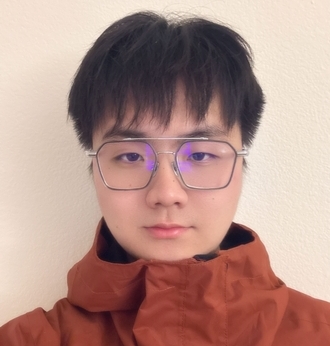
 Weikang Wan
· 5 previous affiliations
- University of California San DiegoSince 2024
- PhD student · Since 2024
- Nvidia (United States)2023–2025
- Research Intern · 2023–2025
- Visiting Student · 2024
- Peking University2020–2024
- Undergrad student · 2020–2024
- Carnegie Mellon University2023–2024
- Visiting Student · 2023–2024
Research Overview
Weikang Wan focuses on machine learning, robotics, and computer vision, with an emphasis on developing methods that enable robots to learn complex manipulation skills from minimal human supervision. His trajectory spans from category-level object manipulation and universal dexterous grasping to differentiable trajectory optimization. Recently, his work investigates long-horizon bimanual coordination and scalable synthetic data generation for embodied AI.
Research Trajectory
Weikang Wan’s early research addressed the foundational challenges of understanding and replicating human-object interactions. In 2022, he participated in the development of HOI4D: A 4D Egocentric Dataset for Category-Level Human-Object Interaction, a large-scale collection of egocentric videos featuring rich annotations such as panoptic segmentation, 3D hand poses, and reconstructed object meshes. This dataset was designed to catalyze research in category-level interaction from 4D visual signals. Building on the need for generalized robotic capabilities, he collaborated on Learning Category-Level Generalizable Object Manipulation Policy via Generative Adversarial Self-Imitation Learning from Demonstrations. This work tackled the difficulty of learning manipulation policies for geometrically diverse articulated objects, utilizing a task-agnostic imitation learning approach that relies only on terminal rewards rather than dense, handcrafted signals.
In 2023, his focus expanded significantly into dexterous robotic grasping. He helped develop UniDexGrasp: Universal Robotic Dexterous Grasping via Learning Diverse Proposal Generation and Goal-Conditioned Policy, a pipeline that splits the grasping task into probabilistic pose generation and goal-conditioned execution. This work contributes to several broader research areas, including the direction of Functional Grasp Synthesis for Robotic Manipulation, the area of Privileged Information Distillation for Sim-to-Real Policy Transfer, work in Robotic Manipulation of Deformable Materials, and the research direction of High Dimensional Search for Dexterous Robotic Grasping. To further refine these vision-based policies across thousands of object instances, he subsequently proposed UniDexGrasp++: Improving Dexterous Grasping Policy Learning via Geometry-aware Curriculum and Iterative Generalist-Specialist Learning, which leveraged geometric task features to significantly improve grasping success rates and generalizability.
Moving into 2024, his research began to integrate continual learning and advanced trajectory optimization into robotic control. He developed LOTUS: Continual Imitation Learning for Robot Manipulation Through Unsupervised Skill Discovery, an algorithm that constructs an ever-growing skill library from unstructured demonstrations. By using an open-vocabulary vision model to extract recurring patterns, LOTUS enables physical robots to learn new tasks throughout their lifespan without catastrophic forgetting. In parallel, he introduced a novel policy representation for control, detailed in DiffTORI: Differentiable Trajectory Optimization for Deep Reinforcement and Imitation Learning and its preprint version DiffTOP: Differentiable Trajectory Optimization for Deep Reinforcement and Imitation Learning. This approach advances the area of Decision Aware Model Based Reinforcement Learning by allowing the cost and dynamics functions of trajectory optimization to be learned end-to-end, directly addressing the objective mismatch issue common in prior model-based reinforcement learning.
By 2025, his work increasingly targeted long-horizon tasks, spatial intelligence, and the scaling of robotic data. He contributed to Na Vid-4D: Unleashing Spatial Intelligence in Egocentric RGB-D Videos for Vision-and-Language Navigation, which utilizes a Vision Language Model to perform spatial reasoning and generate precise instruction-following actions from egocentric RGB-D streams. To address the complexities of multi-arm coordination, he designed Learning to Plan & Schedule with Reinforcement-Learned Bimanual Robot Skills. This hierarchical framework frames contact-rich bimanual manipulation as an integrated planning and scheduling problem, using a Transformer-based planner to orchestrate primitive skills trained via reinforcement learning.
Recognizing the data bottleneck in complex manipulation, he proposed LodeStar: Long-horizon Dexterity via Synthetic Data Augmentation from Human Demonstrations, a system that decomposes human demonstrations into semantic skills and generates diverse synthetic datasets through reinforcement learning. He also participated in creating DexMimicGen: Automated Data Generation for Bimanual Dexterous Manipulation via Imitation Learning, an automated system that synthesizes massive training datasets from minimal human input to enable real-world bimanual deployment. Finally, he was part of a team that introduced Scaling Cross-Embodiment World Models for Dexterous Manipulation, which represents human and robot hands as sets of 3D particles, allowing robots with entirely different morphologies to share training data and transfer skills effectively.
In 2026, Wan introduced DexFLEX: Contact-Aware Foundation Controller for Command-Guided Dexterity, a foundation controller that translates upstream fingertip-motion drafts into contact-consistent joint commands using a Draft-Dream-Select procedure to preserve contact stability across teleoperation and visuomotor policy learning. Wan also contributed to EgoThumb: A Vision-Driven Supernumerary Robotic Thumb for Autonomous Grasp and Holding Assistance, an open-source, tendon-driven supernumerary finger powered by an egocentric visual imitation learning policy, aiding research in Overcoming Visual Self Occlusion in Robotic Manipulation.
Current Directions
The most recent papers in the evidence address the challenges of scaling robot learning for complex, long-horizon tasks and cross-embodiment control. Recent work investigates automated data generation pipelines that synthesize massive demonstration datasets from minimal human input, particularly to overcome the data bottlenecks in bimanual dexterous manipulation. Additionally, current research explores cross-embodiment world models that allow robots with distinct hand designs and morphologies to share training data. This is complemented by the development of contact-aware foundation controllers for command-guided dexterity and vision-driven supernumerary robotic limbs to augment manipulation capabilities.
Profile updated
Loading new papers…
Other researchers whose papers cluster into the same research directions — a proxy for overlapping technical interests and shared intellectual neighborhoods.
See something wrong? Report a mistake