

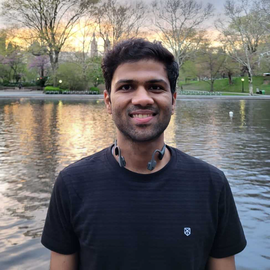
 Vidit Goel
· 3 previous affiliations
- Snap Inc.Since 2023
- Researcher · Since 2023
- Picsart AI Research2021–2023
- Researcher · 2021–2023
- MS student · 2016–2021
Research Overview
Vidit Goel focuses on computer vision, generative modeling, and video instance segmentation. His early work addressed object tracking and continuous representations for video dynamics, before shifting toward fine-grained control in image and video diffusion models. His most recent research investigates 4D scene generation and object-centric manipulation in generative artificial intelligence.
Research Trajectory
Goel’s early research concentrated on the challenges of tracking and segmenting objects across video frames. In 2021, as first author, he introduced MSN: Efficient Online Mask Selection Network for Video Instance Segmentation. This work addressed the accumulation of noise in mask tracking by employing a patch-based convolutional neural network to evaluate and select the most accurate segmentation masks in an online manner. This approach aligned with the broader research direction of Image Segmentation as Mask Classification, moving away from strictly per-pixel classification toward more robust instance-level mask generation and temporal consistency.
In 2022, Goel’s focus expanded to include continuous representations of visual data, addressing the limitations of fixed-resolution grid-based models. He contributed to the area of Continuous Neural Representations for Video Dynamics and themes such as Arbitrary-Scale Super-Resolution via Implicit Neural Representations. As a co-author on VideoINR: Learning Video Implicit Neural Representation for Continuous Space-Time Super-Resolution, he participated in developing a framework that models video as a continuous function in space and time, rather than a discrete sequence of frames. This allowed for flexible, arbitrary-scale upsampling that traditional discrete representations struggle to achieve.
Building on his expertise in video segmentation and temporal dynamics, Goel explored more complex object extraction tasks. In 2023, he was second author on Video Instance Matting, which introduced a novel task extending beyond binary background removal to extract high-quality, time-consistent alpha mattes for multiple overlapping instances in a video. This work required sophisticated handling of temporal information, contributing to the area of Hybrid Temporal Modeling for Local and Global Dependencies. Around this time, Goel transitioned to an industry role as a Machine Learning Engineer at Snap Inc.
By 2024, Goel’s primary research focus shifted toward generative artificial intelligence, specifically the fine-grained control of diffusion models for image and video editing. As first author of PAIR Diffusion: A Comprehensive Multimodal Object-Level Image Editor, he proposed a framework that treats images as an amalgamation of distinct objects, allowing users to independently manipulate the structure and appearance of specific elements without altering the broader scene. He subsequently extended these principles to the temporal domain as second author on VASE: Object-Centric Appearance and Shape Manipulation of Real Videos. This work tackled the research direction of Overcoming Structural Rigidity in Video Diffusion Editing, providing a mechanism to execute precise structural modifications on moving objects while maintaining temporal consistency across frames.
Current Directions
The most recent papers in the evidence indicate a growing focus on 3D and 4D scene generation, as well as the ethical deployment of generative models. Recent work investigates the synthesis of high-quality, dynamic 4D scenes from text prompts or single images. This involves leveraging video diffusion models and feedforward reconstruction techniques to predict 3D Gaussian Splatting, enabling the efficient creation of wide-scope environments and navigable scenes. To achieve this, recent architectures explore fused view-time attention mechanisms that process spatial and temporal data simultaneously within a single sparse layer, rather than relying on traditional sequential processing.
Additionally, Goel has recently contributed to research on fairness in generative AI. This work addresses open-set bias detection, proposing automated pipelines to identify and quantify biases in text-to-image models agnostically, without relying on precompiled lists of known concepts.
Profile updated
Loading new papers…
Other researchers whose papers cluster into the same research directions — a proxy for overlapping technical interests and shared intellectual neighborhoods.
See something wrong? Report a mistake