

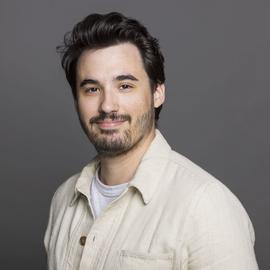
 Tony Bonnaire
· 2 previous affiliations
- Université Paris-SaclaySince 2025
- Researcher · Since 2025
- PhD student · 2018–2021
- École Normale Supérieure - PSL2021–2025
- AI Fellow · 2022–2025
- Postdoc · 2021–2022
Research Overview
Tony Bonnaire focuses on the intersection of statistical physics, generative artificial intelligence, and precision cosmology. His early work developed graph-based algorithms and non-Gaussian statistics to extract cosmological information from the cosmic web. Currently, he investigates the theoretical foundations of machine learning, using tools from physics to understand generalization, memorization, and optimization dynamics in diffusion models and high-dimensional landscapes.
Research Trajectory
Bonnaire’s early research focused on extracting structural and cosmological information from large-scale astrophysical data. He developed computational methods to identify and analyze the cosmic web, the vast network of structures connecting galaxies. In T-ReX: a graph-based filament detection method, he and his collaborators introduced an algorithm combining Minimum Spanning Trees and Gaussian Mixture Models to map the filamentary highways of the universe robustly, even in noisy or sparse datasets. This interest in robust structural extraction extended to general machine learning contexts, as seen in Regularization of Mixture Models for Robust Principal Graph Learning. In this work, topological priors and explicit noise components were embedded into the Expectation-Maximization algorithm to learn principal graphs from highly noisy and heteroscedastic data. Around the same time, he explored hierarchical data organization in Cascade of phase transitions for multiscale clustering, leveraging the phase transitions observed during simulated annealing to automatically discover multi-scale structures without prior assumptions about the number of clusters.
Building on these structural identification techniques, Bonnaire led a series of studies demonstrating that segmenting the universe into distinct environments—voids, walls, filaments, and nodes—can significantly improve cosmological constraints. This work, contributing to the broader area of Beyond Two-Point Statistics in Cosmological Inference, was detailed across three major papers. Cosmology with cosmic web environments I. Real-space power spectra showed how environment-specific power spectra could break statistical degeneracies and tightly constrain parameters like neutrino mass. He extended this framework to observable redshift space in Cosmology with cosmic web environments II. Redshift-space auto and cross power spectra, achieving substantial improvements over standard methods. The culmination of this methodology was presented in Cosmology with cosmic web environments, solidifying the use of environmental decomposition to extract critical evolutionary parameters from galaxy surveys.
In recent years, Bonnaire’s trajectory has shifted toward the theoretical foundations of artificial intelligence, utilizing tools from statistical physics to analyze high-dimensional optimization and generative models. In Dynamical regimes of diffusion models, he participated in research revealing that the generative process in diffusion models transitions through distinct phases: pure noise, speciation (selecting a data category), and collapse (memorizing specific training points). This work intersects with research directions such as Spectral Hierarchy and Feature Emergence in Diffusion Models and Symmetry Breaking in Generative Diffusion.
He further investigated the mechanics of generalization in Why Diffusion Models Don’t Memorize: The Role of Implicit Dynamical Regularization in Training. This study demonstrated that a natural "generalization window" emerges during training because the timescale for generating high-quality samples remains constant, while the timescale for memorization scales linearly with dataset size. This finding provides a mechanistic understanding of implicit regularization, advancing the area of Phase Transitions and Abrupt Learning Dynamics.
Expanding his theoretical focus to associative memory, he authored On the role of non-linear latent features in bipartite generative neural networks. This paper bridges the physics of disordered systems and generative learning to analyze the memory capacity of Restricted Boltzmann Machines, contributing to the fields of Scaling Associative Memory with Higher Order Interactions and Overcoming the Capacity Wall in Associative Memory. Additionally, he examined the fundamental mechanics of gradient descent in rough landscapes in The role of the time-dependent Hessian in high-dimensional optimization, identifying dynamical transitions in the Hessian's spectral properties during phase retrieval tasks and relating them to the algorithm's ability to escape rough regions in the loss landscape.
Current Directions
The most recent papers in the evidence address the theoretical underpinnings of machine learning through the lens of statistical physics. Current work investigates how generalization emerges in highly overparameterized generative systems, particularly diffusion models, by analyzing their training dynamics, timescales, and phase transitions. Additionally, recent research explores the optimization trajectories of gradient descent in high-dimensional, non-convex landscapes by tracking the spectral properties of the time-dependent Hessian. Another active theme involves understanding the memory capacity and latent feature representations in bipartite generative networks and modern Hopfield architectures, seeking to explain why certain network structures are more effective at storing and retrieving complex data patterns.
Profile updated
| Title | Venue | Year |
|---|---|---|
| X-ray emission in IllustrisTNG circum-cluster environments | Astronomy | 2026 |
| Double Descent and Malign Overfitting in Diffusion Models | arXiv | 2026 |
| Topological Exploration of High-Dimensional Empirical Risk Landscapes: general approach, and applications to phase retrieval | arXiv | 2026 |
| First Learn, Then Memorize: The Spectral Bias of Diffusion Models | arXiv | 2026 |
| Why Diffusion Models Don’t Memorize: The Role of Implicit Dynamical Regularization in Training | NeurIPS | 2025 |
| The role of the time-dependent Hessian in high-dimensional optimization | Journal of Statistical Mechanics Theory and Experiment | 2025 |
| On the role of non-linear latent features in bipartite generative neural networks | Scipost | 2025 |
| High-dimensional non-convex landscapes and gradient descent dynamics | Journal of Statistical Mechanics Theory and Experiment | 2024 |
| Dynamical regimes of diffusion models | Nature Communications | 2024 |
| Tracing gaseous filaments connected to galaxy clusters: the case study of Abell 2744 | arXiv | 2024 |
Loading new papers…
Other researchers whose papers cluster into the same research directions — a proxy for overlapping technical interests and shared intellectual neighborhoods.
See something wrong? Report a mistake