

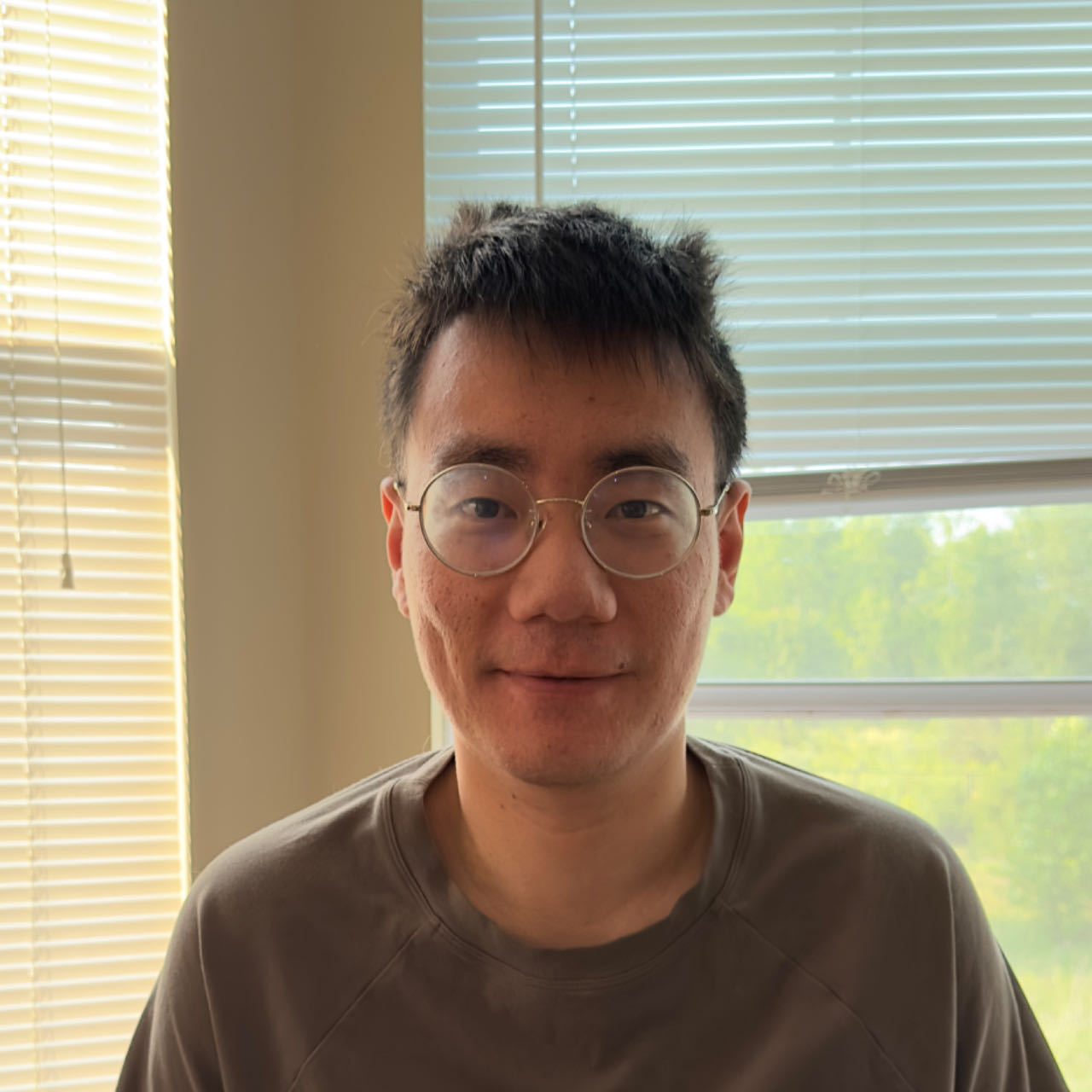
 Tianyi Ma
· 4 previous affiliations
- University of Notre DameSince 2022
- PhD student · 2022–2027
- Graduate Research Assistant · Since 2022
- Current
- Applied Scientist Intern · 2024
- University of Southern California2020–2022
- MS student · 2020–2022
- University of Colorado Boulder2016–2020
- Undergrad student · 2016–2020
5 other authors named Tianyi Ma: Tianyi Ma (4 papers), Tianyi Ma (4 papers), Tianyi Ma (Tencent (China) · 3 papers), Tianyi Ma (Michigan State University · 1 paper), Tianyi Ma (Cornell Tech · Cornell University · 1 paper)
Research Overview
Tianyi Ma focuses on hypergraph representation learning, graph foundation models, and the integration of large language models with complex relational data. His early work developed contrastive learning techniques for higher-order network structures, particularly in security and social domains. More recently, he investigates multi-agent systems and autoregressive generation techniques to improve reasoning and data collection pipelines.
Research Trajectory
Initial research focused on capturing complex, higher-order relationships in data through hypergraph neural networks. Traditional graph models often struggle with multi-way interactions, making hypergraphs a natural fit for modeling complex communities. In 2023, he introduced Hypergraph Contrastive Learning for Drug Trafficking Community Detection, developing self-supervised techniques to identify illicit networks where labeled data is scarce. He subsequently participated in the development of Dual-level Hypergraph Contrastive Learning with Adaptive Temperature Enhancement, contributing to refined contrastive learning approaches that dynamically adjust temperature parameters to improve representation quality.
Continuing his focus on higher-order structures, his 2025 work addressed fundamental limitations in how hypergraphs are processed. Most hypergraph neural networks rely on the homophily principle, which assumes connected nodes share similar features. To overcome this, he developed Hypergraph Representation Learning with Adaptive Broadcasting and Receiving, introducing novel attention mechanisms tailored for heterophilic hypergraphs where connected nodes may be highly dissimilar. In parallel, he designed the Adaptive Expansion (AdE) framework in Adaptive Expansion for Hypergraph Learning. Because standard graph neural networks cannot natively process hypergraphs, researchers typically flatten them using rigid rules that cause information loss. AdE solves this by dynamically learning how to convert hypergraphs into standard weighted graphs, selecting representative anchor nodes and optimizing edge weights based on node features.
A major theme in his recent trajectory is the shift toward general-purpose architectures for relational data. He collaborated on a unifying framework detailed in Graph Foundation Models: A Comprehensive Survey. This review helped systematize several emerging research areas, including the area of Task Unification for General Purpose Graph Foundation Models, the broader field of Foundation Models for Heterogeneous Relational Graphs, and the study of Learning Universal Topological Vocabularies for Graph Transfer. Building on these theoretical foundations, he participated in the design of concrete foundation model architectures. For instance, in Towards Graph Foundation Models: Learning Generalities Across Graphs via Task-Trees, he contributed to the GIT model, which utilizes "task-trees" to process node-, edge-, and graph-level tasks within a single unified framework, enabling strong zero-shot and few-shot generalization. He also co-developed the Neural Graph Pattern Machine in Beyond Message Passing: Neural Graph Pattern Machine. This architecture replaces the standard message-passing paradigm with random-walk-based tokenization and a Transformer-based importance identifier, advancing the research direction of Scaling Graph Transformers via Neighborhood Tokenization.
Parallel to his core graph research, he has extensively explored the intersection of large language models (LLMs) and graph learning, particularly for security and social applications. He designed the LLM-HetGDT framework in LLM-Empowered Class Imbalanced Graph Prompt Learning for Online Drug Trafficking Detection to identify illicit activities under conditions of severe class imbalance and label scarcity. Expanding his focus on cybersecurity, he created PsyScam: A Benchmark for Psychological Techniques in Real-World Scams, a systematic benchmark for evaluating how generative models employ psychological manipulation tactics to bypass defenses.
His work with LLMs also extends to autonomous agents. He introduced AutoData: A Multi-Agent System for Open Web Data Collection, a system that automates the transformation of natural language instructions into structured datasets. AutoData leverages a specialized multi-agent architecture and a novel hypergraph-based communication cache to reduce token costs and coordination overhead while navigating the web.
Current Directions
The most recent papers in the evidence, published in 2026, indicate a dual focus on improving the fundamental mechanics of autoregressive generation and developing domain-specific, graph-grounded benchmarks. A primary area of investigation involves enhancing the reasoning capabilities of sequence models by allowing them to self-correct during generation. He introduced Non-Monotonic Autoregressive Sequence Model, which equips autoregressive models with a learned "undo" token. This non-monotonic approach, combined with masked fine-tuning and reinforcement learning, enables models to explore reasoning paths and retract mistakes in complex math and coding tasks.
Additionally, he continues to explore the integration of graph-structured knowledge with language models to create robust evaluation frameworks. This is exemplified by his collaborative work on GLEN-Bench: A Graph-Language based Benchmark for Nutritional Health, which integrates dietary, clinical, and socioeconomic data to evaluate pipelines for risk detection, personalized recommendation, and explainable question answering under real-world constraints.
Profile updated
Loading new papers…
Other researchers whose papers cluster into the same research directions — a proxy for overlapping technical interests and shared intellectual neighborhoods.
See something wrong? Report a mistake