

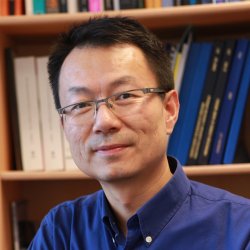
 Tao Xiang
· 3 previous affiliations
- University of SurreySince 2019
- Full Professor · Since 2019
- Queen Mary University of London2001–2019
- Full Professor · 2018–2019
- Associate Professor · 2010–2018
- Assistant Professor · 2006–2010
- Postdoc · 2001–2006
- National University of Singapore1998–2001
- PhD student · 1998–2001
2 other authors named Tao Xiang: Tao Xiang (Chongqing University · 161 papers), Tao Xiang (1 paper)
Research Overview
Tao Xiang focuses on computer vision and large-scale machine learning, with specific emphasis on video activity analysis, sketch understanding, and zero-shot learning. His research trajectory spans from early work in complex scene modeling to foundational contributions in domain generalization and few-shot recognition. Currently, his work addresses multi-modal generative models, temporal action localization, and robust domain adaptation.
Research Trajectory
Tao Xiang’s early research, conducted alongside his academic roles at institutions such as the University of Surrey and his position at the Samsung AI Centre, established a foundation in video surveillance and behavior analysis. He introduced Beyond Tracking: Modelling Activity and Understanding Behaviour in 2006, proposing a unified bottom-up and top-down model selection approach for complex activities. This work moved away from standard trajectory matching by reasoning about the temporal and causal correlations among discrete scene events.
By the mid-2010s, his focus expanded significantly into large-scale machine learning, particularly addressing the challenges of recognizing unseen categories. He contributed to the research direction of Transductive Distribution Alignment for Domain Adaptation with the publication of Transductive Multi-View Zero-Shot Learning. This work tackled projection domain shift and prototype sparsity by aligning multiple semantic views in a shared embedding space. He further advanced this area by developing the Semantic Autoencoder for Zero-Shot Learning, which enforced a reconstruction constraint to ensure visual features could be decoded back from the semantic space. This highly efficient framework became a key contribution to the broader area of Mitigating Seen Class Bias in Open World Learning. He continued to refine these techniques in Zero-shot Fine-grained Classification by Deep Feature Learning with Semantics, which utilized hierarchical semantic structures and label propagation to distinguish subtle visual differences in categories with limited data.
Concurrently, he established a robust research program in sketch analysis, working to connect human-drawn abstractions with natural images. In Sketch Me That Shoe, he and his collaborators presented a deep learning approach for fine-grained, instance-level sketch-based image retrieval, moving beyond simple category-level search. This work was instrumental in the area of Bridging the Domain Gap in Sketch Based Learning and also explored the paradigm of Modeling Sketches as Temporal Stroke Sequences. This era of sketch research also included the development of Sketch-a-Net: A Deep Neural Network that Beats Humans, which demonstrated the capacity of specialized neural architectures to parse human sketches.
Between 2018 and 2019, his work diversified into efficient learning paradigms and person re-identification (re-ID). He introduced Deep Mutual Learning, a collaborative training framework where a cohort of untrained student networks learn together, outperforming traditional one-way teacher-student distillation. This was a major step forward in the research direction of Training Efficient Models Without Large Teacher Supervision. He also addressed computational bottlenecks in multi-view learning with Scalable and Effective Deep CCA via Soft Decorrelation, replacing expensive matrix operations with a stochastic decorrelation loss. In the realm of few-shot recognition, he participated in the development of the Relation Network in Learning to Compare: Relation Network for Few-Shot Learning, which trained a deep neural network to learn a non-linear similarity function rather than relying on fixed distance metrics. For person re-identification, his group proposed Person Re-identification in Identity Regression Space. to handle scalability and incremental learning over time. To support the broader research community in this domain, he released Torchreid: A Library for Deep Learning Person Re-Identification in Pytorch, providing a modular framework and standardized data loaders for major datasets.
Returning to video analysis with modern architectures, his research addressed the area of Temporally Sensitive Pre-training for Video Action Localization. His group formulated Temporal Action Localization with Global Segmentation Mask Transformers to adapt transformer architectures for complex spatio-temporal observations. Recognizing the lack of boundary-sensitive pre-training datasets, he developed Boundary-sensitive Pre-training for Temporal Localization in Videos, introducing a novel pretext task to synthesize temporal boundaries without costly manual annotations. This line of inquiry naturally extended to multi-modal settings in Multi-Modal Few-Shot Temporal Action Detection, which combined visual examples and textual descriptions through a meta-learned prompting mechanism.
In recent years, his trajectory has incorporated generative models for both synthesis and robust training. He addressed unsupervised domain adaptation by proposing Generative Model Based Noise Robust Training for Unsupervised Domain Adaptation, utilizing generative models to eliminate domain shift and handle pseudo-label noise. In the domain of sketch and stylization, he introduced DemoCaricature: Democratising Caricature Generation with a Rough Sketch, balancing abstraction and identity preservation through explicit rank-1 model editing. Pushing the boundaries of video generation and 3D understanding, his group developed Rays as Pixels: Learning A Joint Distribution of Video and Camera Trajectories, a unified framework representing camera parameters as dense images for novel view synthesis and camera-controlled generation. He has also continued refining domain adaptation techniques, as seen in BORT2: Bi-level optimization for robust target training in multi-source domain adaptation.
Current Directions
The most recent papers in the evidence indicate a strong focus on integrating generative models into both robust learning frameworks and complex visual synthesis tasks. Recent work investigates how generative models can simultaneously eliminate domain shift and provide label noise robustness in unsupervised domain adaptation, as well as optimizing target training across multiple source domains. Additionally, his research addresses advanced multi-modal generation, such as democratizing caricature creation through personalized diffusion models that balance sketch abstraction with identity preservation. Furthermore, he is exploring unified generative architectures that learn joint distributions of video frames and camera trajectories, enabling camera-controllable video generation, pose estimation, and novel view synthesis within a single framework.
Profile updated
Loading new papers…
Other researchers whose papers cluster into the same research directions — a proxy for overlapping technical interests and shared intellectual neighborhoods.
See something wrong? Report a mistake