

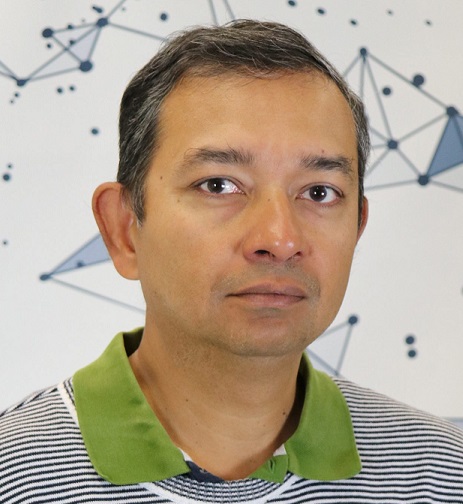
 Suman Banerjee
· 1 previous affiliation
- University of Wisconsin–MadisonSince 2003
- Full Professor · Since 2013
- Associate Professor · 2008–2013
- Assistant Professor · 2003–2008
Research Overview
Suman Banerjee focuses on mobile systems, wireless networking, and the deployment of robust machine learning models on resource-constrained devices. His trajectory spans from large-scale spectrum analysis and adversarial machine learning defenses to optimizing multimodal architectures for edge environments. Recently, his work addresses efficient visual reasoning and the hardware-software co-design necessary to run large language models on battery-powered platforms.
Research Trajectory
The trajectory begins with foundational work in wireless networking and spectrum analysis. In 2019, he contributed to A Framework for Analyzing Spectrum Characteristics in Large Spatio-temporal Scales, investigating the behavior of wireless spectrum over extensive physical and temporal dimensions.
By 2021, his research expanded to address the security, privacy, and robustness of machine learning models. He introduced JTLA in A General Framework For Detecting Anomalous Inputs to DNN Classifiers, an unsupervised method that analyzes internal neural network representations to detect adversarial and out-of-distribution inputs. This contribution aligns with the broader research direction of Class Conditional Anomaly Detection for Robust Neural Networks. That same year, he addressed privacy concerns in computer vision with Face-Off: Adversarial Face Obfuscation. This framework generates imperceptible perturbations to prevent commercial facial recognition systems from identifying individuals, advancing work in areas such as Aesthetic Preserving Privacy against Automated Facial Recognition and the broader field of Cross Model Adversarial Transferability.
Returning to mobile and wireless systems, he developed QfaR: Location-Guided Scanning of Visual Codes from Long Distances in 2023. The following year, he led the development of Cloud-LoRa: Enabling Cloud Radio Access LoRa Networks Using Reinforcement Learning Based Bandwidth-Adaptive Compression. This architecture shifts LoRaWAN physical layer processing to the cloud, utilizing a reinforcement learning-based compression technique to manage high backhaul bandwidth requirements without losing critical signal data.
In 2025, his work diversified across several complex multimodal and sensing challenges. He explored continuous contactless healthcare through Medusa: Scalable Multi-View Biometric Sensing in the Wild with Distributed MIMO Radars, a wireless vital-sign sensing system designed for real-world indoor environments. He also contributed to Babel: A Scalable Pre-trained Model for Multi-Modal Sensing via Expandable Modality Alignment, addressing the integration of diverse sensor data. In the domain of digital media, he participated in the design of VoLUT: Efficient Volumetric streaming enhanced by LUT-based super-resolution, which tackles the massive bandwidth requirements of 3D volumetric video by combining downsampling with specialized super-resolution algorithms.
His 2025 research also heavily emphasizes the optimization and security of large-scale models. He investigated the performance of compressed models on mobile hardware in PALMBENCH: A COMPREHENSIVE BENCHMARK OF COMPRESSED LARGE LANGUAGE MODELS ON MOBILE PLATFORMS, revealing critical trade-offs between quantization, battery life, and model hallucinations. To improve the visual capabilities of Multimodal Large Language Models (MLLMs), he proposed Zoomer: Adaptive Image Focus Optimization for Black-box MLLM. This visual prompting framework intelligently allocates token budgets to high-resolution image crops, contributing to the research direction of The Visual Resolution Bottleneck in Multimodal Models. In generative video, he guided ByteLoom: Weaving Geometry-Consistent Human-Object Interactions through Progressive Curriculum Learning, a Diffusion Transformer framework that maintains strict 3D geometric consistency without requiring expensive hand-mesh annotations. Additionally, he addressed the safety of autonomous systems with AGrail: A Lifelong Agent Guardrail with Effective and Adaptive Safety Detection, a collaborative two-LLM architecture designed to protect LLM-powered agents from systemic security risks while maintaining utility.
The most recent phase of his trajectory focuses on complex reasoning and extreme edge deployment. In 2026, he co-authored Video-in-the-Loop: Span-Grounded Long Video QA with Interleaved Reasoning. This work moves beyond uniform frame sampling to pinpoint specific temporal evidence in long videos, advancing the research areas of Adaptive Temporal Sampling for Long Video Reasoning and Coarse to Fine Reasoning for Long Video Understanding. Finally, he addressed the severe memory and power constraints of running LMMs on tiny devices in TINY BUT MIGHTY: A SOFTWARE-HARDWARE CO- DESIGN APPROACH FOR EFFICIENT MULTIMODAL IN- FERENCE ON BATTERY-POWERED SMALL DEVICES. By dynamically offloading modular components to specific accelerators using zero-copy memory transfers, this framework drastically reduces energy consumption for on-device multimodal inference.
Current Directions
The most recent papers in the evidence indicate a strong focus on deploying and optimizing Multimodal Large Language Models (MLLMs) for resource-constrained edge environments. This includes developing hardware-software co-design strategies to enable continuous, battery-powered multimodal inference on small devices, as well as benchmarking the real-world performance and failure modes of compressed models on mobile platforms. Additionally, current work investigates advanced visual reasoning techniques, specifically addressing the challenges of long-video understanding through adaptive temporal sampling and span-grounded question answering, ensuring that models can efficiently isolate relevant evidence without exhausting token budgets.
Profile updated
Loading new papers…
Other researchers whose papers cluster into the same research directions — a proxy for overlapping technical interests and shared intellectual neighborhoods.
See something wrong? Report a mistake