

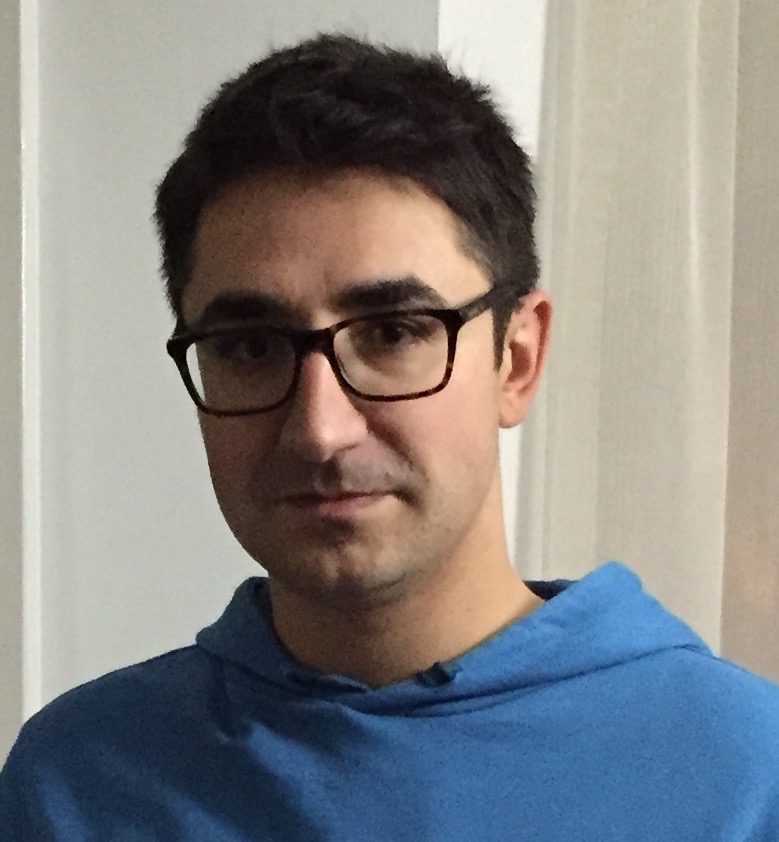
 Stojan Trajanovski
· 6 previous affiliations
- Microsoft (United States)Since 2019
- Senior Applied and Data Scientist · Since 2021
- Researcher · 2019–2021
- Philips Japan, Limited2016–2019
- Researcher · 2016–2019
- Philips2016–2019
- Research and Data Scientist · 2016–2019
- Delft University of Technology2009–2017
- Research Scientist · 2009–2017
- PhD student · 2009–2014
- Postdoctoral Researcher · 2016
- University of Cambridge2010–2011
- Graduate Student Researcher · 2011
- Master's Degree, Advanced Computer Science · 2010–2011
Research Overview
Stojan Trajanovski focuses on network science, optimization algorithms, and applied machine learning. His trajectory spans from foundational work in complex network robustness and game-theoretic models of epidemic protection to deep learning applications in medical imaging and natural language processing. His most recent research addresses resource allocation in distributed systems, algorithmic fairness, and quantum network transmission.
Research Trajectory
Trajanovski’s early research established a strong foundation in complex networks, focusing on structural robustness and the dynamics of information and epidemic spread. He introduced analytical approaches to quantify how networks degrade under stress, as detailed in Robustness envelopes of networks, where he computed performance probability density functions to evaluate worst-case behaviors under targeted node attacks. This interest in network resilience extended to community structures; in Modular Structures, Robustness and Protection of Complex Networks: Theory, Complexity and Algorithms, he investigated the topological and spectral conditions of maximum modularity. He also addressed spatial vulnerabilities, developing polynomial-time algorithms to identify critical geographic regions whose destruction would cause maximum disruption in Finding Critical Regions and Region-Disjoint Paths in a Network.
Alongside structural robustness, Trajanovski explored game-theoretic models of network behavior. With collaborators, he formalized conditions for pure-strategy Nash equilibria in Nash equilibria in shared effort games, modeling scenarios where contributors share profits based on effort thresholds. He applied similar game-theoretic frameworks to network security in Decentralized Protection Strategies Against SIS Epidemics in Networks, analyzing decentralized strategies for nodes to protect against or recover from viral infections.
In subsequent years, Trajanovski expanded his methodological scope to include deep learning, applying neural networks to physiological signals, medical imaging, and natural language processing. He developed multi-task neural networks to account for individual physiological differences in Personalized Driver Stress Detection with Multi-task Neural Networks using Physiological Signals, demonstrating that personalized models outperform generalized approaches. Returning briefly to network formation, he proposed a game-formation technique balancing link cost, performance, and virus resiliency in Designing Virus-Resistant, High-Performance Networks: A Game-Formation Approach.
His work in medical imaging advanced significantly with Towards radiologist-level cancer risk assessment in CT lung screening using deep learning. This two-stage framework achieved performance comparable to human experts, contributing to the broader research area of Expert-Level Medical Diagnosis with Deep Learning. This work also intersects with related fields such as the area of Decoupling Localization and Classification for Accurate Object Detection and the direction of Automated Clinical Report Generation from Medical Imagery. Continuing in medical diagnostics, he utilized hyperspectral imaging and deep learning semantic segmentation for real-time surgical applications, specifically focusing on channel selection techniques in Tongue Tumor Detection in Hyperspectral Images Using Deep Learning Semantic Segmentation. Concurrently, he explored natural language processing, investigating how contextual signals improve text prediction models in When does text prediction benefit from additional context? An exploration of contextual signals for chat and email messages.
Trajanovski’s recent trajectory reflects a synthesis of optimization, machine learning, and distributed systems. He contributed to virtual network function routing by integrating attention mechanisms with deep reinforcement learning in Leveraging Deep Reinforcement Learning With Attention Mechanism for Virtual Network Function Placement and Routing. He also revisited his earlier game-theoretic research, providing a complete mathematical characterization of stable strategies for relative-threshold projects in When Effort May Fail: Equilibria of Shared Effort with a Threshold.
In the domain of algorithmic fairness, he co-developed efficient core-sets for fair diversity maximization in Core-sets for Fair and Diverse Data Summarization, achieving significant computational speedups for real-world summarization tasks with minimal loss in diversity. His focus on distributed infrastructure is evident in his participation in developing fine-grained orchestration frameworks for serverless analytics, detailed in Demeter: Fine-grained Function Orchestration for Geo-distributed Serverless Analytics and its subsequent expansion, Exploiting Wide-Area Resource Elasticity With Fine-Grained Orchestration for Serverless Analytics. Most recently, his collaborative work has extended into quantum communication, addressing multi-qubit entanglement routing in Efficient and Flexible Multi-Qubit Entanglement Transmission in Quantum Networks.
Current Directions
The most recent papers in the evidence address the orchestration of distributed computing resources and the foundational protocols of quantum networks. Recent work investigates fine-grained function orchestration to exploit wide-area resource elasticity for serverless analytics, optimizing performance across geo-distributed environments. Additionally, ongoing collaborative research explores efficient multi-qubit entanglement transmission, signaling an emerging interest in the routing and resource allocation challenges unique to quantum communication networks.
Profile updated
| Title | Venue | Year |
|---|---|---|
| When effort may fail: Equilibria of shared effort with a threshold | Discret. Appl. Math | 2026 |
| Efficient and Flexible Multi-Qubit Entanglement Transmission in Quantum Networks | IEEE Trans. Netw | 2026 |
| Exploiting Wide-Area Resource Elasticity With Fine-Grained Orchestration for Serverless Analytics | IEEE Trans. Netw | 2025 |
| Demeter: Fine-grained Function Orchestration for Geo-distributed Serverless Analytics | INFOCOM | 2024 |
| When Effort May Fail: Equilibria of Shared Effort with a Threshold | arXiv | 2023 |
| Leveraging Deep Reinforcement Learning With Attention Mechanism for Virtual Network Function Placement and Routing | IEEE TPDS | 2023 |
| Video Content Placement at the Network Edge: Centralized and Distributed Algorithms | IEEE Trans. Mobile Computing | 2023 |
| Core-sets for Fair and Diverse Data Summarization | NeurIPS | 2023 |
| When Effort May Fail: Equilibria of Shared Effort with a Threshold | Ssrn | 2022 |
| Tongue Tumor Detection in Hyperspectral Images Using Deep Learning Semantic Segmentation | IEEE Trans. Biomedical Engineering | 2021 |
Loading new papers…
Other researchers whose papers cluster into the same research directions — a proxy for overlapping technical interests and shared intellectual neighborhoods.
See something wrong? Report a mistake