

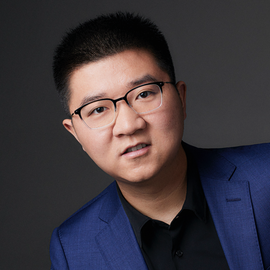
 Songyang Han
· 7 previous affiliations
- Nvidia (United States)Since 2025
- Researcher · Since 2025
- Amazon (United States)2023–2025
- Applied Scientist II · 2024–2025
- Applied Scientist Intern · 2023
- SonyAI2023–2024
- Research Scientist · 2023–2024
- Sony AI2023–2024
- Researcher · 2023–2024
- University of Connecticut2018–2023
- Research Assistant · 2018–2023
- Shanghai Jiao Tong University2015–2018
- Master of Science - MS, Electrical and Computer Engineering · 2015–2018
- Nanjing University2011–2015
- Undergrad student · 2011–2015
Research Overview
Songyang Han focuses on multi-agent reinforcement learning, collaborative perception, and safe behavior planning for connected autonomous vehicles. His trajectory spans early work in multi-robot path planning to recent developments in robust, information-sharing frameworks that guarantee safety in dynamic environments. Currently, he investigates state-adversarial multi-agent systems and uncertainty propagation in collaborative tracking.
Research Trajectory
Han’s early research addressed foundational coordination problems in robotics. In 2016, he developed Path planning for multi-robot systems using PSO and Critical Path Schedule Method, proposing an algorithm that combines particle swarm optimization with scheduling to ensure collision-free navigation in complex environments.
By 2019, his focus shifted toward the emerging domain of connected autonomous vehicles (CAVs), specifically how agents can leverage vehicle-to-vehicle (V2V) communication to improve decision-making. In Exploiting Beneficial Information Sharing Among Autonomous Vehicles, he constructed a hybrid system model that utilizes shared future sequences—such as planned positions and velocities—to optimize lane-changing and navigation policies. This foundational concept of information sharing was soon integrated with deep reinforcement learning. In Behavior Planning For Connected Autonomous Vehicles Using Feedback Deep Reinforcement Learning (2020), Han introduced a multi-agent reinforcement learning (MARL) framework featuring a truncated Q-function to manage system complexity and a safe action mapping technique based on control barrier functions to guarantee safety during execution.
Parallel to his primary work in autonomous systems, Han also explored the impact of rational adversaries in secure communications. In A game-theoretic security framework for quantum cryptography: Performance analysis and application (2020), he analyzed quantum key distribution protocols through a game-theoretic lens, demonstrating that assuming adversaries are rational rather than strictly malicious can yield improved noise tolerance and secure communication rates.
Returning to the challenges of networked cyber-physical systems, Han addressed the difficulty of inducing cooperation among inherently self-interested autonomous vehicles. In Stable and Efficient Shapley Value-Based Reward Reallocation for Multi-Agent Reinforcement Learning of Autonomous Vehicles (2022), he proposed a reward reallocation mechanism to mathematically characterize and incentivize cooperative performance improvements. Around this time, his broader research portfolio expanded to include the area of Spatio-Temporal Interaction Graphs for Multi-Agent Systems, as well as the research directions of Lagrangian Methods for Safe Reinforcement Learning and Adversarial Reinforcement Learning as a POMDP.
In 2023, Han’s work increasingly emphasized robustness and safety under uncertainty. Recognizing that real-world agents rarely have perfect state information due to sensor noise or malicious attacks, he contributed to Robust Multi-Agent Reinforcement Learning with State Uncertainties. This work modeled the environment as a Markov Game with state perturbation adversaries, providing an initial theoretical and empirical analysis of MARL robustness. To handle dynamic driving scenarios involving unconnected hazard vehicles, he co-developed Spatial-Temporal-Aware Safe Multi-Agent Reinforcement Learning of Connected Autonomous Vehicles in Challenging Scenarios, which utilized a Graph Convolutional Network (GCN)-Transformer as a spatial-temporal encoder alongside a parallel Safety Shield.
These threads of safety, communication, and perception culminated in Shared Information-Based Safe And Efficient Behavior Planning For Connected Autonomous Vehicles (2023). This integrated framework combined real-time V2V feature sharing via weight-pruned neural networks with a deterministic safety-mapping layer to ensure zero collisions while optimizing traffic flow. This work directly advanced the research areas of Centralized Training with Decentralized Execution and Overcoming Sensor Occlusion Through Collaborative Perception. The formalization of these techniques was subsequently detailed in the 2024 journal article A Multi-Agent Reinforcement Learning Approach for Safe and Efficient Behavior Planning of Connected Autonomous Vehicles.
Most recently, Han has investigated fundamental solutions for adversarial environments and uncertainty quantification. In What is the Solution for State-Adversarial Multi-Agent Reinforcement Learning? (2024), he explored theoretical remedies for state perturbations, contributing to the broader area of Multi-Agent Coordination with Non-Cooperative and Adversarial Actors. Simultaneously, he addressed the critical need for reliable perception in self-driving systems in Collaborative Multi-Object Tracking With Conformal Uncertainty Propagation (2024), designing a framework to propagate uncertainty quantification from collaborative object detection into multiple object tracking modules.
Current Directions
The most recent papers in the evidence highlight a dual focus on adversarial robustness and uncertainty-aware perception in multi-agent systems. Recent work investigates the theoretical and practical limits of state-adversarial multi-agent reinforcement learning, seeking robust policy solutions when agents operate under malicious state perturbations or imperfect information.
A parallel focus involves uncertainty quantification in collaborative perception. Han is currently exploring how conformal uncertainty propagation can be leveraged across multiple viewpoints to improve the reliability of downstream tasks like multi-object tracking. By bridging the gap between collaborative object detection and onboard prediction modules, this direction aims to enhance the overall safety guarantees of autonomous driving systems in complex, multi-agent environments.
Profile updated
Loading new papers…
Other researchers whose papers cluster into the same research directions — a proxy for overlapping technical interests and shared intellectual neighborhoods.
See something wrong? Report a mistake