

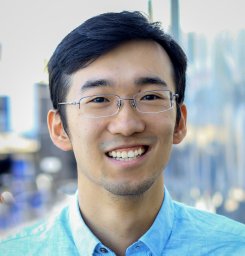
 Sihan Zeng
· 7 previous affiliations
- UpworkSince 2026
- Machine Learning Engineer · Since 2026
- Upwork IncSince 2026
- Researcher · Since 2026
- JPMorgan Chase & Co (United States)2022–2026
- AI Research Lead (Vice President) · 2026
- AI Researcher (Senior Associate) · 2023–2026
- Summer Intern - AI Research Associate · 2022
- J.P. Morgan2023–2026
- Researcher · 2023–2026
- Georgia Institute of Technology2017–2023
- Graduate Research And Teaching Assistant · 2017–2023
- Research Aide · 2021
- Rice University2013–2017
- Undergrad student · 2013–2017
- Bachelor's degree, Electrical Engineering & Statistics
Research Overview
Sihan Zeng focuses on reinforcement learning, game theory, and non-convex optimization, with a particular emphasis on multi-agent systems and mechanism design. His trajectory spans the theoretical foundations of Markov games and stochastic approximation to practical algorithms for resource allocation and bi-level optimization. Recent work investigates the dynamics of mean field games and the optimization landscapes of deep neural networks.
Research Trajectory
Sihan Zeng's early research involved signal processing and generative models. He co-authored Fast Compressive Sensing Recovery Using Generative Models with Structured Latent Variables in 2019, which introduced an algorithm combining Generative Adversarial Networks (GANs) with an Alternating Direction Method of Multipliers (ADMM) framework to achieve stable signal recovery under extreme compression.
His focus subsequently shifted toward the theoretical analysis of reinforcement learning and multi-agent systems. In 2022, he explored online algorithms for constrained environments in Finite-Time Complexity of Online Primal-Dual Natural Actor-Critic Algorithm for Constrained Markov Decision Processes. In the same year, he investigated zero-sum Markov games in Regularized Gradient Descent Ascent for Two-Player Zero-Sum Markov Games. This work advanced the research direction of Sparse Strategy Support in Equilibrium Computation by demonstrating that entropy regularization introduces structures into the optimization landscape, making non-convex and non-concave minimax problems more identifiable and solvable.
Continuing to build on stochastic approximation and optimization geometry in 2023, he analyzed decentralized methods in Finite-Time Convergence Rates of Decentralized Stochastic Approximation With Applications in Multi-Agent and Multi-Task Learning. He then made a significant theoretical contribution to the area of Global Convergence in Non-Convex Reinforcement Learning with Connected Superlevel Set in (Deep) Reinforcement Learning and its Application to Minimax Theorems. This research proved that superlevel sets in reinforcement learning optimization landscapes are inherently connected, a structural insight that enabled new proofs for the existence of Nash equilibria in robust RL problems involving adversarial reward attacks.
In 2024, Zeng expanded his focus into payment-free mechanism design, contributing to the broader area of Mechanism Design Without Monetary Transfers. He developed Regularized Proportional Fairness Mechanism for Resource Allocation Without Money, which balances the maximization of social welfare with incentive compatibility to prevent agents from inflating allocations by misreporting utilities. This work also touched upon the research direction of Scaling Differentiable Optimization in Neural Networks. Concurrently, he advanced stochastic optimization theory with A Two-Time-Scale Stochastic Optimization Framework with Applications in Control and Reinforcement Learning, unifying existing actor-critic algorithms and providing rigorous convergence rates across strongly convex, PL-conditioned, and non-convex problem structures.
His work on resource allocation evolved in 2025 to handle temporal dynamics in Building Sequential Resource Allocation Mechanisms without Payments, which introduced a meta-algorithm to transform single-round fair division methods into robust sequential systems. He also deepened his focus on large-scale games, introducing non-asymptotic convergence guarantees for Stackelberg Mean Field Games in Learning in Stackelberg Mean Field Games: A Non-Asymptotic Analysis. Addressing environments with multiple equilibria, he proposed a direct policy optimization method in Learning in Herding Mean Field Games: Single-Loop Algorithm with Finite-Time Convergence Analysis.
In parallel, Zeng explored decision-making under uncertainty in Partially Observable Contextual Bandits With Linear Payoffs. He collaborated on integrating symmetries into reinforcement learning in Approximate Equivariance in Reinforcement Learning, defining approximately equivariant Markov Decision Processes and contributing to the area of Geometric Inductive Biases for Data Efficient Learning. Additionally, he participated in research within the area of Maintaining Global Coherence in Long Form Text Generation by co-authoring Generating Structured Plan Representation of Procedures with LLMs, a framework that utilizes large language models to convert unstructured standard operating procedures into machine-readable directed acyclic graphs.
Most recently, in 2026, Zeng has applied bi-level optimization techniques to modern machine learning challenges. He developed a single-loop, first-order actor-critic algorithm in A Hessian-Free Actor-Critic Algorithm for Bi-Level Reinforcement Learning with Applications to LLM Fine-Tuning, which efficiently optimizes complex objectives without requiring second-order information. He also provided a theoretical framework for neural network training dynamics in Rethinking Neural Network Learning Rates: A Stackelberg Perspective, proving that non-uniform learning rates across layers can convexify optimization landscapes and accelerate convergence.
Current Directions
Recent work investigates the intersection of bi-level optimization and deep learning, particularly focusing on scalable, first-order methods for complex objectives. This includes applying actor-critic algorithms to the fine-tuning of large language models and using Stackelberg game formulations to understand neural network training dynamics. By modeling the interaction between different network layers as a Stackelberg optimization problem, this research seeks to mathematically ground empirical practices like layer-specific learning rates. Additionally, there is an ongoing focus on the non-asymptotic analysis of large-scale multi-agent systems, specifically designing single-loop algorithms for various classes of mean field games.
Profile updated
Loading new papers…
Other researchers whose papers cluster into the same research directions — a proxy for overlapping technical interests and shared intellectual neighborhoods.
See something wrong? Report a mistake