

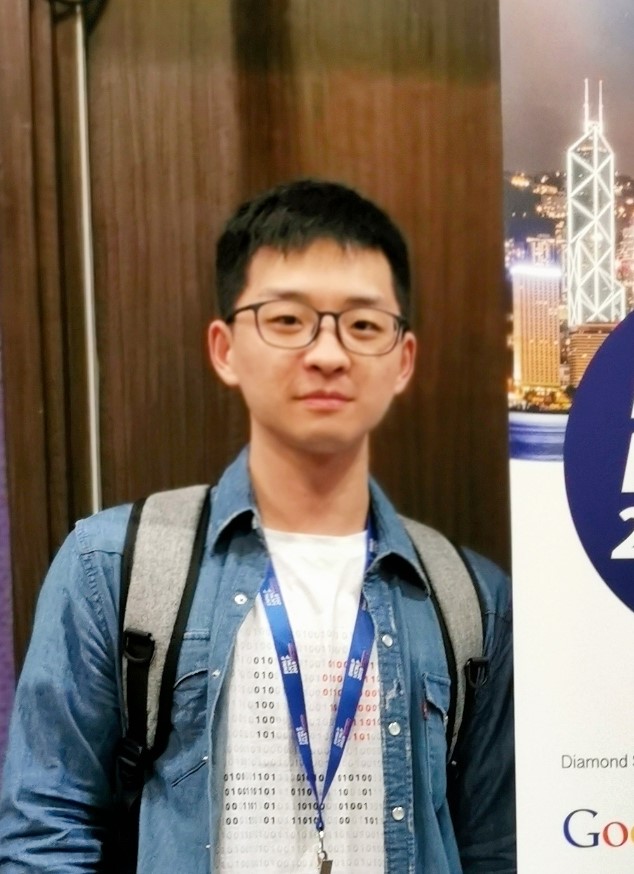
 Shuo Ren
· 3 previous affiliations
- Chinese Academy of SciencesSince 2024
- Associate Professor · Since 2024
- Microsoft (United States)2021–2022
- Researcher · 2021–2022
- Beihang University2016–2021
- PhD student · 2016–2021
1 other author named Shuo Ren: Shuo Ren (1 paper)
Research Overview
Shuo Ren focuses on neural machine translation, multimodal pre-training, and the evaluation of generative models. His early work addressed the challenges of low-resource and unsupervised translation by developing novel training architectures and cross-lingual alignments. More recently, his research has expanded into vision-language reasoning, spatial understanding in multimodal models, and reinforcement learning for mathematical problem-solving.
Research Trajectory
His early research primarily addressed the challenges of translating languages with limited parallel data. He introduced a triangular training architecture in Triangular Architecture for Rare Language Translation to leverage rich languages as intermediate variables, a method that advanced the research direction of Neural Machine Translation for Low-Resource Languages. Moving toward fully unsupervised translation, he tackled the accumulation of noise in pseudo-parallel data by utilizing statistical machine translation models as posterior regularizations in Unsupervised Neural Machine Translation with SMT as Posterior Regularization.. To further bridge the gap between languages without parallel corpora, he developed a cross-lingual masked language model in Explicit Cross-lingual Pre-training for Unsupervised Machine Translation, which used unsupervised n-gram translation tables to provide explicit training signals. Continuing this focus on initialization and data quality, he explored semantic similarity filtering with A Retrieve-and-Rewrite Initialization Method for Unsupervised Machine Translation, demonstrating that editing near-parallel sentences found in monolingual data could significantly improve translation performance.
Around 2020, his focus expanded to the intersection of natural language processing and software engineering, specifically the understanding and generation of programming languages. He developed a novel evaluation metric in CodeBLEU: a Method for Automatic Evaluation of Code Synthesis. By combining traditional n-gram overlap with abstract syntax tree and data-flow analysis, this work touched on several critical research areas, including Normalizing Code to Reveal Underlying Structural Logic, Token Level Importance for Selective Optimization, and the broader area of Structural Logic in Code Language Models. He further integrated structural logic into pre-training with GraphCodeBERT: Pre-training Code Representations with Data Flow, utilizing semantic-level data flow rather than purely syntactic structures to enhance code understanding. To help standardize evaluation across these emerging models, he participated with collaborators in building CodeXGLUE: A Machine Learning Benchmark Dataset for Code Understanding and Generation, a comprehensive suite of tasks and datasets for the community.
Returning to translation and expanding into speech processing, he proposed a semantic interface to bridge pre-trained encoders and decoders in SemFace: Pre-training Encoder and Decoder with a Semantic Interface for Neural Machine Translation. By forcing components to communicate through a shared, language-independent space, this approach improved cross-attention pre-training for low-resource tasks. In the audio domain, he contributed to WavLM: Large-Scale Self-Supervised Pre-Training for Full Stack Speech Processing, a model that jointly learns masked speech prediction and denoising. This self-supervised approach supports a variety of downstream tasks and contributes to work in the area of Disentangling Speaker Identity from Linguistic Content.
By 2025, his trajectory shifted significantly toward the reasoning capabilities and robustness of multimodal large language models (MLLMs). He analyzed architectural bottlenecks in Why Do MLLMs Struggle with Spatial Understanding? A Systematic Analysis from Data to Architecture, investigating how visual encoder positional encodings limit spatial reasoning in multi-view contexts. To address how vision-language models handle vague prompts, he introduced a benchmark and training pipeline in Teaching Vision-Language Models to Ask: Resolving Ambiguity in Visual Questions, teaching models to ask clarification questions rather than hallucinating answers. He also tackled the tendency of models to lose visual grounding during long reasoning chains in Look Again, Think Slowly: Enhancing Visual Reflection in Vision-Language Models, utilizing reinforcement learning to encourage the active re-examination of visual cues. Parallel to this multimodal research, he explored adaptive fine-tuning strategies in Beyond One-Size-Fits-All: Adaptive Fine-Tuning for LLMs Based on Data Inherent Heterogeneity. Finally, he collaborated on reinforcement learning techniques for mathematical reasoning in KTAE: A Model-Free Algorithm to Key-Tokens Advantage Estimation in Mathematical Reasoning, a model-free approach that identifies specific tokens contributing to correct answers, supporting the research direction of Preventing Entropy Collapse in Reinforcement Learning.
Current Directions
The most recent papers in the evidence indicate a strong focus on the reasoning capabilities, spatial awareness, and robustness of multimodal large language models. Recent work investigates the architectural limitations that hinder spatial understanding in multi-view and video contexts, moving beyond simple data scaling. Additionally, there is an emphasis on teaching vision-language models to actively resolve referential ambiguity by asking clarification questions, as well as using reinforcement learning to enhance "slow-thinking" visual reflection so that models maintain visual grounding during extended reasoning chains. Parallel to this multimodal research, current efforts also explore adaptive fine-tuning strategies for large language models and model-free reinforcement learning algorithms designed to optimize mathematical reasoning without the computational overhead of traditional critic models.
Profile updated
Loading new papers…
Other researchers whose papers cluster into the same research directions — a proxy for overlapping technical interests and shared intellectual neighborhoods.
See something wrong? Report a mistake