

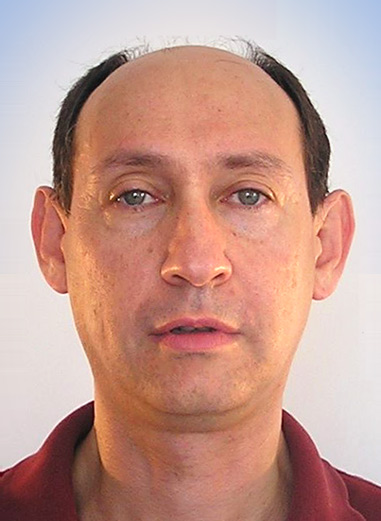
 Sharon Gannot
· 7 previous affiliations
- Bar-Ilan UniversitySince 2003
- Full Professor · Since 2003
- Aalborg University2018–2019
- Full Professor · 2018–2019
- Researcher · 2014
- Researcher · 2014
- Researcher · 2002–2003
- Undergrad student · 1983–1986
- KU Leuven2001
- Postdoc · 2001
- Tel Aviv University1993–2000
- PhD student · 1996–2000
- MS student · 1993–1995
Research Overview
Sharon Gannot focuses on statistical signal processing, microphone array processing, and machine learning for speech enhancement. His trajectory spans foundational work in Kalman filter-based algorithms and beamforming to advanced multi-microphone source separation and dereverberation techniques. Currently, he investigates deep learning and diffusion models for target speaker extraction, acoustic echo cancellation, and spatial audio processing in highly reverberant environments.
Research Trajectory
In the late 1990s and early 2000s, early work established foundational methods for speech enhancement in noisy environments. He introduced Iterative and sequential Kalman filter-based speech enhancement algorithms, utilizing the expectation-maximization (EM) method to iteratively estimate spectral parameters when speech signals are degraded by background noise. Expanding this to multi-sensor setups, he addressed the limitations of generalized sidelobe cancelers in complicated acoustic spaces with Signal enhancement using beamforming and nonstationarity with applications to speech.
Following these beamforming advancements, the focus expanded to tackle the specific challenge of room reverberation. He developed Subspace Methods for Multimicrophone Speech Dereverberation, exploiting generalized singular-value decomposition to construct the null subspace of the data matrix and estimate acoustic transfer functions. To further refine microphone array performance in both directional and diffused noise fields, he proposed Speech enhancement based on the general transfer function GSC and postfiltering, which integrated postfiltering methods to maintain low speech distortion while reducing nonstationary noise.
Moving into the 2010s, the research increasingly integrated machine learning concepts with statistical signal processing. He participated in a comprehensive review of these emerging intersections in Diffusion Maps for Signal Processing: A Deeper Look at Manifold-Learning Techniques Based on Kernels and Graphs. This geometric perspective informed his subsequent investigations into the research direction of The Geometric Manifold of Acoustic Environments. During this period, his group also developed robust methods for localizing sources in reverberant environments. In Estimation of the Direct-Path Relative Transfer Function for Supervised Sound-Source Localization, they proposed estimating the direct-path relative transfer function (DP-RTF) in the short-time Fourier transform domain. This work contributed significantly to the area of Robust Sound Localization via Direct Path Dominance and the broader field of Overcoming the Single Source Assumption in Acoustic Localization. Recognizing the convergence of these distinct methodologies, he later provided a unifying overview of the field in A Consolidated Perspective on Multimicrophone Speech Enhancement and Source Separation.
In the 2020s, the integration of geometric learning and acoustics matured further, as detailed in the monograph Data-Driven Multi-Microphone Speaker Localization on Manifolds. The laboratory also began exploring deep generative models for audio manipulation, demonstrating zero-shot style transfer for singing voice generation in SingIt! Singer Voice Transformation. Concurrently, practical telecommunication challenges were addressed; he introduced an efficient "AEC-last" structure to stabilize conference call audio and reduce echo leakage in Efficient Joint Bemforming and Acoustic Echo Cancellation Structure for Conference Call Scenarios.
The most recent phase of this trajectory is characterized by the extensive application of deep neural networks and diffusion models to spatial audio and speaker extraction. Treating acoustic reconstruction as an image inpainting problem, his group developed DiffusionRIR: Room Impulse Response Interpolation using Diffusion Models to reconstruct missing acoustic data from sparse measurements. He also collaborated on GDiffuSE: Diffusion-based speech enhancement with noise model guidance, which uses a lightweight noise model to rapidly adapt a pre-trained diffusion backbone to unseen acoustic environments at test time. In unsupervised settings, he participated in developing Diffusion-Based Unsupervised Audio-Visual Speech Separation in Noisy Environments with Noise Prior, integrating visual cues like lip movements to separate speech without rigid supervised training.
A major focus of the 2025 publications is advancing the research direction of Target Speaker Extraction with Multimodal Prompts. In Spectral or spatial? Leveraging both for speaker extraction in challenging data conditions, he developed a multi-channel system that dynamically balances voice characteristics and location data to remain robust against incorrect reference information. This was extended to binaural audio in Binaural Target Speaker Extraction using HRTFs and a Complex-Valued Neural Network, utilizing the listener's Head-Related Transfer Function to isolate speech while perfectly preserving spatial cues. Furthermore, he introduced an end-to-end neural network leveraging relative transfer functions as spatial fingerprints in End-to-End Multi-Microphone Speaker Extraction Using Relative Transfer Functions, significantly outperforming traditional direction-of-arrival methods in highly reverberant spaces. Finally, addressing single-microphone scenarios, his group proposed a time-frequency attention network integrated with voice activity detection in Single-microphone speaker separation and voice activity detection in noisy and reverberant environments.
Current Directions
Recent work investigates the intersection of deep generative models and spatial audio processing. A major focus is the application of denoising diffusion probabilistic models to complex acoustic challenges, such as interpolating room impulse responses from sparse measurements and adapting speech enhancement systems to unseen noise conditions at test time.
Additionally, current research heavily addresses target speaker extraction in highly reverberant, multi-talker environments. This involves designing complex-valued neural networks that leverage spatial cues—such as relative transfer functions and head-related transfer functions—to isolate specific voices while preserving the binaural spatial experience for the listener. The integration of multimodal inputs, including visual lip-movement cues, and the dynamic balancing of spectral and spatial features further characterize these ongoing efforts to build robust, unsupervised audio separation systems capable of operating in challenging real-world data conditions.
Profile updated
Loading new papers…
Other researchers whose papers cluster into the same research directions — a proxy for overlapping technical interests and shared intellectual neighborhoods.
See something wrong? Report a mistake