

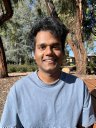
 Sarthak Kumar Maharana
· 6 previous affiliations
- NEC (United States)Since 2026
- Research Scientist Intern · Since 2026
- PhD Research Intern · 2025
- Doctor of Philosophy - PhD, Computer Science · 2023
- University of Southern California2021–2023
- Student Researcher · 2022–2023
- Master of Science - MS, Electrical Engineering, Signal and Image Processing · 2021–2023
- Student Researcher · 2021–2022
- National University of Singapore2020–2021
- Research Assistant · 2020–2021
- Undergrad student · 2016–2020
Research Overview
Sarthak Kumar Maharana focuses on computer vision, continual learning, and test-time adaptation for multimodal systems. His research addresses the robustness of machine learning models in dynamic environments, exploring how systems can adapt to shifting data distributions without catastrophic forgetting. Recent work investigates memory-efficient adaptation mechanisms and the unlearning of specific concepts in generative models.
Research Trajectory
Maharana’s early research investigated speech processing for clinical applications, specifically focusing on acoustic-to-articulatory inversion (AAI) for patients with dysarthric speech. In 2021, he developed Acoustic-to-Articulatory Inversion for Dysarthric Speech by Using Cross-Corpus Acoustic-Articulatory Data, which addressed the dual challenges of imprecise pronunciation and limited data availability in clinical populations by leveraging cross-corpus training techniques. He later expanded on this work in Acoustic-to-Articulatory Inversion for Dysarthric Speech: are Pre-Trained Self-Supervised Representations Favorable? (2024), demonstrating how pre-trained self-supervised learning representations could improve AAI performance under low-resource conditions.
As his research broadened into the security and robustness of deep learning systems, Maharana explored methods for protecting model intellectual property. He introduced a novel watermarking strategy in Not Just Change the Labels, Learn the Features: Watermarking Deep Neural Networks with Multi-view Data (2024). This work proposed the MAT (Multi-view dATa) framework, which uses feature-based regularization to embed watermarks deeply into a model's logic, ensuring they remain detectable even after extraction attacks. This contribution aligns with the area of Ownership Verification for Deep Neural Networks and broader efforts in model verification.
A central theme of Maharana's subsequent work is improving model robustness in dynamic environments through test-time adaptation (TTA). He developed Enhancing Robustness of CLIP to Common Corruptions through Bimodal Test-Time Adaptation (2024), introducing the BATCLIP framework. By jointly fine-tuning the LayerNorm parameters of vision and text encoders, BATCLIP improves the resilience of vision-language models to image corruptions like blur and noise. This research advanced the research direction of Domain Adaptation via Normalization Layer Tuning and the broader area of Synchronized Cross-Modal Alignment for Vision-Language Model Adaptation. Building on these concepts, he later proposed PALM: Pushing Adaptive Learning Rate Mechanisms for Continual Test-Time Adaptation (2025). PALM mitigates the negative effects of noisy pseudo-labels by using model uncertainty and parameter sensitivity analysis to selectively update a small fraction of the network's layers, achieving high accuracy with minimal parameter changes.
Alongside his work on adaptation, Maharana has contributed to data-efficient learning for 3D vision and autonomous driving. With collaborators, he explored active learning strategies in STONE: A Submodular Optimization Framework for Active 3D Object Detection (2024), a framework designed to reduce the high costs of annotating 3D point clouds by selecting the most informative and class-balanced scenes. He extended this submodular optimization approach to semantic segmentation in SELECT: A Submodular Approach for Active LiDAR Semantic Segmentation (2025), introducing a three-stage active learning framework that simultaneously addresses massive data scalability and chronic class imbalance in LiDAR datasets.
Most recently, Maharana has focused on the continuous adaptation and evaluation of multimodal systems. Recognizing a gap in how models are evaluated under real-world noise, he introduced $\texttt{AVROBUSTBENCH}$: Benchmarking the Robustness of Audio-Visual Recognition Models at Test-Time (2025), a benchmark revealing that current state-of-the-art models struggle when both audio and visual inputs are simultaneously corrupted. To address these vulnerabilities, he developed AV-CTTA: Audio-Visual Continual Test-Time Adaptation without Forgetting (2026). This framework allows audio-visual models to adapt to a continuous stream of changing environments by selectively retrieving and updating modality fusion parameters from a memory-efficient buffer, largely preventing catastrophic forgetting.
In parallel with his multimodal adaptation research, Maharana has also participated in efforts to improve the safety and controllability of generative models. He contributed to Unlearning in Diffusion models under Data Constraints: A Variational Inference Approach (2025), which introduced Variational Diffusion Unlearning (VDU). This method balances the removal of specific unwanted concepts with the preservation of overall image generation quality, contributing to ongoing work in Preserving Model Utility During Machine Unlearning and generative unlearning.
Current Directions
The most recent papers in the evidence address the continuous adaptation of multimodal systems and the selective unlearning of concepts in generative models. A primary focus is audio-visual continual test-time adaptation, where the goal is to dynamically update fusion parameters in response to streaming, corrupted data without suffering from catastrophic forgetting. This involves designing memory-efficient buffers and selective retrieval mechanisms that allow models to maintain historical knowledge while adapting to new environments. Additionally, recent collaborative work investigates variational inference frameworks for diffusion models, aiming to safely remove specific data points or features under strict data constraints while maintaining generation quality.
Profile updated
Loading new papers…
Other researchers whose papers cluster into the same research directions — a proxy for overlapping technical interests and shared intellectual neighborhoods.
See something wrong? Report a mistake