

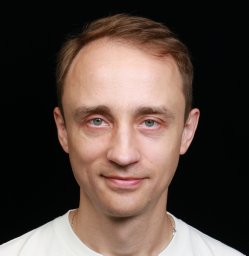
 Roman Koshkin
· 6 previous affiliations
- SB intuitionsSince 2025
- Researcher · Since 2025
- Postdoc · 2025–2026
- Postdoctoral Researcher · 2019–2024
- Research Assistant · 2020
- Amazon (United States)2024–2025
- Amazon Science Fellow · 2024–2025
- Special Research Intern · 2023
- Research Intern · 2022
- Master's degree (with distinction), Cognitive Sciences and Technologies, Psychology · 2015–2017
Research Overview
Roman Koshkin focuses on computational neuroscience, natural language processing, and simultaneous machine translation. His early work utilized electroencephalography to study the cognitive load of human interpreters, which informed his later development of scalable algorithms for analyzing neural population dynamics. Most recently, he investigates the application of large language models and multi-agent systems to real-time speech translation and automated reasoning tasks.
Research Trajectory
Roman Koshkin’s early research investigated the cognitive and neurophysiological underpinnings of simultaneous interpreting. In 2017, he published Commentary: Functional Connectivity in the Left Dorsal Stream Facilitates Simultaneous Language Translation: An EEG Study, which critically evaluated claims that simultaneous interpreters develop enhanced functional brain connectivity through practice. By applying bootstrapping and power analysis, he demonstrated the statistical fragility of these claims, contributing to discussions in the area of The Scale Crisis in Brain Wide Association Studies and the research direction of Sex Restricted Sampling Limits Neurobiological Generalizability. Building on this neurocognitive focus, he subsequently provided electrophysiological evidence for the cognitive load experienced during translation in Testing the efforts model of simultaneous interpreting: An ERP study. By tracking brain responses to background stimuli, this work quantified how an interpreter’s capacity to process incoming speech decreases as working memory load increases, intersecting with methodological work in the area of Blind Source Separation for Artifact Mitigation in EEG.
Transitioning toward computational neuroscience, Koshkin developed scalable algorithms to analyze neural population dynamics and spike data. He introduced a novel approach to identifying putative units of neural computation in Unsupervised Detection of Cell Assemblies with Graph Neural Networks. This method embedded spike data into fixed-size vectors to cluster them by temporal self-similarity, advancing the broader area of Time Decayed Edge Weighting in Dynamic Graphs. He expanded on this unsupervised paradigm with convSeq: Fast and Scalable Method for Detecting Patterns in Spike Data, utilizing backpropagation and GPU acceleration to detect repeating spatiotemporal patterns across massive datasets with built-in uncertainty estimates. Alongside these data-driven methods, he explored biophysical modeling in Astrocyte Regulation of Synaptic Plasticity Balances Robustness and Flexibility of Cell Assemblies, which proposed that astrocyte-modulated short-term plasticity is critical for networks to maintain stable memories while adapting to new information.
In recent years, Koshkin has focused extensively on natural language processing, specifically leveraging large language models (LLMs) for simultaneous machine translation. He developed TransLLaMa: LLM-based Simultaneous Translation System, demonstrating that off-the-shelf, decoder-only LLMs can be fine-tuned on causally aligned data to generate special wait tokens, effectively managing information flow without a separate decision-making policy. This work touches upon the research direction of Mitigating the Multilingual Tokenization Tax in Language Models. He further explored the zero-shot capabilities of these models in LLMs Are Zero-Shot Context-Aware Simultaneous Translators, showing that open-source LLMs can perform competitively on simultaneous translation tasks while easily integrating background context to improve technical translations.
Returning to his foundational interest in the intersection of neuroscience and translation, he co-authored a comprehensive methodological review, Electroencephalography, which synthesized key EEG findings on bilingualism and interlingual reformulation for cognitive translation studies. Concurrently, he broadened his application of LLMs to autonomous reasoning frameworks, introducing MaRGen: Multi-Agent LLM Approach for Self-Directed Market Research and Analysis, a system that orchestrates specialized agents to synthesize raw e-commerce data into structured reports.
His most recent collaborative work continues to push the boundaries of real-time speech processing. He participated in the development of SASST: Leveraging Syntax-Aware Chunking and LLMs for Simultaneous Speech Translation, an end-to-end system that uses linguistic syntax to segment speech into semantically complete chunks, allowing an LLM to autonomously learn optimal translation timing. Additionally, he contributed to Distilling LLM Semantic Priors into Encoder-Only Multi-Talker ASR with Talker-Count Routing, which transfers the semantic capabilities of LLMs into faster encoder-only models to process overlapping speech efficiently, advancing the area of Generative Error Correction for Speech Recognition.
Current Directions
The most recent papers in the evidence indicate a strong focus on optimizing large language models for real-time, simultaneous speech translation and complex autonomous workflows. Recent work investigates how to integrate explicit linguistic structures, such as syntax-aware chunking, into end-to-end translation systems to handle languages with divergent word orders more effectively. Additionally, Koshkin is exploring methods to reduce the computational latency of foundation models in speech recognition. This includes distilling the semantic priors of LLMs into faster, encoder-only architectures capable of handling multi-talker environments. Beyond translation, his recent research also addresses the orchestration of multi-agent LLM pipelines to automate structured reasoning and data synthesis tasks.
Profile updated
Loading new papers…
Other researchers whose papers cluster into the same research directions — a proxy for overlapping technical interests and shared intellectual neighborhoods.
See something wrong? Report a mistake