

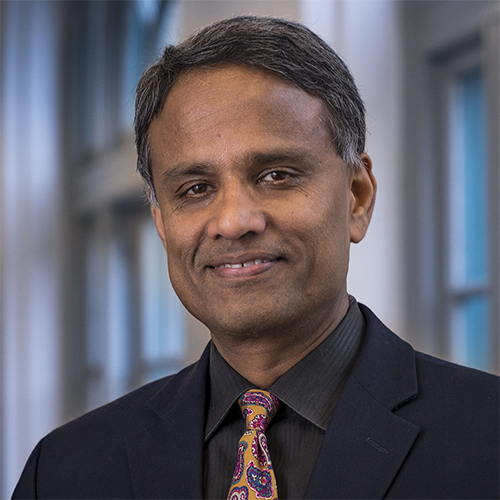
 Ramayya Krishnan
· 1 previous affiliation
- Carnegie Mellon UniversitySince 1998
- Full Professor · Since 1998
Research Overview
Ramayya Krishnan focuses on digital transformation, decision analytics, and the intersection of artificial intelligence with public policy. His extensive trajectory spans early knowledge-based mathematical modeling and peer-to-peer network dynamics to modern spatiotemporal predictive modeling and operations research. Currently, his work investigates AI measurement, system reliability, and the practical trade-offs of deploying large language models in complex organizational environments.
Research Trajectory
Krishnan’s early work explored foundational systems for decision analytics, beginning with A Knowledge-Based Mathematical Model Formulation System (1992). By the early 2000s, his focus expanded to the dynamics of emerging digital platforms and e-commerce. He participated in empirical research on peer-to-peer (P2P) networks, challenging the prevailing assumption of the era that larger networks are inherently superior. In Bigger May Not Be Better: An Empirical Analysis of Optimal Membership Rules in Peer-To-Peer Networks (2001), the analysis demonstrated that while larger networks offer more content, they also suffer from exponential congestion, indicating that smaller, specialized networks can often be more efficient. This interest in network dynamics continued with investigations into Content-Based Community Formation in Hybrid Peer-to-Peer Networks (2004) and the optimization of digital retail tools in Designing a Better Shopbot (2004).
In the late 2000s, Krishnan examined user behavior and security within digital ecosystems. He collaborated on machine learning approaches to predict the success of collaborative efforts, such as Predicting Outcome for Collaborative Featured Article Nomination in Wikipedia (2009). This work highlighted how the voting patterns of highly active "power users" drive outcomes, contributing to broader research areas like modeling the heavy tail of digital user engagement and automated peer review for high-volume scientific literature. Parallel to his work on user engagement, Krishnan explored information risk management. He analyzed how public vulnerability disclosures impact software vendors in An Empirical Analysis of Software Vendors' Patch Release Behavior: Impact of Vulnerability Disclosure (2010), finding that instant disclosure significantly accelerates patch development—a key insight for addressing the patch gap in software supply chains. He further formalized approaches to security in Correlated Failures, Diversification, and Information Security Risk Management (2011).
During the 2010s, Krishnan directed significant research toward operations research, spatiotemporal analytics, and social network influence. He led investigations into how social networks drive technology adoption in Contrasting Multiple Social Network Autocorrelations for Binary Outcomes, With Applications To Technology Adoption (2012), addressing methodological challenges in areas such as quantifying prior sensitivity in Bayesian inference and addressing degeneracy in exponential random graph models. He continued to untangle these effects in Latent Homophily or Social Influence? An Empirical Analysis of Purchase Within a Social Network (2015).
Simultaneously, his research advanced simulation and routing for physical operations. He oversaw the development of An Efficient Simulation-Based Approach to Ambulance Fleet Allocation and Dynamic Redeployment (2012), which optimized emergency medical services through the direct simulation of requests. This was followed by Adaptive collective routing using gaussian process dynamic congestion models (2013), which introduced real-time adaptive routing for cooperative vehicle fleets facing uncertain traffic conditions. This spatiotemporal research matured into analyzing human mobility via sensor data. Following foundational work in Learning Individual Behavior Using Sensor Data: The Case of Global Positioning System Traces and Taxi Drivers (2020), Krishnan guided a comprehensive study on pandemic-era mobility in Changes in Commuter Behavior from COVID-19 Lockdowns in the Atlanta Metropolitan Area (2023). This research provided granular insights into sector-specific movement patterns, advancing methods for inferring human intent from spatiotemporal trajectories, geographic generalization for spatiotemporal predictive models, and semantic location inference from GPS trajectory data.
Current Directions
Recent work investigates the measurement, reliability, and practical deployment of artificial intelligence systems. The most recent papers in the evidence address the engineering and governance challenges of integrating AI into complex environments. In Reliability, Resilience and Human Factors Engineering for Trustworthy AI Systems (2024), Krishnan contributed to a framework that applies classical reliability engineering to AI, proposing concrete metrics like Mean Time to Data Drift to support algorithmic resilience for exascale and warehouse computing, predictive maintenance through real-time condition monitoring, and reliability engineering for human-in-the-loop systems.
He has also focused on the organizational trade-offs of AI adoption. He introduced ML Compass: Navigating Capability, Cost, and Compliance Trade-offs in AI Model Deployment (2025), a framework that treats model selection as a constrained optimization problem to help organizations balance utility, cost, and regulatory compliance, contributing to efforts mitigating the alignment tax in large language models. Most recently, he collaborated on Time-To-Inconsistency: A Survival Analysis of Large Language Model Robustness to Adversarial Attacks (2026), which adapts survival analysis techniques from medical research to predict when large language models will fail during extended adversarial interactions.
Profile updated
Loading new papers…
Other researchers whose papers cluster into the same research directions — a proxy for overlapping technical interests and shared intellectual neighborhoods.
See something wrong? Report a mistake