

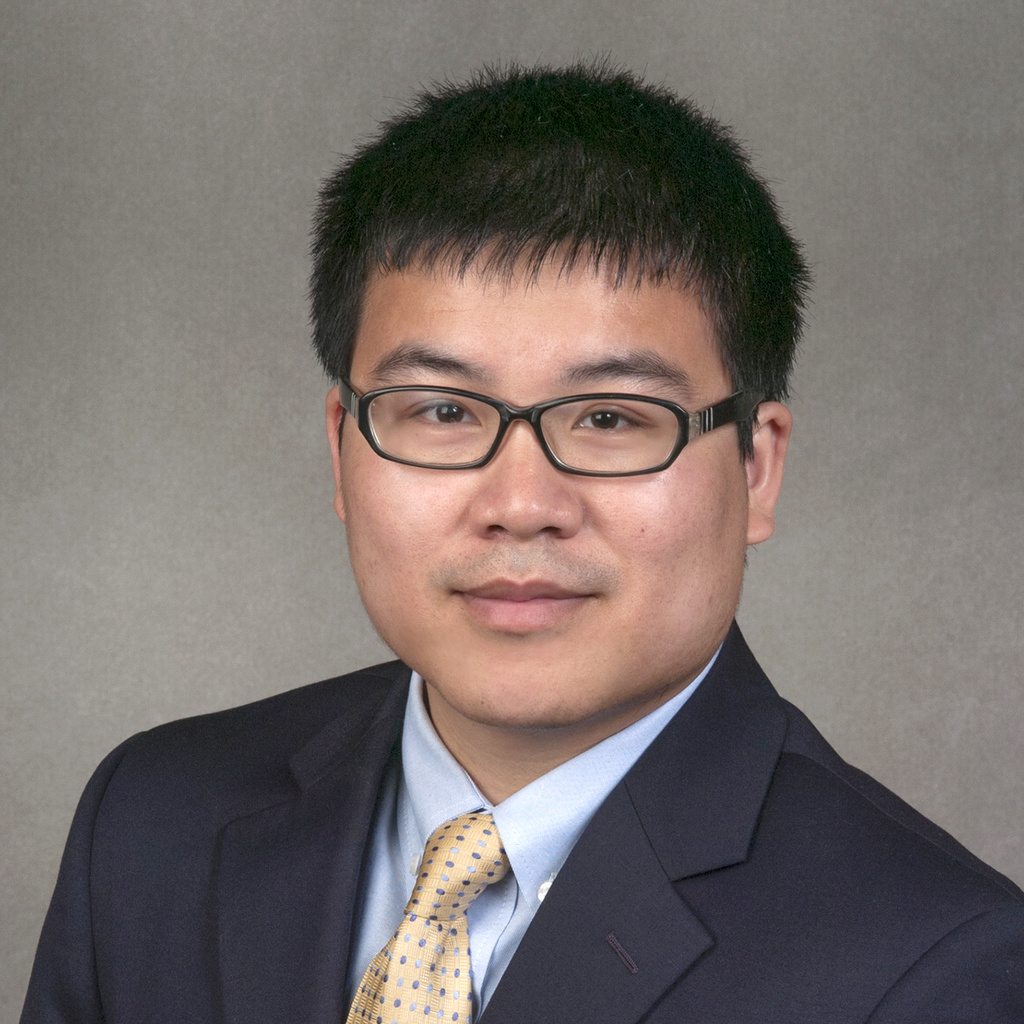
 Qihang Lin
· 1 previous affiliation
- University of IowaSince 2013
- Full Professor · Since 2025
- Associate Professor · Since 2019
- Assistant Professor · 2013–2019
Research Overview
Qihang Lin focuses on stochastic optimization, non-smooth and non-convex problem formulations, and algorithmic fairness. His research trajectory spans the development of optimal primal-dual methods and accelerated subgradient techniques for complex machine learning objectives. Recently, his work emphasizes single-loop algorithms for weakly convex constraints and enforcing distributional fairness across diverse predictive models.
Research Trajectory
Qihang Lin’s early research concentrated on improving the convergence rates and iteration complexity of stochastic optimization algorithms, particularly for non-smooth problems. In 2012, he contributed to the area of Optimal Stochastic Primal-Dual Methods for Structured Optimization by developing Optimal Regularized Dual Averaging Methods for Stochastic Optimization. This work introduced an algorithm based on regularized dual averaging that simultaneously achieved optimal convergence rates for both convex and strongly convex losses. He continued to explore efficient optimization techniques for machine learning, applying accelerated randomized proximal coordinate gradient methods to regularized empirical risk minimization in An Accelerated Randomized Proximal Coordinate Gradient Method and its Application to Regularized Empirical Risk Minimization (2015). The following year, he collaborated on Homotopy Smoothing for Non-Smooth Problems with Lower Complexity than O(1/\epsilon), which proposed the HOPS algorithm to improve iteration complexity for non-smooth optimization problems featuring explicit max-structures.
By 2018, his focus expanded to address the challenges of non-convexity. Advancing the direction of Accelerating Optimization for Non-Smooth and Non-Convex Objectives, he introduced RSG: Beating Subgradient Method without Smoothness and Strong Convexity. This research demonstrated that periodically restarting the standard subgradient method with a geometrically decreasing step size could significantly speed up optimization for problems possessing specific local error bounds. In 2019, he addressed the communication and synchronization bottlenecks inherent in large-scale distributed systems with DSCOVR: Randomized Primal-Dual Block Coordinate Algorithms for Asynchronous Distributed Optimization., utilizing variance reduction to improve computational efficiency.
Moving into the 2020s, Lin tackled increasingly complex constrained optimization and min-max formulations. He developed Quadratically Regularized Subgradient Methods for Weakly Convex Optimization with Weakly Convex Constraints (2020), providing provably efficient algorithms for problems where both the objective and the functional constraints are weakly convex. In 2021, he established a non-asymptotic convergence theory for training models like Generative Adversarial Networks (GANs) in First-order Convergence Theory for Weakly-Convex-Weakly-Concave Min-max Problems, reframing these complex non-convex, non-concave min-max problems as variational inequalities. He also explored heterogeneous federated learning environments, introducing a framework in Federated Learning on Adaptively Weighted Nodes by Bilevel Optimization (2022) that automatically tunes node weights to filter out noisy data from dissimilar peers.
In 2023, Lin’s work yielded several theoretical and practical advances in both optimization and machine learning fairness. He established theoretical lower complexity bounds for first-order methods in First-order Methods for Affinely Constrained Composite Non-convex Non-smooth Problems: Lower Complexity Bound and Near-optimal Methods, introducing an Inexact Proximal Gradient algorithm that nearly reaches this mathematical limit. Concurrently, he contributed to the research direction of Moreau Envelope Smoothing for Non-Smooth Non-Convex Optimization by analyzing a single-loop algorithm in Single-Loop Switching Subgradient Methods for Non-Smooth Weakly Convex Optimization with Non-Smooth Convex Constraints, proving it matches the complexity of more complicated double-loop methods. During this period, he also began significant work in the broader area of Robust Fairness Across All Decision Thresholds. In Stochastic Methods for AUC Optimization subject to AUC-based Fairness Constraints, he reformulated complex pairwise fairness constraints into a min-max optimization problem, achieving linear computational complexity for large-scale datasets.
His most recent work continues to bridge advanced optimization theory with practical algorithmic fairness. In 2025, he participated in the development of a hinge-based penalty approach in Single-loop Algorithms for Stochastic Non-Convex Optimization with Weakly-Convex Constraints. He also introduced the iMELa method in Inexact Moreau Envelope Lagrangian Method for Non-Convex Constrained Optimization under Local Error Bound Conditions on Constraint Functions, achieving near-optimal gradient complexity under weaker constraint qualifications. Expanding his fairness research, he developed a novel post-processing method in Multi-Output Distributional Fairness via Post-Processing (2025), leveraging Optimal Transport to align joint distributions across demographic groups for multi-task classifiers and image encoders. In 2026, his research group introduced Enforcing Fair Predicted Scores on Intervals of Percentiles by Difference-of-Convex Constraints, proposing a "partial fairness" framework that enforces fairness only within specific percentile intervals of predicted scores to better balance predictive accuracy in contested decision regions.
Current Directions
The most recent papers in the evidence indicate a dual focus on advanced non-convex constrained optimization and the scalable enforcement of algorithmic fairness. In optimization, recent work investigates single-loop algorithms and inexact Moreau envelope Lagrangian methods to efficiently solve non-convex problems with convex or weakly convex constraints, particularly under relaxed local error bound conditions. In the domain of machine learning fairness, current research addresses the challenge of enforcing distributional fairness in complex, multi-output models using Optimal Transport. Additionally, recent efforts explore "partial fairness" frameworks that utilize difference-of-convex optimization to enforce fairness constraints exclusively within specific percentile intervals, aiming to preserve overall predictive performance while ensuring equity in critical decision boundaries.
Profile updated
Loading new papers…
Other researchers whose papers cluster into the same research directions — a proxy for overlapping technical interests and shared intellectual neighborhoods.
See something wrong? Report a mistake