

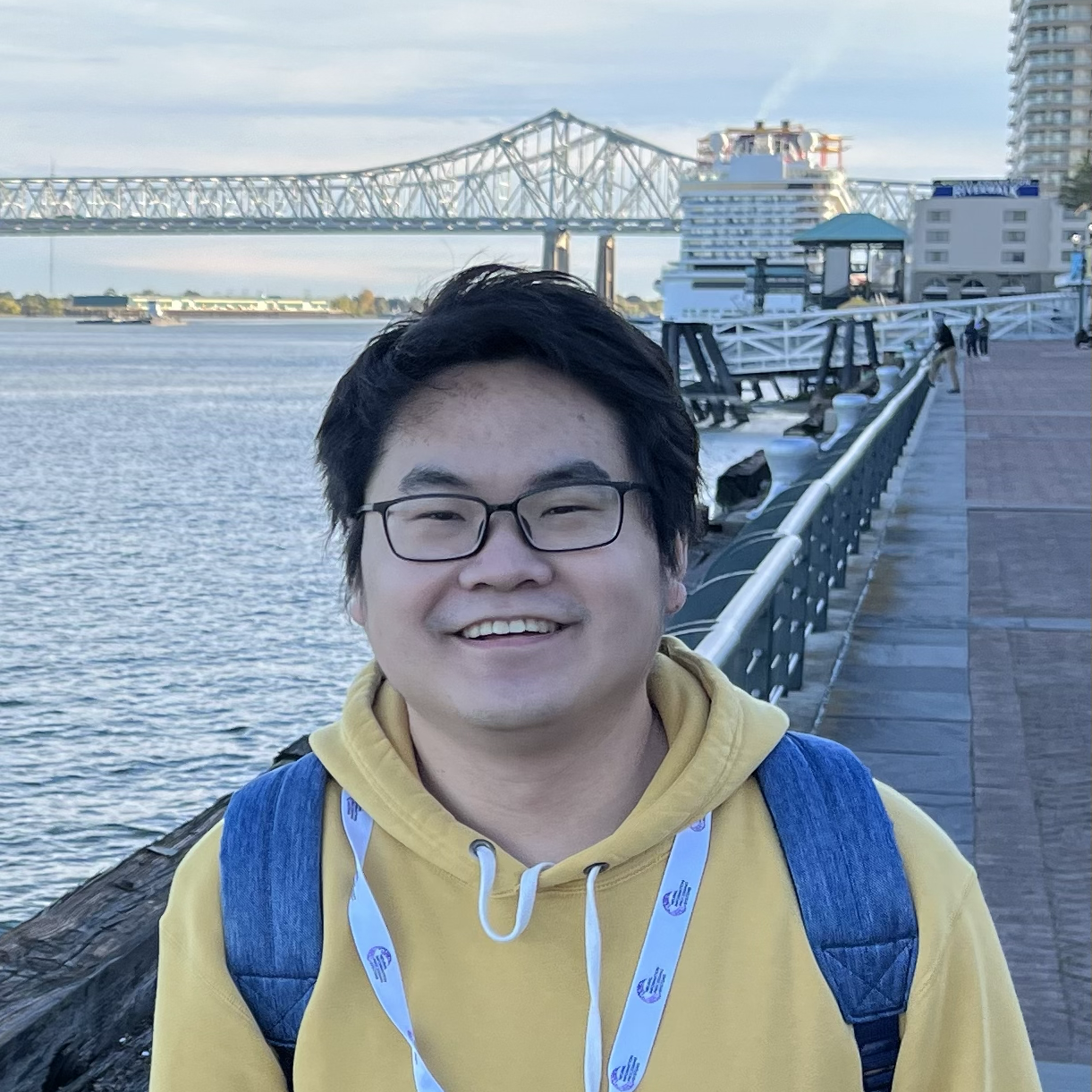
 Pengchong Hu
· 4 previous affiliations
- Wayne State UniversitySince 2022
- PhD student · Since 2022
- Intern · 2026
- Tongji University2019–2022
- MS student · 2019–2022
- Sichuan University2014–2018
- Undergrad student · 2014–2018
Research Overview
Pengchong Hu focuses on 3D scene reconstruction, neural rendering, and simultaneous localization and mapping (SLAM) for large-scale environments. His trajectory spans from integrating depth sensor priors into neural implicit representations to developing scalable, high-fidelity mapping systems. His most recent work addresses memory bottlenecks and global consistency in long-term odometry using 3D Gaussian splatting techniques.
Research Trajectory
Hu's early work addresses the challenges of accurately modeling complex environments by bridging neural network architectures with raw sensor data. In 2023, he introduced Learning Neural Implicit through Volume Rendering with Attentive Depth Fusion Priors. This research improves 3D scene reconstruction by fusing the learned priors of neural implicit models with direct evidence from depth sensors. By doing so, the work contributes to several broader research areas, including the direction of Preserving High Frequency Details in Neural 3D Reconstruction and the area of Neural Depth Completion for Incomplete Sensor Data. The methodology also touches upon the challenges inherent in the research direction of Moving Beyond the Static Scene Assumption and the broader field of Scaling 3D Representations Beyond the Memory Wall.
Building on these foundational reconstruction techniques, Hu's subsequent research shifted toward real-time, large-scale spatial tracking and rendering. In 2025, he developed VTGaussian-SLAM: RGBD SLAM for Large Scale Scenes with Splatting View-Tied 3D Gaussians. This system utilizes "view-tied" 3D Gaussians—simplified spherical primitives that are directly anchored to depth pixels—to facilitate high-fidelity SLAM. To overcome the memory bottlenecks traditionally associated with Gaussian splatting, the system manages the environment in discrete sections and optimizes only local Gaussians. This approach significantly advances the research direction of Scalable Global Consistency for Large Scale Robotic Mapping and contributes to the area of Loop Closure Deficiency in Local Odometry and Mapping by maintaining tracking and rendering accuracy over extended trajectories.
Current Directions
The most recent papers in the evidence indicate a strong focus on real-time, large-scale robotic mapping and spatial representation. Hu's current work investigates methods to optimize 3D Gaussian splatting for SLAM applications, specifically addressing the memory overhead and computational costs that limit the scalability of high-fidelity rendering. By tying geometric primitives directly to sensor observations and partitioning scenes into manageable local sections, his ongoing research seeks to balance rendering accuracy with the strict performance requirements of long-term odometry and global consistency in expansive environments.
Profile updated
Loading new papers…
Other researchers whose papers cluster into the same research directions — a proxy for overlapping technical interests and shared intellectual neighborhoods.
See something wrong? Report a mistake