

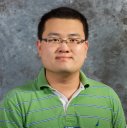
 Chen Gao
· 5 previous affiliations
- Meta (United States)Since 2022
- Research Scientist · Since 2022
- waymoCurrent
- Current
- Virginia Tech2018–2022
- PhD student · 2018–2022
- University of Michigan2015–2017
- MS student · 2015–2017
- Oregon State University2013–2015
- Undergrad student · 2013–2015
5 other authors named Chen Gao: Chen Gao (Tsinghua University · 179 papers), Chen Gao (National University of Singapore · 40 papers), Chen Gao (Tsinghua University · 1 paper), Chen Gao (1 paper), Chen Gao (0 papers)
Research Overview
Chen Gao focuses on the intersection of computer vision, neural rendering, and robust scene reconstruction. His work primarily addresses the challenges of modeling dynamic environments from limited or imperfect visual data, with a specific emphasis on 4D Reconstruction from Monocular Video. By developing methods that jointly optimize for camera motion and scene geometry, Gao’s research seeks to move neural radiance fields (NeRF) beyond controlled laboratory settings into "in-the-wild" scenarios characterized by complex motion, poor texture, and unknown camera parameters.
Research Trajectory
Gao’s early research interests, as indicated by thematic trends in the field, involved foundational problems in Density Regularization for Clean Neural Scene Reconstruction. This work targeted the elimination of "floaters"—semi-transparent artifacts that often plague neural reconstructions due to under-constrained optimization. This focus on the mathematical stability of volumetric representations provided a basis for his subsequent work on more complex, time-varying scenes.
By 2021, his focus shifted toward the temporal dimension, exploring 4D View Synthesis via 3D Scene Flow Aggregation. Reconstructing a dynamic 3D world from a single moving camera is fundamentally under-constrained, as a monocular video only captures a 2D slice of the 4D (space-time) continuum at any given moment. Gao’s work in this area addressed the ambiguities of depth in moving objects and the difficulties posed by occlusions in dynamic sequences.
Parallel to these developments in computer vision, Gao has maintained an interest in the broader methodological problems of machine learning, specifically regarding how models generalize and handle bias. This is reflected in his engagement with Counterfactual Debiasing for Recommendation and Ranking Systems and Causal Representation Learning for Out-of-Distribution Generalization. These themes suggest a research philosophy that prioritizes the identification of underlying causal structures over the exploitation of spurious statistical correlations—a perspective that is particularly relevant when disentangling static backgrounds from dynamic foregrounds in complex video sequences.
In 2023 and 2024, Gao’s work became increasingly focused on the robustness of radiance fields. A significant bottleneck in 3D reconstruction is the reliance on Structure from Motion (SfM) algorithms to provide accurate camera poses. In real-world videos involving rotating cameras or highly dynamic subjects, SfM often fails. Gao’s recent contributions involve the development of "SfM-free" or "joint-optimization" frameworks that estimate camera parameters and scene geometry simultaneously, thereby extending the utility of neural rendering to casually captured smartphone videos.
Representative Work
Gao has contributed to several key advancements in robust neural rendering and video matting, particularly focusing on the integration of 2D and 3D representations to handle complex scene dynamics.
In Robust Dynamic Radiance Fields, Gao served as a primary contributor to a framework designed to overcome the limitations of traditional SfM in dynamic contexts. The research addresses the instability of radiance field reconstruction when camera poses are unknown or erroneously estimated. By jointly estimating static and dynamic radiance fields alongside camera focal lengths and poses, the method achieves stable reconstructions on challenging videos where prior methods typically fail. This work is significant for its move toward fully automated, end-to-end 4D reconstruction from uncalibrated video sources.
Gao’s work on OmnimatteRF: Robust Omnimatte with 3D Background Modeling further explores the decomposition of video into constituent layers. While previous video matting techniques often relied on 2D image layers to represent backgrounds, this research introduces a 3D background model. This hybrid approach allows for a more accurate separation of dynamic foreground objects and their associated effects—such as shadows and reflections—from the static environment. By leveraging a 3D representation for the background, the method can better account for parallax and complex camera trajectories that 2D layers cannot adequately express.
In the domain of large-scale scene modeling, Gao participated in the development of Progressively Optimized Local Radiance Fields for Robust View Synthesis. This research tackles the dual challenges of unknown camera poses and the limited representational capacity of global radiance fields when applied to long trajectories in unbounded scenes. The proposed algorithm uses a progressive optimization strategy to refine camera poses and scene geometry locally, which improves the robustness of the reconstruction process for "in-the-wild" videos. This work highlights Gao’s involvement in scaling neural rendering techniques to more expansive and less controlled environments.
More recently, Gao contributed to SpecNeRF: Gaussian Directional Encoding for Specular Reflections, which addresses the difficulty NeRF models face when rendering glossy surfaces under near-field lighting. Traditional methods often assume distant lighting, which fails to capture the spatially-varying nature of reflections in indoor settings. This work introduces a learnable Gaussian directional encoding that emulates prefiltered environment maps, allowing for more efficient and accurate evaluation of view-dependent effects. While Gao was a middle author on this paper, the work aligns with his broader trajectory of enhancing the physical accuracy and visual fidelity of neural scene representations.
Current Directions
Gao’s current research appears to be expanding into the evaluation and reasoning capabilities of large-scale models. This is evidenced by his recent focus on the Shifting from Static Benchmarks to Dynamic Evaluation. As Large Language Models (LLMs) increasingly face issues with data contamination—where test benchmarks are inadvertently included in training sets—Gao is exploring methods for more rigorous, procedural testing that can distinguish between genuine reasoning and simple pattern memorization.
This shift suggests an interest in the intersection of generative modeling and evaluative frameworks, applying the same rigor found in his 3D reconstruction work to the burgeoning field of foundation models. By moving toward dynamic benchmarks, this research aims to provide a more accurate assessment of how models generalize to novel logic problems and procedural tasks.
Profile updated
Loading new papers…
Other researchers whose papers cluster into the same research directions — a proxy for overlapping technical interests and shared intellectual neighborhoods.
See something wrong? Report a mistake