

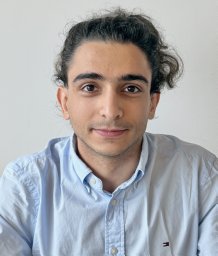
 Parsa Hosseini
· 4 previous affiliations
- Capital One (United States)Since 2026
- Research Intern · Since 2026
- University of Maryland, College ParkSince 2024
- PhD student · 2024–2029
- Research Assistant · 2024
- Sharif University of Technology2019–2024
- Undergrad student · 2019–2024
- Teacher Assistant · 2021–2023
- Research Assistant Intern · 2023
Research Overview
Parsa Hosseini focuses on the robustness of machine learning systems, specifically addressing spurious correlations in computer vision and vulnerabilities in multimodal large language models. His work explores how models rely on superficial cues and develops methods to mitigate these biases. Recently, his research investigates adversarial red-teaming and the reliability of agentic systems in dynamic environments.
Research Trajectory
Hosseini's early work addresses the failure of standard empirical risk minimization on out-of-distribution data, particularly in computer vision. In 2024, he collaborated on Decompose-and-Compose: A Compositional Approach to Mitigating Spurious Correlation, which tackles distribution shifts arising from the compositional nature of images. By addressing how background components create misleading signals, this work contributes to the broader area of Mitigating Spurious Correlations Without Manual Labels. It also advances techniques in the direction of Causal Invariance for Robust Out of Distribution Generalization, alongside work in the area of Counterfactual Data Augmentation for Robust Generalization.
Extending this focus on model reliability to multimodal architectures, Hosseini led investigations into whether Multimodal Large Language Models (MLLMs) inherit similar visual biases despite language supervision. He introduced SpurLens, an automated pipeline utilizing object detectors and language models to identify and quantify spurious visual cues without human supervision. Detailed in Seeing What's Not There: Spurious Correlation in Multimodal LLMs and its subsequent presentation SpurLens: Finding Spurious Correlations in Multimodal LLMs, this research demonstrated that spurious correlations cause MLLMs to over-rely on contextual cues for recognition and significantly amplify object hallucination. This pipeline represents a key contribution to the research direction of Overcoming Spurious Contextual Correlations in Visual Models.
Parallel to his work on vision-language models, Hosseini has explored the security and reasoning capabilities of text-based LLMs. He helped develop a training-free prompting strategy in Chain-of-Defensive-Thought: Structured Reasoning Elicits Robustness in Large Language Models against Reference Corruption, which forces models to cross-check and verify external references before generating answers. This method protects retrieval-augmented generation systems from prompt injection and reference corruption, aligning with the broader research area of Knowledge Poisoning in Retrieval Augmented Generation and intersecting with challenges in the direction of Securing Decentralized Learning Against Colluding Malicious Majorities.
His research also extends to the vulnerabilities of agentic LLMs operating in dynamic environments. He participated in studies evaluating how agents select and utilize tools, including Gaming Tool Preferences in Agentic LLMs, which revealed how description engineering—such as adding assertive marketing language—can drastically manipulate an agent's tool selection rate. Additionally, he collaborated on Temporal Blindness in Multi-Turn LLM Agents: Misaligned Tool Use vs. Human Time Perception, investigating how agents fail to account for real-world time elapsed between messages and introducing the TicToc-v1 benchmark to evaluate this temporal awareness.
Most recently, Hosseini has focused on proactive red-teaming for multimodal systems. In 2026, he co-developed GHOST: Hallucination-Inducing Image Generation for Multimodal LLMs, an automated pipeline that synthesizes natural-looking images specifically optimized in the CLIP embedding space to induce hallucinations in MLLMs. This work highlights systemic and transferable vulnerabilities across different vision-language architectures, demonstrating how easily these models can be tricked into perceiving non-existent objects.
Current Directions
The most recent papers in the evidence indicate a strong focus on adversarial red-teaming and the operational reliability of autonomous agents. Current work investigates the systemic vulnerabilities of Multimodal Large Language Models, particularly how targeted image generation can reliably induce hallucinations and expose architectural weaknesses in vision-language integration. Concurrently, Hosseini is exploring the limitations of agentic LLMs in dynamic, multi-turn environments. This includes addressing "temporal blindness"—the inability of agents to perceive elapsed time—and mitigating their susceptibility to manipulated tool descriptions, aiming to build more robust, secure, and context-aware autonomous systems.
Profile updated
Loading new papers…
Other researchers whose papers cluster into the same research directions — a proxy for overlapping technical interests and shared intellectual neighborhoods.
See something wrong? Report a mistake