

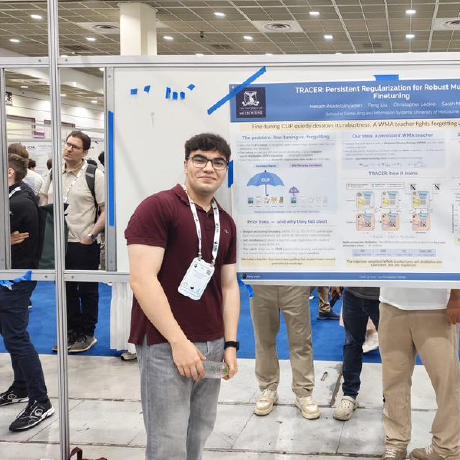
 Hesam Asadollahzadeh
· 4 previous affiliations
- The University of MelbourneSince 2025
- PhD student · Since 2025
- Current
- Wellcome Sanger Institute2023–2025
- Researcher · 2023–2025
- Sharif University of Technology2023–2025
- Researcher · 2023–2025
- University of Tehran2019–2024
- Undergrad student · 2019–2024
Research Overview
Hesam Asadollahzadeh focuses on trustworthy machine learning, specifically addressing distributional robustness and out-of-distribution generalization in deep neural networks. His early work explores methods to mitigate spurious correlations and shortcut learning without relying on explicit group annotations. Currently, his research emphasizes the robustness of foundation vision-language models, investigating scalable techniques to prevent catastrophic forgetting and adversarial vulnerabilities during multimodal finetuning.
Research Trajectory
Hesam Asadollahzadeh’s research trajectory began with a focus on mitigating spurious correlations in deep learning models, particularly in scenarios where explicit metadata about demographic or subpopulation groups is unavailable. In 2023, he and his collaborators introduced Annotation-Free Group Robustness via Loss-Based Resampling. This work proposed Loss-Based Feature Reweighting (LFR), a method that intelligently selects training samples based on their loss values from an empirical risk minimization (ERM) model. By retraining the final layer using these selected samples, the approach effectively reduced the model's reliance on non-causal, spurious features.
Building on this foundation in 2025, he helped develop EVaLS in Exploiting What Trained Models Learn for Making Them Robust to Spurious Correlations without Group Annotations. This post-hoc method leverages the information acquired during standard training to protect underrepresented groups from performance drops, even when the specific spurious correlations are unknown. This contribution advanced the broader research area of Unsupervised Subpopulation Identification via Training Loss and provided new techniques for Breaking Shortcut Learning in Deep Neural Networks. Alongside these empirical methods, he explored the theoretical underpinnings of optimization in On the Potential of the Four-Point Model for Studying the Role of Optimization in Robustness to Spurious Correlations. Using a simplified theoretical model, this work demonstrated how smaller batch sizes can accelerate the learning of core, generalizable features, helping models avoid misleading correlations present in the training data.
By 2026, his focus expanded to the robustness and reliability of massive foundation models and vision-language architectures. He introduced TRACER in TRACER: Persistent Regularization for Robust Multimodal Finetuning, addressing the challenge of catastrophic forgetting. The work highlighted how adapting large pretrained models like CLIP to specialized tasks often degrades their broad, general-purpose knowledge and out-of-distribution robustness, proposing persistent regularization to stabilize the finetuning process.
In collaborative work on multimodal vulnerabilities, he participated in developing an automated red-teaming pipeline in GHOST: Hallucination-Inducing Image Generation for Multimodal LLMs. By optimizing stealth tokens in the CLIP embedding space and utilizing guided diffusion, the GHOST pipeline synthesizes natural-looking adversarial images designed to trick multimodal systems into hallucinating objects. This research contributed to the broader directions of Adversarial Optimization on the Latent Image Manifold and Aligning Visual Features with Language Model Embeddings, revealing systemic and transferable vulnerabilities across different models.
His recent work also addresses uncertainty quantification and scalable architectural design. In Softmax is not Enough (for Adaptive Conformal Classification), he co-developed an energy-based reweighting scheme using Helmholtz Free Energy. This approach overcomes the overconfidence and saturation issues of standard softmax outputs, creating conformal prediction sets that are more efficient for easy samples and more honest for hard or out-of-distribution data, advancing the area of Geometric Distance as a Proxy for Model Uncertainty. Finally, he contributed to DirMoE: Dirichlet-Routed Mixture of Experts, which framed routing as a variational inference problem. By disentangling expert selection from expert contribution using a Dirichlet-based framework, DirMoE achieved superior expert specialization without the optimization difficulties of traditional non-differentiable routers, intersecting with work in the area of Learning Discrete Decisions with Differentiable Binary Gates.
Current Directions
The most recent papers in the evidence indicate a strong focus on the robustness, safety, and scalable architecture of foundation vision-language models. Recent work investigates techniques to prevent representation degradation during multimodal finetuning, ensuring that massive pretrained models retain their general-purpose out-of-distribution capabilities when adapted to specific tasks. Additionally, ongoing research addresses adversarial vulnerabilities in multimodal systems, exploring how latent image manifolds can be optimized to systematically induce or defend against hallucinations. Beyond vision-language alignment, recent contributions also explore scalable architectural improvements, including fully differentiable routing mechanisms for Mixture-of-Experts models and energy-based conformal prediction methods for more rigorous and adaptive uncertainty quantification.
Profile updated
Loading new papers…
Other researchers whose papers cluster into the same research directions — a proxy for overlapping technical interests and shared intellectual neighborhoods.
See something wrong? Report a mistake