

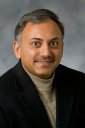
 Pankaj K Agarwal
· 1 previous affiliation
- Duke UniversitySince 1989
- Professor · Since 1989
1 other author named Pankaj K Agarwal: Pankaj K. Agarwal (2 papers)
Research Overview
Pankaj K. Agarwal focuses on computational and discrete geometry, developing approximation algorithms and data structures for complex spatial problems. His trajectory spans foundational work in metric embeddings and geometric optimization to recent advancements in scalable algorithms for optimal transport. Currently, he investigates robust, high-precision methods for continuous and discrete optimal transport problems.
Research Trajectory
Agarwal’s research addresses fundamental computational bottlenecks in geometric optimization, shape analysis, and spatial data processing. Early in the observed period, his work advanced the research direction of Hierarchical Tree Embeddings for Metric Space Approximation. In 2018, he and his collaborators investigated the computational complexity of comparing metric spaces, presenting Computing the Gromov-Hausdorff Distance for Metric Trees. This work proved the NP-hardness of approximating the Gromov-Hausdorff distance even for simple tree structures, while simultaneously providing a polynomial-time algorithm with guaranteed approximation ratios. This contributed to the broader area of Tightening Approximation Guarantees for Combinatorial Optimization. Building on hierarchical tree structures, he later developed An Improved ε-Approximation Algorithm for Geometric Bipartite Matching (2022), which utilized compressed graph representations to achieve significantly faster runtimes in higher dimensions.
In 2023, Agarwal applied his algorithmic techniques to multi-agent systems in Multi-robot motion planning for unit discs with revolving areas. This research introduced a novel approach for planning collision-free paths in shared environments, guaranteeing that the total travel distance remains within a constant factor of the optimal, even in online settings where robot tasks arrive sequentially. Concurrently, Agarwal began a sustained focus on optimal transport (OT), a mathematically rich area historically limited by steep computational costs. He co-authored Fast and Accurate Cost-Scaling Algorithm for the Semi-Discrete Optimal Transport, presenting an algorithm to efficiently compute minimum-cost transport plans between continuous and discrete distributions, with a runtime dependent on the dimension and the diameter of the distributions' supports.
Throughout 2024, Agarwal maintained a dual focus on database query optimization and geometric algorithms. In the realm of data management and temporal analysis, he contributed to Computing A Well-Representative Summary of Conjunctive Query Results and explored temporal data structures in On Reporting Durable Patterns in Temporal Proximity Graphs. His work in classical computational geometry also continued with Fast Approximation Algorithms for Piercing Boxes by Points.
Simultaneously, his optimal transport research accelerated. He introduced a framework that avoids the smoothness requirements of previous numerical methods in A Combinatorial Algorithm for the Semi-Discrete Optimal Transport Problem. This combinatorial approach achieved polynomial runtimes in low dimensions and enabled sub-linear time data structures for querying discrete OT against massive datasets. This theoretical expansion was complemented by further methodological refinements in Fast and Accurate Approximations of the Optimal Transport in Semi-Discrete and Discrete Settings.
Moving into 2025 and 2026, Agarwal’s research expanded deeply into the area of Stochastic Optimization for Continuous Optimal Transport. Recognizing that standard OT is highly sensitive to outliers—often forcing algorithms to expend massive computational effort moving noisy data—he developed geometric characterizations for robust variants in Efficient Algorithms for Robust and Partial Semi-Discrete Optimal Transport. By introducing $\alpha$-partial and $\lambda$-robust formulations, this work allowed models to gracefully ignore outliers while maintaining high precision and near-linear approximation speeds. He also tackled complex metric spaces in Efficient Approximation Algorithm for Computing Wasserstein Barycenter under Euclidean Metric.
Most recently, Agarwal published A Scalable Constant-Factor Approximation Algorithm for $W_p$ Optimal Transport (2026). This work represents a significant breakthrough in the computational geometry of optimal transport, introducing the first truly scalable approximation algorithm for the $W_p$ distance that remains efficient even as the parameter $p$ approaches infinity.
Current Directions
The most recent papers in the evidence indicate a strong, ongoing focus on the computational geometry of optimal transport. Agarwal is currently investigating scalable, high-precision approximation algorithms for complex OT problems, including the computation of Wasserstein barycenters and the $W_p$ distance. A major theme in this recent work is robustness; he is developing partial and robust semi-discrete OT algorithms that can efficiently handle outliers and noisy data without sacrificing near-linear approximation speeds. This direction bridges theoretical computer science and machine learning, providing mathematically guaranteed, scalable solutions for distribution alignment and metric optimization in high-dimensional spaces.
Profile updated
Loading new papers…
Other researchers whose papers cluster into the same research directions — a proxy for overlapping technical interests and shared intellectual neighborhoods.
See something wrong? Report a mistake