

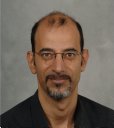
 Panagiotis Tsiotras
· 5 previous affiliations
- Georgia Institute of TechnologySince 1998
- David and Andrew Lewis Chair · Since 2019
- Full Professor · Since 1998
- Associate Director for Research at Institute for Robotics and Intelligent Machines · 2016–2024
- Dean's Professor · 2012–2018
- University of Virginia1994–1998
- Assistant Professor · 1994–1998
- Purdue University West Lafayette1989–1993
- Graduate Research Assistant · 1989–1993
- Master of Science (MS), Applied Mathematics · 1992
- Virginia Tech1986–1987
- Graduate Research Assistant · 1986–1987
- Undergrad student · 1981–1986
Research Overview
Panagiotis Tsiotras focuses on the theoretical and experimental investigation of highly complex, uncertain aerospace and mechanical systems, with specific emphasis on stochastic control, multi-agent reinforcement learning, and optimal transport. His trajectory spans from learning Nash equilibria in zero-sum games to optimal covariance steering for continuous and discrete-time linear systems. His most recent work investigates scalable probabilistic verification and efficient distribution steering for large agent populations.
Research Trajectory
The early portion of the documented trajectory establishes a strong foundation in multi-agent environments and autonomous systems. In 2020, he addressed the computational bottlenecks of finding Nash equilibria in zero-sum stochastic games. By moving away from intractable linear program updates, he developed entropy-regularized policy approximations in Learning Nash Equilibria in Zero-Sum Stochastic Games via Entropy-Regularized Policy Approximation. This work directly advanced the research direction of Annealed Entropy Regularization for Game Equilibria and contributed to the broader area of learning in non-stationary multi-agent environments.
Expanding into the physical domain of autonomous navigation, he collaborated on Simultaneous Control and Trajectory Estimation for Collision Avoidance of Autonomous Robotic Spacecraft Systems in 2022. The following year, he formalized a novel approach to adversarial movement costs in On the Adversarial Convex Body Chasing Problem. This research proposed a discretization-based algorithm to find near-optimal strategies against an opponent selecting convex bodies, contributing to the area of quantization for continuous state and action Markov Decision Processes.
In 2024, his focus on stochastic systems deepened, particularly regarding optimal covariance steering. He investigated continuous-time formulations in Optimal Covariance Steering for Continuous-Time Linear Stochastic Systems With Martingale Additive Noise. Applying these theoretical control frameworks to physical platforms, he co-authored Stochastic Control of UAVs: An Optimal Tradeoff between Performance, Flight Smoothness and Control Effort. By combining a hybrid machine-learning aerodynamic estimator with optimal covariance steering, this framework achieved precise quadrotor trajectory tracking in windy conditions without aggressive, battery-draining jitter. This application advanced several research areas, notably the direction of Mitigating Actuator Chattering in Robust Control Systems, as well as active uncertainty management via covariance steering and robust navigation in stochastic environmental flows.
The year 2025 marked a significant expansion of his research across multi-agent coordination, neural network verification, and optimal transport. In the domain of multi-robot missions, he addressed bandwidth-aware information sharing in Communication-Aware Iterative Map Compression for Online Path-Planning. This framework enabled sensor robots to intelligently compress local map information, drastically reducing transmitted data while maintaining path-planning performance. He further optimized multi-agent systems in Distributed Event-Triggered Distance-Based Formation Control for Multi-Agent Systems, introducing a decentralized strategy that relies solely on inter-agent distances rather than global positioning. By triggering updates only when measurement errors exceed a threshold, the system significantly reduced actuator and communication overhead, contributing to the area of event-triggered communication for networked control systems.
Continuing his work in competitive dynamics, he explored information asymmetry in Strategic Concealment of Environment Representations in Competitive Games. To scale multi-agent reinforcement learning to massive populations where traditional algorithms fail, he utilized mean-field theory in Learning Large-Scale Competitive Team Behaviors with Mean-Field Interactions. This research extended proximal policy optimization to the mean-field domain, allowing for the tractable modeling of macroscopic agent behavior in zero-sum competitive environments.
Alongside multi-agent systems, he made critical contributions to the safety and efficiency of machine learning models. He co-developed a framework for the area of probabilistic verification for scalable safety guarantees in BaB-prob: Branch and Bound with Preactivation Splitting for Probabilistic Verification of Neural Networks. By splitting internal neuron preactivations, this method achieved sound and complete verification for high-dimensional problems. In the realm of distribution steering, he introduced a training-free approach to Schrödinger Bridge problems in Go With the Flow: Fast Diffusion for Gaussian Mixture Models. By modeling distributions as Gaussian Mixture Models, the method achieved massive computational speedups, directly advancing the research direction of Efficient Multi-marginal Optimal Transport. He applied similar Gaussian Mixture Model approximations to the physical control of large swarms in Steering Large Agent Populations Using Mean-Field Schrödinger Bridges With Gaussian Mixture Models, contributing to the area of robust adaptive control for uncertain linear systems. Finally, he continued his foundational control research with Optimal Covariance Steering for Discrete-Time Linear Stochastic Systems.
Current Directions
The most recent papers in the evidence indicate a strong ongoing focus on scaling control and learning algorithms for massive, complex systems. A primary current direction involves leveraging mean-field theory and Schrödinger Bridges to manage large agent populations and competitive teams, moving beyond the limitations of traditional multi-agent reinforcement learning. Additionally, recent work addresses the critical need for formal safety guarantees in AI, developing scalable probabilistic verification methods for deep neural networks. Finally, the ongoing refinement of optimal covariance steering—spanning both continuous and discrete-time stochastic systems—remains a central pillar of his efforts to achieve robust, efficient control in uncertain environments.
Profile updated
| Paper | Venue | Year |
|---|---|---|
| Go With the Flow: Fast Diffusion for Gaussian Mixture ModelsGitHubgeorgeRapa/ | NeurIPS | 2025 |
Loading new papers…
Other researchers whose papers cluster into the same research directions — a proxy for overlapping technical interests and shared intellectual neighborhoods.
See something wrong? Report a mistake