

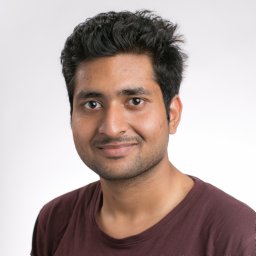
 Manish Prajapat
· 5 previous affiliations
- Amazon (United States)Since 2024
- Researcher · Since 2025
- Applied Scientist · 2024
- ETH AI CenterSince 2021
- Doctoral Fellow · Since 2021
- ETH Zurich2017–2024
- Doctor of Philosophy - PhD, Reinforcement learning and Controls · 2021–2024
- Teaching Assistant, Embedded Control Systems · 2019
- Teaching Assistant, Autonomous Mobility on Demand · 2018–2019
- Masters Student · 2017–2019
- Fixposition AG2020–2021
- Robotics Research Engineer · 2020–2021
- California Institute of Technology2019–2020
- Visiting Researcher · 2019–2020
Research Overview
Manish Prajapat focuses on safe exploration in reinforcement learning, constrained Markov decision processes, and probabilistic dynamics modeling for autonomous systems. His trajectory spans from early work on perception and state estimation to the development of theoretically grounded algorithms for safe, non-episodic learning. Currently, he investigates optimal control and online dynamics learning to guarantee safety and stability in complex physical environments.
Research Trajectory
Early work involved participation in applied autonomous systems, specifically contributing to redundant perception and state estimation pipelines in Redundant Perception and State Estimation for Reliable Autonomous Racing. Building on this foundation in complex environments, he shifted toward foundational reinforcement learning, particularly in competitive Markov decision processes. He introduced Competitive policy optimization, addressing the challenge of designing efficient optimization methods with desirable convergence and stability properties. This work contributed to the broader research direction of Trust Region and Divergence Regularization for Stable Policy Optimization.
The focus subsequently expanded to multi-agent coordination and complex reward structures under safety constraints. He developed MacOpt, an algorithm detailed in Near-Optimal Multi-Agent Learning for Safe Coverage Control, which efficiently learns unknown density functions to approximately solve NP-hard coverage problems while strictly preserving agent safety. Addressing environments with diminishing returns rather than simple additive rewards, he introduced SUBPO in Submodular Reinforcement Learning. This policy gradient algorithm successfully optimizes complex, history-dependent rewards by greedily maximizing marginal gains, advancing the area of Joint Learning of Transition Dynamics and Reward Functions. Concurrently, he formalized safety guarantees for continuous control, proposing a novel optimal control framework in Safe Guaranteed Exploration for Non-linear Systems. This approach achieves guaranteed exploration for non-linear systems with finite-time sample complexity bounds while maintaining provable safety.
In 2025, his research heavily emphasized Model Predictive Control (MPC) and online dynamics learning. He developed COAT-MPC, presented in Performance-Driven Constrained Optimal Auto-Tuner for MPC, a framework that automatically tunes control parameters using safe Bayesian Optimization. By combining goal-directed exploration with robust theoretical convergence guarantees, the system ensures performance never drops below a critical threshold during tuning. This work is central to his contributions in the area of Safe Reinforcement Learning via Constrained Markov Decision Processes. To address the challenge of deploying agents without episodic resets, he introduced SageDynX in Safe and Near-Optimal Control with Online Dynamics Learning. This framework allows agents to safely learn unknown system dynamics on the fly while mathematically guaranteeing near-optimal performance, intersecting with the research directions of Safe Exploration through Guaranteed Return Paths and Gaussian Process Dynamics for Safe and Data Efficient Control.
Furthering the use of probabilistic models, he formulated a sampling-based framework in Finite-Sample-Based Reachability for Safe Control with Gaussian Process Dynamics. By drawing a finite number of functions from a Gaussian Process posterior, this method constructs reachable sets that provide formal safety and stability guarantees without the extreme conservatism typically found in robust control. He also proposed a pessimistically safe framework in Safe Guaranteed Dynamics Exploration with Probabilistic Models that ensures continuous online learning of dynamics by optimistically exploring informative states within a safe policy space, even when model uncertainty prevents reaching those states directly.
Most recently, his collaborative work has applied these theoretical safety guarantees to practical and high-stakes domains. He participated in the development of SOOPER, detailed in Safe Exploration via Policy Priors, a model-based reinforcement learning algorithm that leverages suboptimal but safe policy priors—such as a basic controller or simulator-trained policy—to explore optimistically while pessimistically falling back to the prior under high uncertainty. Additionally, he contributed to Robust-Sub-Gaussian Model Predictive Control for Safe Ultrasound-Image-Guided Robotic Spinal Surgery, which introduces an MPC framework that characterizes complex estimation errors from ultrasound data as sub-Gaussian noise with a bounded mean. By developing new uncertainty propagation techniques, this work enables robust, closed-loop safety guarantees for critical surgical tasks.
Current Directions
The most recent papers in the evidence address the deployment of autonomous agents in safety-critical, real-world environments where episodic resets are impossible. Recent work investigates online dynamics learning, utilizing probabilistic models such as Gaussian Processes to construct reachable sets that provide formal stability and safety guarantees. A major ongoing theme is the refinement of Model Predictive Control (MPC) frameworks, including automated parameter tuning and the handling of complex, non-standard estimation errors (such as sub-Gaussian noise in medical imaging). This research aims to bridge the gap between theoretical safety bounds and practical deployment in high-stakes physical systems, ensuring that agents can continuously learn and explore without risking catastrophic failure.
Profile updated
Loading new papers…
Other researchers whose papers cluster into the same research directions — a proxy for overlapping technical interests and shared intellectual neighborhoods.
See something wrong? Report a mistake